Cost for a Heat Pump: 2026 Pricing Guide for Homes
Understand upfront costs, incentives, and long-term savings for heat pumps, with a detailed breakdown of air-source and geothermal systems and how to budget for installation, rebates, and maintenance.


The cost for a heat pump typically ranges from a few thousand dollars up to tens of thousands, depending on unit type (air-source vs geothermal), installation complexity, and regional incentives. Heatpump Smart Analysis, 2026 indicates that rebates can cut upfront costs, while energy savings improve long-term ROI. This framing helps homeowners budget accurately and compare bids on a like-for-like basis.
Understanding the price tag: what drives the cost for a heat pump
Pricing a heat pump isn’t just about the sticker price of the equipment. The total cost includes the outdoor condenser, the indoor air handler, refrigerant lines, controls, and any required coil upgrades. But the biggest swings come from installation and site conditions. The choice between an air-source versus a geothermal system, the home’s size and climate, and the existing ductwork (or its absence) drive the final number. According to Heatpump Smart Analysis, 2026, most price variance stems from installation complexity, electrical work, permits, and potential retrofits. A transparent quote that separates equipment from labor, ductwork, and upgrades helps homeowners compare bids accurately and forecast the true return on investment over the system’s lifetime. It also frames expectations about rebates and financing options that affect the total cost for a heat pump.
In practice, buyers should expect that efficiency upgrades, climate considerations, and local market conditions will push totals in different directions. The value proposition isn’t only upfront price; it’s energy savings, comfort, and long-term reliability. Heatpump Smart emphasizes quality, not just price, to optimize lifecycle outcomes. When you start with a clear cost framework, you can distinguish essential investments from optional add-ons and avoid sticker shock later in the project.
Typical upfront ranges by system type
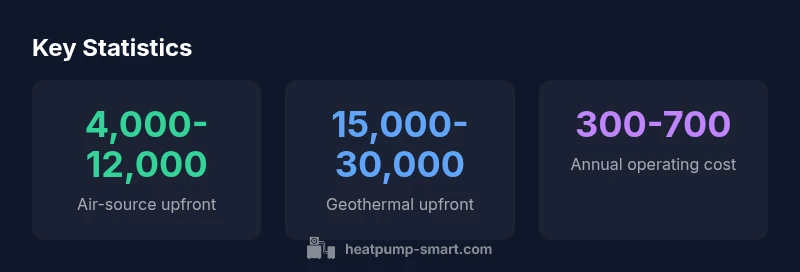
Understanding the upfront investment requires distinguishing air-source and geothermal systems. Air-source heat pumps are typically cheaper to buy and install than geothermal systems, thanks to simpler siting and fewer ground loops. Heatpump Smart Analysis, 2026 places typical installed costs for air-source in a broad range such as $4,000-$12,000, depending on size and climate. Geothermal heat pumps, which rely on buried loops or vertical sleeves, carry higher upfront costs in the ballpark of $15,000-$30,000 or more in many markets. These ranges include equipment, labor, and basic permits but exclude specialized electrical upgrades or ductwork changes. Always request a breakdown of line items to see how much is for the unit, labor, loops, or trenching. Regional differences, contractor experience, and energy codes will shift these numbers.
The choice between air-source and geothermal should consider not just upfront costs but the long-term operating costs and climate suitability. In milder climates, air-source units often deliver the best balance of price and performance. In cold regions, geothermal may offer superior efficiency and reliability, though with a steeper initial price tag. Heatpump Smart recommends evaluating total cost of ownership rather than upfront price alone, including potential rebates and maintenance needs.
How installation complexity changes price
Installation complexity can dramatically alter the final price. Factors include the ease of access to outdoor units, indoor distribution challenges, and the need for electrical upgrades. If an installer must run new circuits, upgrade a panel, or install new thermostats and zoning controls, expect labor to rise. Attic or crawlspace installations may require more ductwork or insulation improvements, further inflating costs. In addition, longer refrigerant line runs, the need for trenching or drilling for geothermal loops, and city permitting all contribute to the final number. Heatpump Smart Analysis, 2026 notes that the marginal cost of complexity often eclipses the base equipment price, underscoring the importance of site surveys before committing to a bid.
The impact of existing ductwork and retrofit needs
If your home already has well-sealed, appropriately sized ductwork, you’ll likely see lower installation costs because fewer changes are needed. Conversely, homes with leaky ducts or undersized networks may require sealing, resealing, or complete duct replacement, which adds to the upfront price. In some cases, retrofit projects might also require improvements to the electrical system, pads or mounting hardware, or refrigerant line upgrades. These elements can add hundreds to thousands of dollars to the total cost. A careful assessment that documents duct condition, insulation levels, and accessibility helps a contractor provide an accurate quote and avoid unexpected charges later in the project.
Efficiency, lifespan, and long-term value
Efficiency metrics such as SEER (Seasonal Energy Efficiency Ratio) and HSPF (Heating Seasonal Performance Factor) influence both upfront costs and ongoing savings. Higher-efficiency units typically cost more initially but reduce energy bills over the life of the system. A heat pump’s longevity, often 12-15 years for outdoor units and longer for some indoor components with proper maintenance, is a critical factor in total cost of ownership. The COP (Coefficient of Performance) rating also guides expected performance in different climates. Heatpump Smart recommends balancing upfront spend with anticipated energy savings and comfort improvements to determine the most cost-effective option for your home.
Rebates, incentives, and financing
Rebates and incentives—at federal, state or local levels—can substantially reduce the upfront cost. The availability and size of incentives vary by region and system type, and may require specific efficiency ratings or installation practices. Financing options, including low-interest loans or energy-efficiency contracts, can spread the cost while preserving cash flow. Heatpump Smart Analysis, 2026 highlights that a thoughtful mix of rebates, financing, and smart sizing often yields the best overall cost-to-benefit profile. Always document eligibility requirements and keep copies of all invoices for rebate processing.
Financing strategies and how to plan cash flow
Cash flow planning is essential when budgeting for a heat pump. If you’re financing, compare loan terms, interest rates, and any additional fees. Some homeowners prefer a staged approach: pay for the equipment upfront and finance installation or electrical upgrades if necessary. A cost-conscious approach also considers anticipated energy savings and potential demand charges or off-peak rates that can affect monthly costs. Heatpump Smart recommends building a scenario that captures up-front costs, ongoing energy savings, and maintenance needs to determine the most sustainable financing path for your household.
How to estimate your own costs with a calculator
A practical DIY estimate starts with a home energy audit or a detailed load calculation. Gather key inputs: home size, climate zone, insulation levels, existing ductwork, and any needed electrical upgrades. Then, compare at least three quotes that itemize equipment, labor, ductwork, and permitting. Use a calculator to model payback based on your local energy prices and the system’s efficiency. Finally, add a contingency for unforeseen issues—commonly 10-20% of the project cost. Heatpump Smart recommends keeping quotes under separate line items to transparently compare equipment, installation, and any ancillary work.
Sizing the system for cost efficiency
Correct sizing is crucial for both performance and cost. An oversized system wastes energy and upfront capital, while an undersized unit strains to meet demand, reducing comfort and shortening equipment life. Professionals use load calculations (such as Manual J or equivalent) to determine the optimal size. In many cases, zoning and thermostat controls can help tailor output to different areas, improving comfort and reducing annual energy use. Although a larger unit may seem appealing for quick comfort, it rarely provides value if it exceeds the actual load. Heatpump Smart stresses the importance of accurate sizing as a foundation for cost efficiency.
Common cost myths debunked
Misconceptions about heat pump costs often mislead homeowners. Common myths include: ' installation is always cheap,' 'geothermal is always the most expensive option,' and 'rebates cover all costs.' In reality, price varies with climate, ductwork, and local labor markets. Rebates reduce the upfront expense but rarely cover the entire bill. Truthfully, long-term savings from energy efficiency and reliability often justify the initial outlay when planned with a full lifecycle view. Heatpump Smart emphasizes evaluating total cost of ownership rather than focusing solely on upfront price.
Smart buying: comparing quotes and warranties
When evaluating bids, insist on itemized quotes, clear warranties, and service terms. Ask about system certifications, refrigerant handling, and expected maintenance schedules. Compare warranty length, what it covers (compressor, parts, labor), and whether upgrades or changes void coverage. Time-to-service and the contractor’s reputation matter as much as the price. Heatpump Smart recommends validating quotes against a baseline: equipment efficiency, expected energy savings, and the contractor’s track record with local installations.
Maintenance as a cost factor over the lifecycle
Maintenance costs are often overlooked but matter for long-term price. Routine inspections, refrigerant checks, evaporator cleanliness, and duct sealing help sustain efficiency and prevent expensive repairs. Scheduling annual or biannual maintenance can reduce unexpected failures and extend equipment life. Budget for filter replacements, minor part wear, and occasional coil cleaning. Heatpump Smart notes that proactive maintenance commonly yields steadier performance and predictable annual costs, improving overall lifecycle value.
Comparison of upfront and ongoing costs for air-source vs geothermal heat pumps
| Factor | Air-source cost range | Geothermal cost range | Notes |
|---|---|---|---|
| Upfront cost (equipment + installation) | $4,000-$12,000 | $15,000-$30,000 | Region and contractor affect numbers |
| Annual operating cost | $300-$700 | $200-$500 | Depends on climate and usage |
| Payback period (with energy savings) | 5-12 years | 10-25 years | Based on energy prices and efficiency |
| Ductwork retrofit cost | $0-$3,000 | $0-$5,000 | If ducts exist in good condition, costs lower |
Your Questions Answered
What is the typical upfront cost range for a heat pump?
A typical installed air-source heat pump runs within the $4,000-$12,000 range, while geothermal can be $15,000-$30,000, depending on site conditions and system type. Always request an itemized quote.
Air-source usually costs four to twelve thousand; geothermal costs more but may offer better long-term savings.
Do rebates reduce the total cost?
Yes. Rebates and incentives reduce upfront costs, and some programs also offer performance-based savings. Availability varies by region and system type.
Rebates can cut upfront costs; check local incentives before signing a contract.
What hidden costs should I plan for?
Ductwork retrofit, electrical upgrades, permits, and potential site prep (drainage, trenching) can add hundreds to thousands of dollars. Include a contingency in your budget.
Watch for ductwork and electrical upgrades and permits.
How long does installation take?
Most installations take 1-3 days for typical homes, with longer timelines if ductwork or electrical upgrades are required. Complex multi-zone systems may extend this further.
Most installs are a day or two.
Air-source vs geothermal: which is cheaper upfront?
Air-source is generally cheaper upfront due to simpler siting. Geothermal costs more upfront because of buried or drilled loops, but may offer greater long-term savings in some climates.
Air-source is cheaper upfront; geothermal costs more but can save more over time.
“Cost considerations should include both upfront and long-term savings; high-efficiency heat pumps often pay for themselves in energy savings over time.”
Top Takeaways
- Ask for an itemized quote to compare apples-to-apples
- Air-source heat pumps usually have lower upfront costs than geothermal
- Rebates and incentives can significantly reduce the upfront price
- Consider total cost of ownership: energy savings matter more over time
- Get multiple quotes and verify ductwork, electrical, and permits upfront