Geothermal Heat Pump Replacement Cost: A Practical Guide
Discover the true geothermal heat pump replacement cost, including installed price ranges, cost drivers, incentives, and how to estimate saving opportunities for homeowners and builders.


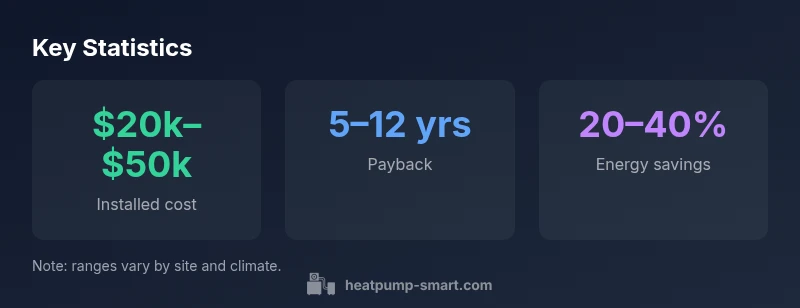
Geothermal heat pump replacement costs typically fall in the range of $20,000 to $50,000 installed, depending on system size, loop field requirements, and site conditions. Expect higher costs in regions with challenging geology or limited drilling access, and lower costs where existing boreholes or loops can be reused. Incentives and financing can further affect the final out-of-pocket expense.
Understanding the Geothermal Replacement Cost Landscape
For homeowners evaluating a geothermal system, replacement costs can be confusing. According to Heatpump Smart, the total installed price includes not just the heat pump unit but also the loop field, drilling, plumbing, electrical work, and permits. The Heatpump Smart team found that site conditions—such as soil type, access to boreholes, and existing utilities—drive most of the variation in final costs. This is why a like-for-like swap can still produce a wide price range. When planning, map out your objectives (heating capacity, cooling needs, and warranty expectations) and prepare for contingencies like unexpected drilling challenges or trenching if the yard layout is constrained. Understanding these factors helps you separate necessary labor from optional upgrades and better evaluate bids from contractors.
Key Cost Components to Expect
A geothermal replacement consists of several major components, each with its own cost trajectory. The heat pump unit itself can represent a significant portion of upfront costs, followed by the loop field or borehole work, which is highly site-dependent. Labor and permitting typically account for a sizable share of the total, especially in regions with stringent codes or difficult access. Electrical work, refrigerant charging, and system commissioning add to the bottom line. When budgeting, consider potential upgrades such as a higher-efficiency model, improved distribution piping, or enhanced controls. Keep in mind that reuse of an existing loop or borehole can substantially reduce the overall price.
Site and System Variability: Soil, Climate, and Home Type Matter
Geothermal replacement costs are not one-size-fits-all. Soil composition, groundwater presence, and climate influence drilling depth and loop field design. In rocky or hard soils, borehole drilling cost tends to rise, while ample, accessible land supports more economical horizontal loops. Urban settings may require vertical loops or more complex permitting, increasing both cost and project duration. Home size, insulation quality, and current energy loads leave a big footprint on the required heating and cooling capacity, which in turn affects equipment choice and installation complexity. To minimize surprises, obtain a detailed site assessment and a clear scope from your installer before breaking ground.
Financing, Incentives, and Long-Term Savings
The economics of geothermal replacement improve when you factor in incentives and long-term energy savings. While upfront costs are higher than many alternatives, the lifetime operating costs are typically lower due to high efficiency. Federal tax credits, state rebates, and local utility programs can offset a portion of the installed price, especially when paired with high-efficiency systems and smart thermostats. The actual savings depend on your climate, energy prices, and how well your home is insulated. It’s important to view incentives as reducing the upfront burden rather than a total subsidy, and to model a full 10–15 year cash flow to appreciate net value.
How to Estimate Your Geothermal Replacement Cost
A reliable estimate begins with a professional load calculation to determine the system size, followed by a site assessment to quantify loop field requirements. Request multiple formal bids, ensuring each bid itemizes equipment, labor, drilling or trenching, permits, and controls. Compare not only the price but also the proposed equipment efficiency, warranty terms, and service commitments. Ask for a 3D layout or schematic of the loop design, expected drilling depth, and a rough project timeline. Finally, verify that the contractor will handle all necessary permits and post-install checks.
Regional Variations: Case Studies and Real-World Ranges
Regional differences can swing prices significantly. In markets with abundant, easy-to-drill rock, costs may trend toward the lower end of the range, while areas with challenging geology or restricted access push prices higher. Case studies show that homeowners in milder climates with existing holes or wells may achieve the fastest payback, whereas homes in cold climates with large heat loads may need more robust systems and larger loop fields. Use these regional patterns to calibrate your expectations and to negotiate smarter bids.
Maintenance and Longevity: Protecting Your Investment
Geothermal systems require periodic maintenance to sustain efficiency and prevent unexpected outages. Regular servicing includes refrigerant checks, electrical inspections, and coil cleaning. A well-maintained system can preserve performance and avoid costly early replacements. Additionally, investing in proper insulation, air sealing, and thermostat optimization reduces load demands, which translates to lower operating costs over time. Planning for routine maintenance as part of the lifecycle cost is essential to maximizing the value of your geothermal replacement.
Getting Ready: Next Steps and Contractor Selection
Begin by assembling a shortlist of qualified geothermal contractors with verifiable licenses and good references. Check for industry certifications such as geothermal installer credentials and warranty-backed workmanship. Ask potential installers for recent project examples similar in scope and for a transparent cost breakdown. Schedule site visits that include a thorough discussion of your goals, a proposed loop design, drilling methods, and anticipated disruption. A careful selection process today yields a smoother installation and stronger long-term performance.
Geothermal replacement cost factors by component
| Aspect | Typical Range | Drivers | Notes |
|---|---|---|---|
| Installed system cost | $20,000–$50,000 | Loop field size, site access | Residential range; specialty sites may exceed |
| Loop field cost | $7,000–$30,000 | Soil type, drilling method | Vertical vs horizontal impact cost |
| Heat pump unit price (equipment only) | $4,000–$12,000 | Model efficiency, capacity | Excludes labor and loop field |
| Labor and permitting | $3,000–$10,000 | Local rates, permit fees | Significant share depending on region |
| Annual operating costs | $200–$600/year | Energy prices, efficiency | Lower with high COP and proper insulation |
Your Questions Answered
What is the typical installed cost range for geothermal heat pump replacement?
In general, expect installed costs to fall within the $20,000–$50,000 range for most homes, depending on loop field size, capacity, and site conditions.
Most replacements fall between twenty and fifty thousand dollars, varying with loop field and home size.
How long does installation take?
Most projects take several days to a week, depending on site access and whether a new loop field is required.
Installation usually takes a few days to a week.
Are there incentives to offset replacement costs?
Yes, federal tax credits and state rebates can lower upfront costs; check current programs that apply to geothermal systems.
There are tax credits and rebates that can cut upfront costs.
Should I replace indoor and outdoor components at the same time?
Often yes; if the compressor, fan, or heat exchanger are aging, replacing them together can reduce future service calls.
If both are aging, replace together to avoid future issues.
What maintenance affects long-term costs?
Regular servicing, coil cleaning, and proper insulation reduce energy use and extend system life.
Keep up with maintenance to save on energy and repairs.
How can I estimate costs more accurately?
Start with a load calculation, request multiple quotes, and compare equipment efficiency and warranties.
Get several quotes and compare efficiency and warranties.
Is geothermal replacement cost different for new builds?
Replacement costs apply to existing systems; new builds with geothermal integration may share trenching or borehole costs.
New builds with geothermal may share some costs with the overall project.
“Geothermal replacement cost is a function of site condition, system size, and future savings. When planned carefully, the long-term energy reliability and reduced operating costs justify the upfront investment.”
Top Takeaways
- Plan for a wide cost range based on site conditions.
- Factor loop field work and permitting into total cost.
- Consider incentives to offset upfront expense.
- Obtain multiple detailed bids for true comparisons.
- Prioritize high-efficiency equipment for long-term savings.