What Is Heat Pump Price? A Homeowners Guide
Explore what drives heat pump price, typical installed cost ranges for air-source and geothermal systems, and tips to save with rebates, financing, and correct sizing.


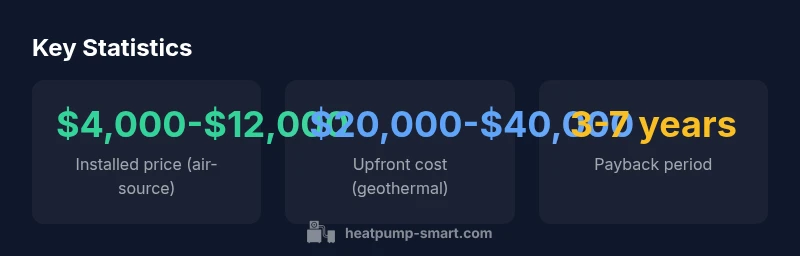
What is heat pump price? It varies by system type, home size, and installation complexity. Typical installed costs for air-source heat pumps with standard ductwork range roughly from $4,000 to $12,000, with larger or higher-efficiency models climbing to $12,000–$20,000 or more. Geothermal installations commonly start around $20,000 and can reach $40,000 or higher.
How price is determined
When homeowners ask what is heat pump price, the first answer is: price is not fixed. It depends on system type (air-source vs geothermal), capacity in BTUs, and efficiency ratings (SEER/HSPF/COP). Higher efficiency models provide larger energy savings but carry higher upfront costs. Installation complexity matters: existing ductwork, electrical service, and any required upgrades can add or subtract thousands. Geography influences prices through labor rates and permitting requirements. Ductless or mini-split configurations can alter both price and installation time. A reliable contractor will tailor a bid based on your home's climate, insulation, and comfort goals, balancing upfront cost against long-term operating savings. In summary, the price for heat pump installation is a function of hardware, labor, and local regulations, not a single sticker price. According to Heatpump Smart, upfront costs are typically higher for high-efficiency units, but lifetime energy costs may be lower. When estimating what is heat pump price, consider both purchase price and ongoing energy bills.
Price ranges by system type
Air-source heat pumps remain the most common choice for retrofits and new builds in temperate climates. Typical installed ranges are roughly $4,000-$8,000 for basic single-zone systems with ductwork, and $6,000-$12,000 for multi-zone configurations. For homes without ducts, ductless mini-splits commonly cost between $3,000 and $9,000 per zone, depending on brand and indoor unit count. Geothermal (ground-source) heat pumps carry a much higher upfront price, generally in the $20,000-$40,000 range, due to drilling and trenching requirements. In colder climates, some customers opt for paired systems combining heat pumps with supplemental heat. Price differences also arise from refrigerant types and the warranty terms offered by manufacturers. While geothermal offers very low operating costs in suitable climates, it requires significant site work and permits. By understanding these ranges, homeowners can calibrate expectations and plan budgets more effectively.
Upfront vs long-term costs
Upfront costs are only part of the equation. The energy savings from heat pumps reduce monthly utility bills, which over time can lead to a favorable total cost of ownership. When comparing bids, look at the efficiency ratings and estimated annual energy consumption, not just headline price. A higher-efficiency unit typically reduces operating costs more, especially in homes with higher heating loads or in regions with expensive electricity. The payback period depends on climate, electricity prices, usage patterns, and how well the system is sized and installed. In Heatpump Smart's experience, homes in moderate climates with good insulation often see shorter payback times, while extreme cold climates may require supplemental heating during peak periods. Financing options, rebates, and utility programs can shorten the payback period further by lowering the net price.
Additional cost drivers
Several components beyond the equipment price affect total installed cost. Ductwork replacement or upgrades can add thousands; electrical service improvements may be needed to support a heat pump’s load. Ground-source systems require drilling or trenching, which increases labor and equipment costs. Permits, inspections, and potential structural or zoning requirements add to the bill. System selection (single-zone vs multi-zone, air-source vs geothermal), refrigerant type, and brand-specific installation practices also influence price. Finally, the presence of existing HVAC infrastructure, local codes, and contractor competition can sway final numbers. Heatpump Smart notes that installers may offer bundled packages that include thermostat upgrades, smart controls, and extended warranties, which can alter the effective price.
How to estimate for your home
Start with a rough heating load assessment for your home: compare square footage, insulation quality, window integrity, and climate. Use these inputs to approximate the BTU capacity needed and then consult a licensed installer for a formal load calculation (often using Manual J). Gather at least three quotes to compare included items: equipment, labor, ductwork, permits, and post-installation maintenance. Ask for a breakdown of energy savings assumptions using your local electricity rates. Consider potential rebates, tax credits, and utility programs that can reduce net price. If you plan to upgrade insulation or windows, factor that into the project scope since improved envelope performance can lower required capacity and overall costs. Finally, look beyond the first-year price; estimate five- and ten-year total costs and savings to gauge true value.
Financing options and incentives
Many homeowners finance heat pump installations through energy-efficient loan programs, manufacturer promotions, or utility rebates. Financing can help absorb upfront costs, turning a large one-time payment into manageable monthly amounts. Government and utility incentives vary by region, and some programs require system qualifications like energy star certification or contractor eligibility. Heatpump Smart recommends checking federal or state tax credits and local rebates, then coordinating with your installer to ensure the chosen equipment qualifies. Some programs also offer performance-based incentives tied to energy savings. Look for warranties that cover both parts and installation and inquire about maintenance plans that lock in predictable costs.
How to compare bids
When you receive bids, ensure each quote includes a complete equipment list, exact model numbers, capabilities, and a clear installation scope. Compare the same features across bids: ductwork, electrical upgrades, permits, thermostats, and a service plan. Verify the installer’s license, insurance, and track record; ask for references and energy-use estimates. Request a performance-based estimate that translates to your expected annual energy bill savings. Check the timeline and any seasonal pricing variations. Finally, calculate the total cost of ownership over 5-10 years, including maintenance, filter replacements, and potential refrigerant charges. A well-priced bid balances upfront price with long-term value.
Real-world scenarios
Scenario A: A 1,200 sq ft starter home in a temperate climate with existing ducts; installed price around the lower end of the range; moderate energy savings; payback around 5-6 years. Scenario B: A 2,600 sq ft home in a cold climate with upgraded insulation; multi-zone air-source system installed; higher upfront cost but potential for substantial energy savings over time. Scenario C: A retrofit in an older, poorly insulated home may require envelope improvements alongside the heat pump, increasing total project cost but improving comfort and efficiency over the long term.
Future-proofing your investment
Choose a heat pump with a solid warranty and a reputable service plan. Schedule annual maintenance to keep efficiency high, replace filters regularly, and inspect refrigerant lines for leaks. Pair your system with smart thermostats and good home insulation to maximize savings. Planning for future upgrades, such as solar compatibility or battery storage, can further enhance resilience and reduce energy costs over the system’s lifetime.
Installed price ranges by heat pump system type
| System Type | Installed Price Range | Notes |
|---|---|---|
| Air-source heat pump (single-zone) | 4,000-8,000 | Basic retrofit with ductwork |
| Air-source heat pump (multi-zone) | 6,000-12,000 | Larger homes, multiple zones |
| Geothermal (ground-source) | 20,000-40,000 | Drilling/trenching; long payback |
| Ductless mini-split | 3,000-9,000 | Flexible retrofit; no ductwork |
Your Questions Answered
What factors most affect heat pump price?
System type, capacity, and efficiency are the main drivers; installation complexity and ductwork influence costs; climate and local codes also matter.
The main price drivers are system type and efficiency, plus install details.
Is geothermal heat pump pricing worth the higher upfront cost?
Geothermal has high upfront costs but can offer very low operating costs in suitable climates; perform a cost-benefit analysis including incentives.
Geothermal can pay off in some climates; analyze costs and incentives.
How do rebates and incentives affect the final price?
Local and national rebates can substantially reduce net installation costs; eligibility varies by region and program; consult Heatpump Smart guidance and a licensed installer.
Rebates can cut the price significantly.
What is a reasonable payback period for a heat pump?
Payback typically spans several years, often 3-7 depending on usage and energy costs; payback can vary widely by climate and efficiency.
Most payback takes a few years, often between 3 and 7.
Can I install a heat pump myself to save money?
Professional installation is required for electrical and refrigerant handling; DIY installation is dangerous and often illegal; hire a licensed contractor.
Don’t DIY; hire a licensed pro.
What maintenance is required for heat pumps?
Annual service checks, filter replacement, and coil cleaning help maintain efficiency and prolong equipment life.
Schedule yearly maintenance and replace filters regularly.
“Price is the starting point, not the end of the conversation; the right heat pump balances capacity, efficiency, and climate for long-term savings.”
Top Takeaways
- Know your system type before bidding
- Expect higher upfront for high-efficiency models
- Factor in installation costs (ductwork, electrical upgrades)
- Check rebates and financing to reduce net price
- Get multiple bids to find best value