Heat Pump Cost After Grant: What You Pay After Subsidies
Understand how grants and rebates affect heat pump costs, compare post-grant price ranges, and plan installation, maintenance, and long-term savings for homes and buildings.


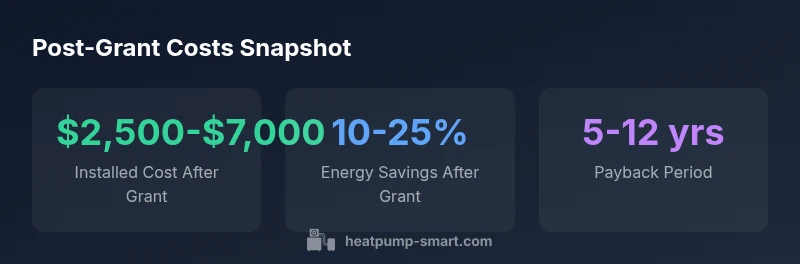
The heat pump cost after grant typically falls into a broad range driven by system type, climate, and installation complexity. After applying rebates or tax credits, homeowners commonly pay a reduced upfront amount, with final costs varying by region and contractor quotes. This post-grant price is influenced by equipment choice, efficiency, and any required electrical or ductwork upgrades, so compare several quotes to capture the best value.
Why the heat pump cost after grant matters for homeowners
According to Heatpump Smart, understanding the heat pump cost after grant helps homeowners plan budgets and maximize long-term savings. Grants, rebates, and tax credits reduce upfront expenditure, but the final price depends on system type, installation complexity, and regional program rules. For homeowners, this means a clearer view of total cost of ownership—from purchase to maintenance—rather than focusing solely on sticker price. In practice, your post-grant cost reflects not just the equipment, but the whole package: wiring upgrades, thermostat controls, and any needed duct or refrigerant line work. By mapping these components, you can compare offers more effectively, ensure compliance with program requirements, and identify ways to optimize energy efficiency across seasons.
How grants reshape the upfront price vs long-term costs
When you apply a grant, the headline upfront cost usually drops, but it is essential to distinguish between installed price and total ownership costs. Grants may cover a portion of equipment, labor, or both, while some regions cap the grant amount or require specific efficiency ratings. The Heatpump Smart team notes that, in many cases, the net present value improves when you factor in reduced energy bills, potential rebates for insulation upgrades, and longer-term reliability. This means the post-grant cost should be evaluated alongside expected operating costs, maintenance frequency, and performance in winter versus summer.
Major factors that shift the post-grant price range
Several variables push the final figure up or down after a grant. Climate affects seasonal load and heat pump sizing; ductwork quality and home insulation can require more extensive installation; the choice between air-source and geothermal systems changes baseline costs, efficiency, and grant eligibility. Equipment efficiency ratings (SEER and HSPF) influence grant coverage and long-term savings. Local permitting, electrical panel upgrades, or compatible smart thermostats may also add to or reduce the post-grant cost. Finally, contractor experience and regional labor rates introduce a broad pricing band that can swing five to ten thousand dollars in complex projects.
A practical method to calculate your post-grant cost
To estimate your post-grant cost, start with the following steps: 1) identify eligible grants in your area (rebates, tax credits, utility programs); 2) get multiple quotes for the same system size and efficiency; 3) compute the installed price minus the grant amounts; 4) add potential ancillary costs (ductwork, electrical work, upgrades to meet code); 5) forecast annual energy savings to assess payback. Use a conservative sizing approach and verify that quotes include permits and commissioning. A simple formula is: Post-Grant Cost = (Pre-Grant Installed Price − Grant Amount) + Ancillary Costs − Measured Energy Savings Value.
Real-world scenarios: small home vs larger property
Consider a modest 1,200-square-foot home in a mixed climate with a ducted air-source heat pump. Pre-grant installed price might be in the mid-range, but eligibility for a regional rebate brings the post-grant price into a tighter band. A larger 2,400-square-foot home with a geothermal system will typically show a higher upfront price even after grants, yet the long-term energy savings and comfort level can be substantial. In both cases, the grant’s impact varies by program terms, local costs, and how well insulation and air sealing were addressed beforehand. Always compare per-year operating costs after the grant, not just the one-time payment.
Financing options and best practices to maximize grant value
If your region offers multiple grant channels, consider stacking where allowed (rebates plus tax credits). Look for contractor bids that explicitly list every cost component and the grant application steps. Ask about performance guarantees and post-installation commissioning. Some utilities offer lower interest financing or payment deferral aligned with expected energy savings. Finally, ensure your home is optimized for efficiency with ventilation, insulation, and sealing upgrades to maximize the benefit of the heat pump after grant.
Quick-start checklist for homeowners and builders
- Confirm all eligible grants and expiration dates before signing a contract.
- Obtain at least three detailed quotes for the same system size and efficiency.
- Ensure quotes include permits, wiring, and commissioning; ask for a breakdown of ancillary costs.
- Check that the system meets your climate needs and your home’s insulation status.
- Plan for future maintenance and potential thermostat optimization to maximize savings.
Estimated post-grant costs by system type
| System Type | Post-Grant Installed Cost (approx) | Notes |
|---|---|---|
| Air-source heat pump (ducted) | $3,000-$7,000 | Common retrofit option across climate zones |
| Air-source heat pump (ductless) | $2,500-$6,000 | Flexible for space constraints and retrofits |
| Geothermal heat pump | $10,000-$25,000 | Higher upfront; high efficiency; grant impact varies |
Your Questions Answered
What is included in the term 'heat pump cost after grant'?
It includes the installed system price after grant, plus labor, permits, and any required upgrades to meet code. Some programs may cap components covered, so always review the quote line-by-line.
The post-grant cost covers the fully installed heat pump package, including labor and necessary upgrades, with possible grant caps.
Do all regions offer grants for heat pumps?
Grant availability varies by country and locality. Check government, utility, and program-specific requirements to determine eligibility and timing.
Grants differ by region, so you should check your local programs and application windows.
How long do grant programs last?
Most programs have application windows and project deadlines. Availability and caps change over time, so plan ahead and verify current rules before purchase.
Grant windows are time-limited and can change, so verify current deadlines before buying.
Can grants cover installation costs?
Some grants cover part of equipment and installation, but many programs limit the total grant and require specific system performance. Read the terms carefully.
Grants can cover some or all installation costs depending on the program; read the terms.
What factors affect the payback after grant?
Payback depends on climate, system efficiency, insulation quality, and energy prices. A higher-efficiency unit often yields greater long-term savings, improving the post-grant economics.
Payback is driven by climate, efficiency, and energy costs; higher efficiency often pays off more.
“Grants reduce the sticker price, but the real value comes from energy savings and proper system sizing performed by qualified installers.”
Top Takeaways
- Estimate post-grant cost early with a contractor quote.
- Grants reduce upfront price but vary by region.
- Consider total ownership costs, not just install price.
- Ductwork and existing infrastructure influence final cost.
- Compare multiple quotes and check grant requirements.