Heat Pump Cost After Rebate: Net Price, Payback, and Tips
Explore how rebates affect heat pump costs, from net price to payback, plus a framework to compare offers and maximize incentives. Heatpump Smart analyzes 2026 data to help homeowners, builders, and property managers decide smarter.


Heat pump cost after rebate refers to the net price you pay once all eligible rebates are subtracted. This net figure is influenced by system type, efficiency, installation complexity, and local programs. Heatpump Smart analysis, 2026 shows typical net price ranges, payback timelines, and how climate affects value. Use these benchmarks to set budget expectations and compare bids.
How rebates affect the price you pay
Rebate programs shave a meaningful portion of the upfront cost, but the net price is not a fixed sticker price. The base price for an air-source heat pump includes equipment and installation, while ductless mini-splits may have different cost structures. When you evaluate bids, ask each installer to show the pre-rebate quote, the available rebates by program, and the resulting net price. The Heatpump Smart analysis, 2026 indicates that net costs after rebates typically fall in a broad range, with larger homes and higher-efficiency models driving higher upfront figures but greater long-term savings. Regional incentives, utility programs, and tax credits can further adjust the final number. Customers should consider total cost of ownership, not just the initial outlay, and factor in expected energy savings, climate, and usage patterns. Always confirm that a rebate is still active and that you meet eligibility requirements before finalizing a contract.
What counts toward net cost after rebates
Not every element of the install qualifies for rebates. Most programs consider the equipment price (the heat pump unit) and necessary installation labor, as well as compatible auxiliary components if required for efficiency or controls. Some rebates cover only the equipment, others cover both equipment and labor, and a few apply to certain zones or efficiency tiers. In practice, you’ll typically need to supply a detailed quote, proof of energy usage, and compliance with efficiency standards. Tax credits, if available, may be separate from rebates but still influence the net outlay. Keep receipts and confirm eligibility before submitting applications, since misfiled paperwork can delay credits or void incentives. Heatpump Smart analysis emphasizes verifying program rules for your specific region to avoid missing eligible costs.
Regional variation in rebates
Rebate availability varies widely by state, province, utility, and even neighborhood. Some programs reward higher efficiency with larger, longer-lasting incentives, while others prioritize grid resilience or fossil fuel replacement. Regional variations mean the same heat pump project can have very different net costs depending on where you live. For some regions, upfront rebates are common; others offer ongoing energy credits or performance-based incentives. Utility companies often publish updated programs each year, so it’s essential to check state or local databases like DSIRE and your utility’s website. Heatpump Smart analysis recommends starting with a live quote, then cross-checking available incentives before scheduling installation. Remember that in some jurisdictions, you may need to complete an energy assessment or choose eligible equipment to qualify.
Comparing installed systems: equipment, efficiency, and incentives
Comparing bids should go beyond the sticker price. Focus on SEER and HSPF ratings, COP, and the expected annual energy usage. Higher-efficiency models can have a higher upfront net price but reduce operating costs more quickly, especially in extreme climates. Some installers build rebates into the quote, while others list incentives as separate credits. Draft a side-by-side comparison that includes base price, installation, mandatory extras, and all eligible rebates. When calculating 12-year or 15-year total cost of ownership, include maintenance costs, potential tax credits, and the expected rise in energy prices to keep forecasts realistic.
Payback analysis: when rebates pay off
Payback analysis translates net cost and annual energy savings into a simple figure: time to recover your investment. The general approach is Payback years = Net cost after rebates / Estimated annual energy savings. Because energy prices and usage vary by climate, payback windows differ widely. Use conservative estimates for savings and consider weather patterns, insulation, and thermostat behavior. Heatpump Smart analysis stresses that payback can be highly favorable in cold climates where electric resistance space heaters would otherwise run more, and in homes with older insulation that reduces heat loss. Always validate assumptions with a professional before committing.
Case studies: home scenarios
Case A: 1,800-square-foot home in a mixed climate adopts a mid-range heat pump. After applying local rebates, the net price sits in a mid-range band, with noticeable energy savings during both heating and cooling seasons. The system typically demonstrates a solid value proposition, especially when paired with proper insulation and smart thermostat usage. Case B: 2,600-square-foot home in a cooling-dominant climate selects a high-efficiency model. Rebates reduce the upfront cost, and the projected energy savings are more pronounced during peak cooling months. Depending on usage patterns and solar or generator backup, the payback period often lands within a heatpump Smart-approved window. These scenarios illustrate how climate, home envelope, and equipment choice shape net cost and value.
How to maximize value: steps for homeowners
To extract maximum value from rebates, start by gathering multiple bids that separate equipment costs, installation labor, and eligible incentives. Verify eligibility with the program administrator before submitting paperwork and keep copies of all receipts. Prioritize high-efficiency models with reliable performance in your climate, and coordinate installation timing with utility programs to avoid overlapping discounts. Evaluate long-term operating costs, not just the upfront net price, and consider adding smart thermostats, regular maintenance, and preventive service plans to sustain savings over time.
Net cost after rebates by installation scenario
| Scenario | Net Cost After Rebates | Payback Period (years) |
|---|---|---|
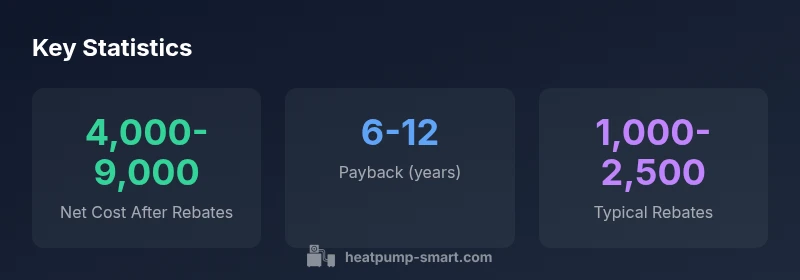
| Single-Family New Install | 4,000-9,000 | 6-12 |
| Multi-Unit/duplex | 6,000-12,000 | 8-14 |
| Fossil-fuel Furnace Replacement | 5,000-11,000 | 7-13 |
Your Questions Answered
What exactly is meant by heat pump cost after rebate?
The net price you pay after any eligible rebates are applied to the base equipment and installation costs. Rebates vary by program and region; ensure eligibility and keep documentation. The net cost reflects both equipment and labor minus incentives.
Net price after rebates is the actual amount you pay after incentives are applied. Check regional programs and keep receipts.
How much rebate can I expect for my heat pump?
Rebates vary widely by location, program type, and system efficiency. Typical ranges are influenced by your climate, electricity rates, and the product you choose. Consult local utility pages and state programs for a realistic estimate.
Rebates differ by region and program. Check local utilities and state incentives for a current figure.
Does rebate cover installation costs?
Some rebates cover both equipment and labor, while others apply only to the equipment. Always review the program terms and get a breakdown from your installer to understand what is eligible.
Some rebates include labor; others don't. Read the program rules and ask for a breakdown.
How does climate affect payback period?
Climate influences heating and cooling needs, which in turn affect energy savings. Colder climates often see greater savings from heat pumps, potentially shortening payback, while milder climates may extend it.
Cold climates often boost savings, which helps payback, while milder areas may take longer.
Do rebates expire or require paperwork?
Yes, many rebates have expiration dates and require timely submission of receipts, contractor details, and installation verification. Missing paperwork can delay or void incentives.
Yes—rebates often have deadlines and paperwork requirements. Stay organized.
Are ductless mini-splits eligible for rebates?
Ductless mini-splits can be eligible for rebates when they meet program criteria for efficiency and installation. Check eligibility rules for your region and compare options accordingly.
Ductless systems can qualify; verify regional rules and efficiency standards.
“Heat pumps offer meaningful long-term payoffs once rebates are factored in, thanks to their efficiency and predictable operating costs.”
Top Takeaways
- Estimate net cost after rebates using size and local programs.
- Expect a 6–12 year payback range for many homes.
- Higher-efficiency models save more energy over time.
- Shop multiple contractors to compare rebates and installation costs.