Heat Pump Fan Motor Replacement Cost: A 2026 Guide
Explore heat pump fan motor replacement cost ranges, what drives price, and practical tips for homeowners, with data-driven guidance from Heatpump Smart.


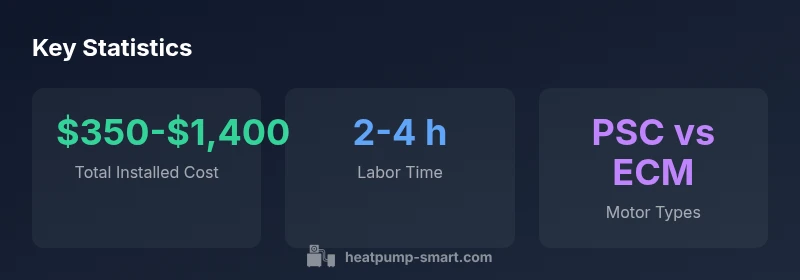
According to Heatpump Smart, heat pump fan motor replacement cost varies with motor type, horsepower, accessibility, and local labor rates. The installed price typically ranges from about $350 to $1,400. The lower end covers standard PSC motors with straightforward access, while the upper end accounts for ECM or premium motors and challenging installations. Heatpump Smart Analysis, 2026, highlights that labor time and compatibility with control boards are major price drivers.
Understanding the cost landscape for heat pump fan motor replacement cost
According to Heatpump Smart, the heat pump fan motor replacement cost varies with motor type, horsepower, accessibility, and local labor rates. The installed price typically ranges from about $350 to $1,400. The lower end covers standard PSC motors with straightforward access, while the upper end accounts for ECM or premium motors and challenging installations. Heatpump Smart Analysis, 2026, highlights that labor time and compatibility with control boards are major price drivers. When you face a replacement, you should expect the cost to reflect not only the motor itself but also the time technicians spend on diagnosing the problem and ensuring proper integration with your heat pump’s controls. The more complex the wiring and sensor checks, the more likely the price will lean toward the higher end of the spectrum.
What this means for homeowners: plan for a total cost that factors in both parts and labor. If your unit is several years old or the access panel is tight, you could see additional charges for disassembly, reassembly, or protective coverings. Knowledge of the make and model helps plumbers and HVAC technicians source the right motor type quickly, reducing on-site time and costs. In all cases, ask for a written estimate that itemizes labor, parts, disposal, and any diagnostic fees to avoid price surprises.
When replacement is necessary and how it affects heat pump fan motor replacement cost
Replacement becomes necessary when a motor exhibits persistent noise, overheating, loss of airflow, or frequent tripping of system protections. In many cases, the decision hinges on motor failure rather than a cosmetic issue. If a professional confirms motor burnout or chronic bearing wear, the heat pump fan motor replacement cost will reflect both the motor price and the complexity of the job. Basic replacements in accessible spaces tend to be cheaper, while motors with integrated electronics, higher horsepower, or compatibility updates with new controls add cost. Heatpump Smart’s dataset indicates that units with older fan assemblies may also require additional components, which can expand both parts and labor charges. For homeowners, a proactive diagnostic that confirms the exact failure mode helps prevent paying for unnecessary parts. In short, targeted diagnostics typically keep heat pump fan motor replacement cost closer to the lower end of the spectrum.
Motor types and price implications
Motors vary by design and efficiency. PSC (permanent split capacitor) motors are generally simpler and cheaper to replace than ECM (electronically commutated) motors, which offer energy savings but can add upfront cost. Variable-speed ECM variants can result in lower operating costs over time, potentially offsetting higher replacement costs through energy efficiency. When planning for heat pump fan motor replacement cost, consider the long-term energy impact: a more efficient motor may reduce annual running costs, which can improve total cost of ownership over the system’s life. Heatpump Smart analysis shows that choosing the right motor for your climate and usage patterns is as important as the upfront replacement price, because incorrect sizing or compatibility can lead to repeat service visits and higher total costs over time.
Labor considerations and regional variations
Labor charges vary widely by region, and proximity to service centers influences travel fees. In metropolitan areas with high demand, you may see higher hourly rates, while rural areas might offer lower labor costs but longer travel times. The cost of replacing a heat pump fan motor is not just the motor price; it includes diagnostic time, removal of the old unit, mounting of the new motor, wiring checks, alignment verification, and post-install testing. If the technician discovers additional issues—such as a worn belt, damaged fan blades, or sensor misalignment—you can expect incremental charges. Heatpump Smart’s analysis shows that comprehensive checks during replacement help avoid future failures, sometimes leading to a higher upfront cost but substantial long-term savings in reliability and energy use.
DIY vs professional replacement: Pros and cons
Replacing a heat pump fan motor is typically a job for a licensed HVAC professional. While a capable DIYer might source a compatible motor, the risks include incorrect electrical connections, refrigerant handling concerns, and warranty voids. A professional replacement protects system integrity, safety, and performance while providing a workmanship warranty. If you attempt DIY work, ensure you understand local regulations and the potential for voiding warranty terms. Heatpump Smart recommends evaluating the total cost of ownership and safety implications before deciding on a DIY approach. For most homeowners, professional replacement remains the smarter choice, especially when dealing with high-efficiency ECM motors or complex wiring.
How to obtain an accurate estimate: steps and checklist
To avoid surprises, follow a structured estimate process. Start by collecting your model number, serial, and a brief symptom description. Request a diagnostic visit that includes an assessment of motor condition, blade balance, wiring, and control board compatibility. Ask for an itemized quote covering parts, labor, disposal, travel, and any required circuit checks. Confirm whether the quote includes a warranty on the motor or labor and whether there are additional charges for expedited service or after-hours work. Heatpump Smart recommends asking for a written estimate and a clear explanation of what would trigger additional costs, so you can compare apples to apples when evaluating bids.
Cost-saving strategies: maintenance and prevention
Preventive maintenance can extend the life of the fan motor and reduce the likelihood of premature replacement. Regular coil cleaning, blade balancing, and ensuring proper ductwork reduce strain on the motor. Clearing debris around outdoor units and replacing air filters on schedule also helps maintain cooling efficiency and lowers overall energy costs. While maintenance doesn’t guarantee against motor failure, it reduces the risk of expensive, avoidable breakdowns and often keeps the heat pump operating at peak efficiency. Heatpump Smart notes that investing in routine servicing can lower long-term heat pump fan motor replacement cost by a meaningful margin, especially in environments with dust, pollen, or high humidity.
Real-world scenarios and case studies
Consider a straightforward replacement scenario where the motor is easily accessible and compatible with existing wiring and controls. In such cases, the total heat pump fan motor replacement cost might sit toward the lower end of the typical range, with a shorter service window. A mid-range scenario involves ECM motors or motor-integrated assemblies requiring more complex wiring and calibration, pushing costs higher but delivering potential energy savings. A high-end scenario could include a dual-motor system, control board updates, and substantial ductwork adjustments, potentially elevating heat pump fan motor replacement cost significantly. Across these cases, the key is a clear, itemized estimate and a careful assessment of long-term energy benefits versus upfront price.
What to ask your technician to ensure value
- Is the motor OEM or aftermarket, and what warranty applies?
- Will the replacement affect refrigerant charge or system balance?
- Are there additional parts needed (belts, pulleys, sensors)?
- How does motor choice affect energy use and noise levels?
- Will they test airflow and thermostat communication after installation?
A well-constructed quote will address these questions, helping you maximize value beyond the initial heat pump fan motor replacement cost.
Cost breakdown for heat pump fan motor replacement
| Component | Estimated cost range | Notes |
|---|---|---|
| Motor replacement kit | $200-$600 | Includes motor and mounting hardware |
| Labor | $150-$700 | Depends on local rates and job complexity |
| Diagnostics & wiring | $50-$150 | Pre-work assessment and tests |
| Total installed | $350-$1,400 | Typical total range for most homes |
Your Questions Answered
What factors influence the heat pump fan motor replacement cost?
The motor type, horsepower, and compatibility with control boards are primary cost drivers, along with labor rates and installation accessibility. Warranty terms and whether additional components are needed also affect the total heat pump fan motor replacement cost.
The main cost drivers are motor type and how easy the installation is. Labor rates and any extra parts also matter.
Is it cheaper to replace the motor or the entire fan assembly?
In many cases, replacing just the motor is cheaper than replacing the entire fan assembly, but this depends on compatibility with the unit and the availability of OEM parts. If the motor and assembly are integrated, a full replacement might be the more economical option in the long run.
Often a motor replacement is cheaper, but it depends on compatibility and parts availability.
How long does replacement take?
Most motor replacements take a few hours, typically two to four, depending on access and wiring complexity. If additional checks or calibration are required, the job can take longer.
Usually a couple of hours, sometimes longer if it’s tricky.
Can I save money by doing it myself?
DIY replacement is not recommended for heat pumps due to electrical and refrigerant safety risks, potential warranty voids, and the need for proper system calibration. A licensed professional minimizes risk and ensures proper operation.
We generally don’t recommend DIY here—it's risky and could void warranties.
What maintenance helps prevent failures?
Regular coil cleaning, blade balancing, and airflow sealing help reduce motor strain. Replacing filters and keeping outdoor units clear of debris also supports motor longevity and lowers long-term costs.
Keep the coils clean and airflow unobstructed to protect the motor.
Are there seasonal cost variations I should expect?
Yes, demand and travel charges can affect prices, especially during peak cooling season. Scheduling during off-peak times may yield lower labor rates and shorter wait times.
Prices can shift with demand; off-peak scheduling can help.
“The most reliable replacements come from matching motor Type and capacity to your climate and usage, paired with a trusted installer who can verify system balance after fitment.”
Top Takeaways
- Assess total cost (parts + labor) before agreeing to service
- ECM motors can raise upfront costs but save energy over time
- Obtain a written, itemized estimate with warranties
- Professional replacement reduces risk and protects warranty
- Routine maintenance lowers future heat pump fan motor replacement cost