Heat Pump Tariff Comparison: 2026 Guide for Savings
A clear heat pump tariff comparison that explains tariff structures, compares cost scenarios, and offers practical tips to reduce energy bills and boost home comfort.


In a heat pump tariff comparison, the right pricing structure can significantly affect operating costs. This quick guide compares common tariff types and how they interact with heat pumps, helping homeowners and managers choose the most economical option. Read on for a structured approach to evaluate fixed-rate, variable, and time-of-use tariffs.
Why a heat pump tariff comparison matters
Across markets migrating toward electrified heating, the right tariff can tilt the economics of owning a heat pump. According to Heatpump Smart, a thorough heat pump tariff comparison helps homeowners, builders, and property managers move beyond list prices and discover true operating costs under real-world conditions. Tariffs define when energy is priced higher or lower, and heat pumps often run during shoulder seasons or in efficient, staged heating cycles. The better you align your heat pump usage with tariff structure, the more you can reduce waste and improve comfort. A robust comparison considers standing charges, seasonal adjustments, and dynamic pricing, while accounting for occupancy patterns, climate, and insulation levels. The Heatpump Smart team emphasizes that tariff choice interacts with appliance control strategies, smart thermostats, and energy storage plans. Without this alignment, even an efficient heat pump can underperform economically. The goal of this guide is to provide a framework for assessing tariff options, focusing on total cost of ownership and long-term sustainability rather than sticker price alone. We will examine common tariff families, the practical implications for heat-pump operation, and how to make a decision that remains robust as prices and regulations evolve. By the end, readers will know how to approach a heat pump tariff comparison for their specific home, climate, and budget.
Understanding tariff structures for heat pumps
Tariff structures shape how much you pay for electricity when your heat pump runs. Most markets offer several core options: fixed-rate tariffs with a constant price per kilowatt-hour, variable-rate tariffs that change with market conditions, and time-of-use tariffs that assign different prices to energy consumed in different blocks of the day. Some regions also offer seasonal or demand-based tariffs that reward off-peak usage or penalize peak demand. Important charges include the standing charge (a daily fee regardless of usage) and any caps or credits that apply during extreme weather. When you perform a heat pump tariff comparison, you should model how your heating season aligns with tariff windows, your occupancy patterns, and your home's insulation. Heatpump Smart notes that the control strategy matters: a heat pump that preheats during cheap periods or uses a hot water buffer can extract more value from a TOU tariff. Always verify whether a tariff requires a smart meter or compatible thermostat to realize price signals; some programs are only accessible with specific devices. In all cases, the goal is to minimize energy costs while maintaining comfort and reliability. This means evaluating both unit prices and how the tariff handles high load events, ramping requirements, and contract lengths. A holistic heat pump tariff comparison goes beyond per-kWh price to include the full economics of your system and home.
Fixed-rate vs variable tariffs: pros and cons
Fixed-rate tariffs provide budgeting simplicity. You lock in a price for a contract term, making monthly bills more predictable and easier to forecast. They are especially appealing for households with stable heating needs and little appetite for price fluctuations. However, fixed rates can miss opportunities when market prices fall or when usage patterns shift. Variable tariffs, by contrast, expose you to price swings but offer the chance to pay lower rates during slumps in the market. For heat pumps, this means potential savings if you can align usage with favorable periods and if you have the flexibility to absorb occasional higher bills during peak times. The trade-off is not just price, but risk and planning requirements. In a heat-pump tariff comparison, you should weigh the reliability of supply and the likelihood of price spikes against the potential for savings, along with any contractual penalties for changing plans.
Time-of-use tariffs and how they interact with heat pumps
Time-of-use tariffs assign different prices to energy used at different times of day or days of the week. For heat pumps, TOU pricing encourages shifting heating activities to cheaper periods, especially if you have a programmable thermostat or a smart controller. The savings potential depends on climate, occupancy, and insulation, as well as the granularity of the tariff’s time blocks. A well-designed heat pump tariff comparison considers whether the local TOU program supports smart metering, how quickly the price signals are updated, and what happens during weekends or holidays. In practice, TOU tariffs reward proactive scheduling, preheating before the cheaper window, and using hot water storage to avoid peak demand. Heatpump Smart’s guidance is to simulate several weekly profiles to see how often your system would operate during off-peak periods and how often you would incur peak charges.
Regional vs national tariffs: what matters
Tariff availability and structure often vary by region. Regional tariffs may reflect local generation mix, grid congestion, and distribution charges that affect a heat pump’s operating cost differently than a national average. When you compare tariffs, it is essential to consider what local programs exist, including any region-specific TOU offerings, seasonal adjustments, or peaks during cold snaps. Additionally, transmission constraints can influence price signals and reliability expectations. Heatpump Smart emphasizes aligning tariff choice with local climate patterns and building codes, since a mismatch can erode efficiency gains and comfort. A careful tariff comparison should map tariff availability to your property's location and to anticipated occupancy and heating demands.
How to compare tariffs: a step-by-step guide
Begin with a clear picture of your typical heating season. Gather tariff terms from your utility or provider, including unit rates, standing charges, minimum fees, and any caps or credits. Build a simple cost model that estimates annual energy expenditure under each tariff, factoring in typical daily usage, climate-driven demand, and insulation quality. Compare both fixed and variable components, including potential demand charges and any penalties for early termination. Consider the practicality of implementation: TOU tariffs usually require smart meters or compatible thermostats to realize price signals. Evaluate contract length, renewal terms, and the risk of price changes mid-term. Finally, incorporate non-monetary factors such as customer service, outage history, and program stability. Heatpump Smart recommends running sensitivity analyses for mild and severe seasons to understand how robust each tariff is to weather variability and occupancy changes.
Case studies: hypothetical scenarios
Case A involves a compact apartment with modest heating needs and steady occupancy. A fixed-rate tariff offers budgeting simplicity and decent predictability, which suits consistent daily patterns. Case B involves a large family home in a colder climate with variable occupancy and significant heating demand. A Time-of-Use tariff paired with smart controls is likely to yield better alignment with usage peaks and cheaper windows, provided the system can be configured to shift heating loads without compromising comfort. In both scenarios, success depends on accurate usage modeling, reliable metering, and ongoing bill monitoring. The aim is to project annual costs under each tariff and compare them against the expected energy performance of the heat pump and the home's insulation. Heatpump Smart’s approach is to combine historical weather data with current tariff terms for a robust forecast and scenario planning.
Practical tips to optimize tariffs and energy bills
Implement smart load shifting by scheduling preheating or pre-cooling during off-peak periods when available. Invest in a modern, well-insulated building envelope to reduce heat loss and improve the effectiveness of tariff-based savings. Pair a heat pump with a smart thermostat and, if feasible, a small energy storage solution to smooth demand around peak price blocks. Regularly review your energy bills and tariff terms, especially near contract renewal dates. Consider combining tariff selection with efficiency upgrades like improved insulation, sealing, and ductwork, as these changes reduce overall energy consumption and amplify the value of favorable tariffs. Finally, stay informed about new programs or rebates that can complement tariff-based savings and enhance overall energy efficiency.
When to switch tariffs and providers: decision framework
Switch tariffs when you identify a consistent pattern of potential savings that outweighs switching costs and contract terms. Evaluate the stability of the tariff, the provider’s service quality, and any price caps or guarantees. Consider your climate, occupancy, and heating strategy; if your heat pump operates mostly during off-peak periods, TOU tariffs may be favorable. Conversely, if your heating pattern is uncertain or highly seasonal, fixed-rate tariffs can deliver budget certainty. Heatpump Smart recommends a formal decision framework: compare projected annual costs under current and alternative tariffs, test scenarios for your climate, and factor in non-monetary considerations like reliability and customer support. This method helps ensure the chosen tariff remains robust as prices and energy policies evolve.
Authoritative sources
For deeper analysis and policy context, consult credible sources such as government and academic publications. Examples include:
- https://www.energy.gov
- https://www.nrel.gov
- https://www.energy.gov/eere/buildings
Comparison
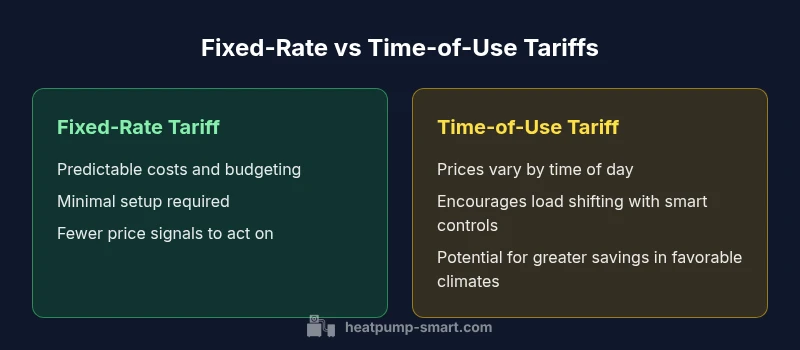
| Feature | Fixed-Rate Tariff | Time-of-Use Tariff |
|---|---|---|
| Representative rate structure | Set rate for contract duration; predictable bills | Different rates by time blocks; pay for peak or off-peak usage |
| Best For | Budget stability and simplicity | Maximizing savings through shifting load to cheaper periods |
| Smart controls required | Not strictly required; helpful for forecasting | Beneficial with proactive scheduling and controls |
| Price volatility | Low exposure; fixed pricing | Higher exposure to price swings; potential savings in off-peak periods |
| Implementation complexity | Low; straightforward contract | Moderate; may require smart meter or compatible equipment |
| Regional availability | Widely available | Varies by region; TOU more common in dense grids |
Advantages
- Predictable, fixed monthly costs for budgeting
- Low operational risk and simple setup
- Less dependence on advanced controls or smart devices
- Protection against price spikes in volatile markets
Disadvantages
- Limited opportunity to save if prices drop
- Inflexible to shifting load to cheaper periods
- Potentially longer contract terms with penalties
Time-of-use tariffs generally offer the best balance of savings and risk for heat-pump users when paired with smart controls
Fixed tariffs provide budgeting certainty but miss opportunities from price fluctuations. TOU tariffs reward smart operation, but require reliable control infrastructure to realize savings.
Your Questions Answered
What is a heat pump tariff comparison?
A heat pump tariff comparison evaluates different electricity pricing options to determine which offers the lowest annual cost for running a heat pump, considering factors like usage patterns, climate, and home efficiency. It weighs fixed rates, variable rates, and time-based pricing to inform a decision.
A tariff comparison weighs fixed, variable, and time-based pricing to find the lowest annual cost for running a heat pump.
Do heat pumps benefit from time-of-use tariffs?
Heat pumps can benefit from time-of-use tariffs if the system can shift heating loads to cheaper periods without compromising comfort. The benefit depends on climate, occupancy, and the capability of smart controls to respond to price signals.
TOU tariffs help if you can shift heating to cheaper periods using smart controls.
Is a smart meter required to access TOU tariffs?
Many TOU programs require a smart meter or compatible thermostat to receive accurate price signals. Check with your utility to confirm device requirements and availability in your area.
A smart meter or compatible thermostat is often needed for TOU signals.
Can tariffs change during a contract?
Tariffs can be subject to market changes or policy updates. Review contract terms for any price-change provisions and the process for notification and adjustment.
Tariffs may change; review terms for price-change provisions.
How do I estimate savings from a tariff with a heat pump?
Estimate savings by modeling your annual heat-pump usage under each tariff, considering climate, occupancy, and insulation. Use a simple cost model to compare total predicted costs, not just per-kWh price.
Model usage under each tariff and compare total predicted costs.
What role do rebates and incentives play in tariff decisions?
Rebates and incentives can alter the economics by reducing upfront costs or offering credits. Include available rebates in the overall cost assessment alongside tariff terms.
Rebates can boost savings; include them in the overall calculation.
Top Takeaways
- Identify your heating pattern before choosing a tariff
- TOU tariffs work best with smart controls and a well-insulated home
- Budget certainty favors fixed tariffs in stable usage scenarios
- Always verify meter/thermostat requirements for price signals
- Regularly reassess tariff choices as prices and policies evolve