Comparing Heat Pump Water Heaters: A Practical Guide
An analytical guide to comparing heat pump water heaters, detailing tank-style vs tankless designs, installation considerations, efficiency, costs, climate effects, and rebates for homeowners and professionals.


Comparing heat pump water heaters focuses on two main designs: tank-style with a storage tank and integrated heat pump, and tankless (on-demand) models. Key considerations include energy efficiency, ambient climate, installation needs, space, initial cost, and long-term operating costs. This guide explains how these designs differ and how to choose the best fit for homes, apartments, and multifamily buildings.
Understanding the landscape of comparing heat pump water heaters
When evaluating options for the home, the goal is to understand how heating water with a heat pump differs from traditional electric resistance heaters and where each design shines. In the context of comparing heat pump water heaters, you are weighing two broad families: storage-tank HPWHs and tankless HPWHs. A tank-style unit stores hot water in a insulated tank and uses a heat pump to maintain the water temperature; a tankless unit heats water on demand as it flows through a heat exchanger. The Heatpump Smart team notes that HPWHs can deliver meaningful energy savings when installed in spaces that allow adequate air exchange and mild ambient temperatures. Real-world performance depends on climate, airflow, electrical capacity, and how households use hot water. In this guide, we break down the core distinctions, then translate them into practical decisions for homeowners, builders, and property managers. By the end, you’ll know which design to choose based on demand, space, and long-term value.
Tank-style HPWH vs Tankless HPWH: Core differences
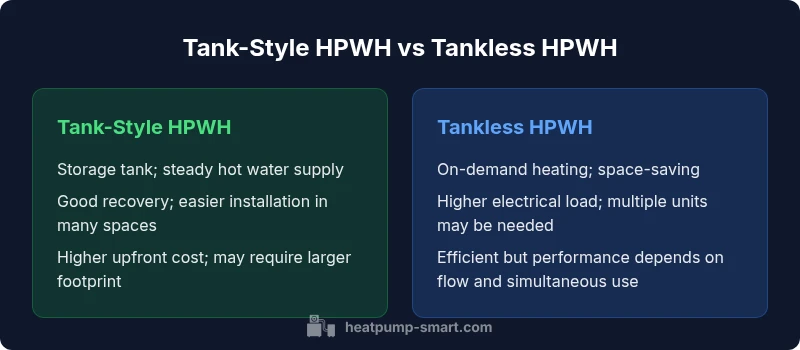
Tank-style HPWHs store hot water in a tank and rely on a built-in refrigerant circuit to raise water temperature. Tankless HPWHs heat water on demand as it passes through a coil or exchanger, without storing large volumes. The practical implications matter: storage tanks provide a steady supply and fast recovery after draws, while tankless units save space and can be placed closer to points of use. When comparing heat pump water heaters, consider your hot water usage pattern, whether you prefer a single centralized heat source or multiple units, and how important uninterrupted hot water is during peak times. Climate and installation specifics also matter: storage-style units often perform reliably in spaces with reasonable ambient temperatures; tankless units may require higher electrical capacity and careful placement of vents or condensers. Regardless of design, correct sizing and professional installation are essential. In the sections that follow, we outline real-world scenarios and how to translate them into a practical spec.
Energy efficiency and performance metrics
Two key metrics inform the comparison: COP (coefficient of performance) and EF (energy factor). In general, HPWHs outperform conventional electric resistance heaters, though the exact values depend on ambient temperature and water draw patterns. Tank-style HPWHs typically deliver strong efficiency due to stored hot water and the ability to run the compressor at a steady pace, while tankless HPWHs can achieve high COPs when hot water demand is moderate and flows are well managed. The trade-off centers on standby losses from storage versus potential flow limitations in tankless configurations. The Heatpump Smart team emphasizes that real-world performance hinges on usage: households with frequent long showers or multiple simultaneous draws benefit from larger storage tanks or higher-flow tankless arrangements. Proper insulation of pipes and water heater cabinets further amplifies efficiency gains. In short, expect better energy performance with HPWHs than traditional electric heaters, but tailor the choice to your daily hot-water profile.
Climate and placement considerations
Ambient air temperature and humidity substantially affect HPWH efficiency. In warm or moderate climates, HPWHs can achieve excellent energy savings, while in colder spaces efficiency can decline and recovery times may lengthen. Placement matters: near living spaces, in garages, or inside utility rooms chosen for adequate ventilation will perform better than tightly sealed closets. Some configurations incorporate a small vent or dedicated intake to maintain optimum operation. Tank-style units generally benefit from placement near primary hot-water draws to minimize pipe losses and delays; tankless units are often installed closer to kitchens or bathrooms to reduce distribution losses and improve response time. Acoustic considerations are also relevant: compressors and fans produce noise that can be disruptive if placed in or near living areas.
Sizing and installation challenges
Sizing HPWHs requires analyzing peak hot-water demand, simultaneous draws, and the recovery rate of the unit. Storage tanks must be large enough to cover typical daily needs, but oversized tanks increase standby losses. Tankless units require suitable flow rates and may necessitate multiple units for larger households, which can complicate plumbing and electrical design. Electrical requirements frequently include dedicated circuits and higher amperage than standard storage heaters; in retrofit projects, upgrading panels and wiring may be necessary. Plumbing considerations include cold-water supply quality, drain lines for condensate, and ensuring correct valve arrangements and checkups. The goal is to avoid undersizing or oversizing, both of which erode energy savings and reliability. A professional assessment is critical to prevent installation bottlenecks and guarantee code compliance.
Costs and long-term value
A thorough cost analysis weighs upfront equipment costs against long-term energy savings and maintenance. Tank-style HPWHs typically come with higher upfront costs than standard electric water heaters but can deliver significant energy savings over time, especially in homes with steady hot-water use. Tankless HPWHs often require a higher initial investment due to advanced heat exchangers and electrical load, yet they offer space savings and potentially meaningful energy efficiency, particularly in smaller living spaces. When judging value, account for local electricity prices, expected hot-water consumption, and available rebates or tax incentives. Heatpump Smart analysis suggests incentives and rebates can shorten payback periods in many regions when combined with proper sizing and installation. Regardless of design, good insulation and streamlined plumbing minimize standby losses and maintenance costs.
Space, noise, and integration with existing systems
Storage tanks require more floor space than compact tankless units, influencing where you can locate the heater in a home or building. Noise from compressors and fans can be noticeable if the unit sits near bedrooms or living spaces, so choose a location with minimal disruption. For multifamily buildings, centralized HPWH systems can leverage shared infrastructure and maintenance schedules, though distribution design must account for pipe length and flow balance. Tankless HPWHs are frequently installed near points of use to minimize heat losses in long runs, but this can complicate plumbing and circuit planning. If you are integrating HPWHs with solar or other renewables, a centralized control strategy can optimize efficiency and comfort. A thoughtful placement strategy is as important as the unit specifications themselves.
Maintenance, warranties, and lifespans
All HPWHs require routine maintenance to preserve efficiency and reliability. Tank-style units may need more frequent checks on storage-tank components, insulation, and occasional anode inspection to combat corrosion. Tankless models focus maintenance on heat exchangers and sensors; mineral buildup can affect flow and heat transfer if the water is hard. Warranties vary by brand and model, with longer coverage typically reflecting more robust heat-exchanger and compressor protections. Establishing a regular maintenance schedule with a qualified technician helps detect leaks, refrigerant issues (where applicable), and performance declines early. With proactive care, HPWHs can deliver many years of service and consistent hot water.
Environmental and rebate considerations
Heat pump water heaters offer environmental benefits by reducing electricity consumption and enabling flexible operation with other energy systems. The sustainability advantage grows when HPWHs are integrated with renewables or demand-response programs, though outcomes depend on climate and building airtightness. In many regions, rebates or tax incentives exist for energy-efficient water heaters, reducing the effective cost of ownership. Availability and terms vary by jurisdiction and program design. Heatpump Smart analysis, 2026 emphasizes the importance of coupling proper sizing with incentives to maximize environmental and financial returns. Always verify current programs with local utilities and government sites before purchasing.
Practical installation scenarios for different home types
Single-family homes can often accommodate a storage HPWH in a garage or utility closet with ample ventilation. For apartments and compact homes, a compact tankless HPWH placed near kitchens or bathrooms can minimize pipe losses and free up space. In multifamily settings, a hybrid configuration—central storage HPWH serving common hot-water needs plus point-of-use units for individual units—may balance performance and cost. Retrofit projects should assess existing plumbing, electrical panels, and available ducting for air intake. A professional assessment helps identify restrictive constraints and ensures compliance with local codes and appliance standards. By aligning the design with actual hot-water patterns and building layout, you can achieve consistent comfort and energy savings over the system’s life.
How to compare models: a practical checklist
Use a standardized checklist when evaluating HPWH models: energy efficiency features (COP/EF), storage capacity or flow rate, electrical requirements, space availability, climate suitability, noise, warranty terms, and local rebates. Request performance data for your climate and installation location, and verify compatibility with your plumbing and electrical infrastructure. Compare installation costs, expected energy savings, and maintenance needs. A disciplined comparison helps prevent overbuying or undersizing and keeps you aligned with your budget and performance goals. Remember to factor in installation lead times and utility connection requirements when planning.
Authority sources and further reading
To verify guidance and data for comparing heat pump water heaters, consult primary sources from government and energy organizations. Useful starting points include the Department of Energy's Energy Saver pages on water heating, the ENERGY STAR product specifications for heat pump water heaters, and research efforts from the National Renewable Energy Laboratory. These sources provide foundational context on efficiency metrics, installation best practices, and policy incentives that influence decision-making for homeowners and professionals alike.
Comparison
| Feature | Tank-style HPWH | Tankless HPWH |
|---|---|---|
| Energy efficiency | Generally very high due to stored hot water and stable compressor operation | High efficiency with on-demand heating, highly dependent on flow and unit sizing |
| Hot water supply | Ready hot water from storage; fast recovery after usage | On-demand hot water with no standby storage |
| Space requirements | Larger footprint due to storage tank and surrounding clearance | Compact footprint, can be placed closer to usage points |
| Installation complexity | Typically easier retrofit in many homes; standard electrical | Often more complex; may require electrical panel upgrades and routing |
| Climate sensitivity | Works well in moderate ambient temperatures; efficiency can drop in cold spaces | Requires adequate water flow and favorable electrical capacity; less climate sensitivity but depends on installation |
| Cost considerations | Higher upfront cost but strong long-term savings in many scenarios | Higher upfront cost; potential savings depend on usage and space constraints |
Advantages
- Significant energy savings versus conventional electric heaters
- Tank-style offers reliable on-demand hot water and easy zoned outages
- Tankless units save space and reduce distribution heat loss
- Potential rebates and tax credits improve payback when available
Disadvantages
- Higher upfront cost than traditional heaters
- Tank style increases footprint and may require more ventilation
- Tankless units can have higher electrical requirements and complex installation
- Performance can vary with climate and draw patterns
Tank-style HPWHs generally suit larger homes with steady hot-water needs; tankless HPWHs suit compact spaces and variable-use scenarios.
Choose tank-style if you need reliable, high-volume hot water and have the space. Opt for tankless if space is at a premium and your hot-water demand is moderate or concentrated near points of use.
Your Questions Answered
What is the main difference between tank-style and tankless HPWH?
Tank-style HPWH stores hot water in a tank and heats it continuously, providing a steady supply. Tankless HPWH heats water on demand with no storage, saving space but relying on flow rates. Your pattern of hot-water use determines which design fits best.
Tank-style holds hot water for quick access; tankless heats on demand. Choose based on your water use and space.
Are HPWHs suitable for cold climates?
HPWHs perform best in moderate climates or well-ventilated spaces. Efficiency can decline in very cold spaces, which may affect recovery time and energy savings.
Yes in many places, but performance drops in colder spaces; plan for placement and insulation.
Do HPWHs require electrical upgrades?
Most HPWHs require dedicated circuits and higher amperage than standard heaters; some installations may need panel upgrades.
Often you’ll need a dedicated circuit, and bigger upgrades can be needed.
Can HPWHs be retrofitted into older homes?
Yes in many cases, but assess space, wiring, plumbing, and permit requirements. A professional assessment helps ensure compatibility and code compliance.
Yes, but you’ll want a pro check to fit wiring and pipes safely.
Are there tax credits or rebates for HPWHs?
There are often rebates and tax incentives for efficient HPWHs; availability varies by region and program. Check with local utilities and government programs.
Look for local rebates or credits; programs vary by region.
How long does installation take?
Installation time varies based on design and home; typical projects range from a few hours to a couple of days depending on upgrades needed.
Most installs are completed within one or two days with proper planning.
Top Takeaways
- Assess hot-water demand before choosing a design
- Tank-style suits steady usage and larger spaces
- Tankless works well for space-constrained homes
- Consider climate, installation complexity, and rebates
- Plan for proper sizing and professional installation