How Much Is a Heat Pump in Canada? Costs & Rebates
Find out how much a heat pump costs in Canada, including equipment, installation, rebates, and energy savings. Learn realistic price ranges and a simple method to estimate your total investment in 2026.


In Canada, installed heat pump costs vary widely by system type and home, but most homes see a full package in the CAD 8,000–15,000 range for air-source units, with higher totals for larger homes or complex installs. Geothermal systems can be CAD 20,000–40,000 or more. Rebates and energy savings reduce the net cost over time, according to Heatpump Smart Analysis, 2026.
Understanding the Canadian price landscape
When homeowners ask how much is heat pump in canada, the answer depends on several variables: the chosen system, home size, climate, existing ductwork, and how much retrofitting is required. According to Heatpump Smart, equipment costs for most Canadian homes fall into two broad bands: air-source heat pumps and geothermal systems. The installed price reflects not only the unit itself but also labor, permits, electrical work, and any needed duct modifications. In 2026, the trend shows gradually rising base costs, but rebates and improved efficiency can significantly offset the upfront spend. For families weighing a purchase, the key is to balance initial outlay with long-term energy savings and comfort benefits.
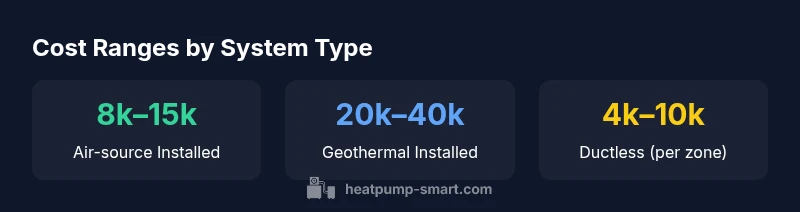
If you’re wondering about the exact figure, remember that the price is a range rather than a fixed number. Regional differences, contractor availability, and the specifics of your home’s insulation and air sealing all influence final quotes. A typical Canadian home might see air-source installations in the CAD 8,000–15,000 range, while geothermal installations commonly run higher, often CAD 20,000–40,000. The Heatpump Smart analysis emphasizes that the most accurate estimates come from local quotes that consider your home’s unique features.
What influences total cost and value
Costs fall into several buckets, each with its own impact on the bottom line. Equipment price is the start, but installation—especially ductwork, electrical upgrades, and controls—often determines the final number. Climate plays a role: in colder parts of Canada, a heat pump’s performance and size must be tuned for efficiency, which can raise both equipment and installation costs. Home age and insulation level affect how well the system works and what retrofits might be necessary to avoid heat loss. Finally, the quality of the installation matters: a precise refrigerant charge, proper sealing of ductwork, and a well-placed outdoor unit can prevent future service calls and energy waste.
For homeowners, the longer the payback period, the more critical it becomes to factor rebates and energy-price trends into the calculation. Rebates can substantially shorten the effective payback, but program availability varies by province, territory, and year. Heatpump Smart notes that diligent pre-quote checks, including energy modeling or a quick home assessment, can make quotes more comparable and help reveal hidden costs before signing.
Equipment options: air-source vs geothermal vs ductless
Air-source heat pumps are the most common choice for Canada’s diverse climates. They typically provide a good balance of upfront cost, efficiency, and ease of installation, making CAD 8,000–15,000 a feasible range for many households when installed with existing ductwork. Geothermal systems deliver high efficiency and very low operating costs, especially in extreme cold; however, their upfront price is substantially higher, often CAD 20,000–40,000 or more, due to trenching or boreholes and longer installation times. Ductless mini-splits offer flexibility for homes without ductwork and can be installed gradually by zone, with per-system costs commonly CAD 4,000–10,000. Each option has different payback timelines and maintenance profiles, so a careful life-cycle cost comparison is essential.
Installation costs, warranties, and long-term value
Beyond the sticker price, installation costs reflect site preparation, electrical upgrades, thermostat automation, and in some cases, environmental compliance work. A high-quality installation reduces the risk of refrigerant leaks, uneven cooling, and short cycling, all of which can undermine the system’s efficiency. Warranties differ by brand and installer; a longer manufacturer warranty paired with a reputable installer often translates to fewer unexpected repair costs later. When evaluating quotes, request a breakdown that itemizes equipment, labor, permits, and any required renovations. This transparency makes it easier to compare apples to apples and ensure your investment delivers the expected energy savings over time.
Rebates, incentives, and financing options in Canada
Federal and provincial programs can substantially improve the economics of a heat pump project. Availability, eligibility, and application steps vary, but rebates often target higher-efficiency models and complete home retrofits. Financing options, sometimes bundled with the rebate, can spread costs over several years with manageable monthly payments. Since programs change, it’s wise to confirm current incentives before finalizing quotes. Heatpump Smart recommends pairing a rebate strategy with a pre-inspection to maximize energy savings and reduce the total cost of ownership.
How to estimate your total cost for a specific home
Start with a baseline estimate for your home size, climate zone, and existing heating system. Gather at least three quotes that include a detailed breakdown: equipment price, installation labor, ductwork or electrical work, permits, and any necessary upgrades (e.g., insulation or sealing). Factor in ongoing operating costs based on your local electricity rates and weather patterns. Don’t forget to account for potential rebates—these can significantly affect the net investment and the payback period. A conservative approach is to model best-case and worst-case scenarios to understand the financial risk and return.
Practical tips to reduce upfront costs without sacrificing value
- Bundle projects (insulation, air sealing) with heat pump installation to maximize energy savings and rebates.
- Choose a proven model with high efficiency ratings, but avoid paying for features you won’t use.
- Schedule projects during mild weather to reduce labor downtime and potential delays.
- Request quotes that include a commissioning checklist to verify performance after installation.
- Plan for future needs (additional zones, smart controls) to minimize future retrofits.
Cost and payback ranges by system type in Canada, 2026
| System Type | Avg Installed Cost (CAD) | Typical Payback (years) | Notes |
|---|---|---|---|
| Air-source heat pump | CAD 8,000–15,000 | 6–12 | Popular choice for Canada; good balance of cost and performance |
| Geothermal heat pump | CAD 20,000–40,000 | 10–20 | High upfront; very efficient; best for cold climates |
| Ductless mini-split (per zone) | CAD 4,000–10,000 | 5–10 | Flexible for homes without ductwork; zone control |
Your Questions Answered
What factors affect the price of a heat pump in Canada?
System type, home size, climate, ductwork needs, and installation complexity drive the price. Equipment quality, efficiency, and warranty also influence the total cost. Always compare quotes that break down these components for a true apples-to-apples comparison.
Price is driven by system type, home size, climate, ductwork, and install complexity. Compare quotes with clear breakdowns.
Are rebates available for heat pumps in Canada?
Yes, rebates exist but vary by province and year. Eligibility depends on efficiency, installation scope, and location. Check provincial and federal programs when budgeting and plan quotes around current incentives.
Yes—rebates exist, but the details vary by where you live. Check local programs.
Is geothermal cheaper to operate than an air-source heat pump?
Geothermal systems typically have lower operating costs due to higher efficiency, but upfront costs are higher. Payback periods can be longer unless rebates and energy prices align favorably.
Geothermal saves more on operation, but costs more upfront.
Can I finance a heat pump installation?
Many installers offer financing plans, and some lenders provide special programs for energy upgrades. Rebates can sometimes be applied at the point of sale to reduce the loan amount.
Yes, financing is often available with rebates helping.
How long does installation typically take?
Most single-system installations take one to three days, depending on ductwork, wiring, and permits. More complex retrofits can extend installation time.
Most installs take a few days, depending on work ahead.
What should I ask my contractor before installation?
Ask about permits, expected efficiency ratings (SEER/HSPF), warranties, system sizing, and the commission process. Request a written, itemized quote and a post-installation performance check.
Ask about permits, warranties, and quotes. Get it in writing.
“Upfront costs can be daunting, but a heat pump delivers reliable comfort and lower operating costs over time. The Heatpump Smart Team notes that rebates and energy savings shorten the payback period for many Canadian homes.”
Top Takeaways
- Get multiple quotes to compare.
- Rebate eligibility can dramatically reduce net cost.
- Air-source is the most common starting point in Canada.
- Geothermal offers long-term savings but has higher upfront costs.
- Plan for installation complexity and insulation needs.