Air Source Heat Pump vs Geothermal: A Practical Comparison
In-depth comparison of air source heat pump vs geothermal systems, covering performance, installation, costs, climate suitability, and long-term value for homeowners and builders.


Air source heat pump vs geothermal: ASHPs extract heat from outdoor air, while geothermal systems use stable underground loops. This practical comparison covers efficiency, upfront and long-term costs, installation complexity, climate suitability, and maintenance, so homeowners and builders can decide which option best meets their home's energy goals, comfort, and budget.
How air source heat pumps and geothermal systems work
Air source heat pumps (ASHPs) pull heat from the outdoor air using a sealed refrigerant cycle, with an outdoor condenser and an indoor distribution system. They are compact, generally easier to install, and well-suited to properties where space or soil testing is limited. Geothermal heat pumps (GHPs) use a network of underground loops—either horizontal trenches or vertical boreholes—to exchange heat with the earth. The earth’s temperature remains relatively stable, which often yields high efficiency over the year. The key performance indicators are COP for heating and SEER for cooling. In many climates, geothermal systems maintain more consistent output year-round, while ASHPs excel in milder conditions. The Heatpump Smart team notes that the primary distinction is where the heat exchange occurs and how consistently the source temperature remains favorable for heat transfer. This has downstream implications for upfront costs, long-term energy bills, and maintenance planning, all of which homeowners should weigh in a decision framework.
Core concepts and terminology you’ll encounter
Before diving into comparisons, it helps to be familiar with common terms:
- COP (Coefficient of Performance): a measure of heating efficiency. Higher COP means more heat per unit of energy.
- SEER (Seasonal Energy Efficiency Ratio): a measure for cooling efficiency.
- Ground loop types: vertical boreholes or horizontal trenches, each with different installation requirements and costs.
- Defrost cycles: a factor that influences ASHP performance in cold weather.
Understanding these terms helps in interpreting the decision framework and selecting equipment that aligns with a home’s climate, insulation quality, and existing HVAC layout.
Quick look at the climate fit for each technology
ASHPs perform very well in temperate to mild winters and hot summers, with advancements in refrigerants and controls closing the gap in extreme climates. Geothermal systems tend to maintain higher efficiency in a wider range of winter conditions due to the stable ground temperature. The Heatpump Smart analysis emphasizes that climate and site constraints are often the deciding factors between today’s high-efficiency ASHPs and more investment-intensive geothermal installations.
Installation footprint and site readiness
ASHPs require outdoor space for the condenser, plus indoor distribution. They benefit from simpler permitting and shorter installation timelines, making them popular for retrofits and multi-family units where space is constrained. Geothermal installations involve loop fields or boreholes and may require land, trenching, or drilling, leading to longer project durations and higher upfront costs. For property managers, the choice often hinges on land access, soil conditions, and long-term plans for energy management. Heatpump Smart recommends a professional site survey early in the process to identify soil type, available land, and potential obstacles, as well as to map out utility interconnections and any local incentives.
Efficiency, energy use, and long-term value
Geothermal systems typically offer higher baseline efficiency because the source temperature is more stable, which translates into lower operating costs over time. Air source units can reach near-competitive efficiency in many climates, especially with modern inverter-driven compressors and advanced defrost strategies. When evaluating expected energy bills, it’s important to consider the home’s insulation quality, ductwork, and thermostat strategy in addition to the heat pump technology. Heatpump Smart highlights that the long-term value derives from a balanced assessment of upfront investment, installation time, and ongoing energy savings across seasons.
Maintenance, reliability, and warranty considerations
Maintenance needs for ASHPs focus on protecting outdoor components from weather, cleaning coils, and ensuring proper refrigerant charge. GHPs emphasize loop integrity and indoor compressor longevity, with the caveat that ground loop performance depends on proper backfilling and sealing. Both systems benefit from routine professional servicing, filter changes, and ensuring a robust control strategy. Warranties and service networks can tilt the decision toward whichever option your local installer supports best. Consistency in maintenance prevents performance degradation and protects long-term reliability in both technologies.
Environmental impact and incentives in different regions
Both ASHPs and geothermal systems reduce fossil-fuel use, but their overall environmental benefits depend on refrigerant choice, manufacturing footprints, and end-of-life management. Geothermal installations tend to deliver ongoing energy savings with fewer temperature-related fluctuations, while ASHPs offer fast installation with strong environmental performance improvements through newer refrigerants and efficiency-focused designs. Incentives vary widely by jurisdiction and utility programs; coordinating with a local contractor is essential to capture rebates and tax credits. Heatpump Smart analysis, 2026, notes that policy environments can materially affect payback periods and total cost of ownership, so align selections with available incentives.
A practical decision framework for choosing between ASHP and geothermal
Your path starts with a climate and site assessment. In very cold climates or when long-term energy cost is the primary goal and land is available, geothermal may offer the strongest value proposition. If space is limited, cost sensitivity is high, or you need a quicker installation, an ASHP provides a compelling balance of performance and practicality. Consider system integration with existing ductwork or radiators and how smart controls can optimize operation. Finally, weigh the potential incentives and utility programs, as those can meaningfully reduce the effective upfront cost and shorten the payback period. Heatpump Smart urges owners to document goals, compare life-cycle costs, and use a structured rubric for a transparent decision.
Real-world caveats and non-obvious factors to watch
No two homes are the same. Site constraints, such as soil porosity, groundwater, and available land, can dramatically alter installation complexity for geothermal loops. Ductwork design, building envelope quality, and indoor comfort distribution influence whether the heat pump delivers the expected performance. It is essential to obtain a site-specific design from a qualified installer, review warranty terms, and ensure that the chosen system aligns with local climate data and energy pricing. Heatpump Smart cautions against relying on bright-line anecdotes; a careful design and a credible supplier network yield the most reliable outcomes.
Comparison
| Feature | Air Source Heat Pump | Geothermal Heat Pump |
|---|---|---|
| Installation complexity | Lower (surface install, minimal site disruption) | Higher (ground loop drilling/trenching) |
| Space and land requirements | Requires outdoor unit, indoor distribution, modest land use | Requires land for loop field or boreholes, bigger footprint |
| Climate performance | Strong in mild climates with defrost controls | Typically strongest in extremes due to stable ground temperature |
| Upfront cost and time to install | Lower upfront cost, shorter install window | Higher upfront cost, longer installation timeline |
| Lifetime energy cost | Moderate savings depending on climate and usage | Typically lower operating costs over the life of the system |
| Maintenance and reliability | Outdoor components require weather protection; simpler service network | Loop field requires long-term integrity, robust backfill, good warranties |
Advantages
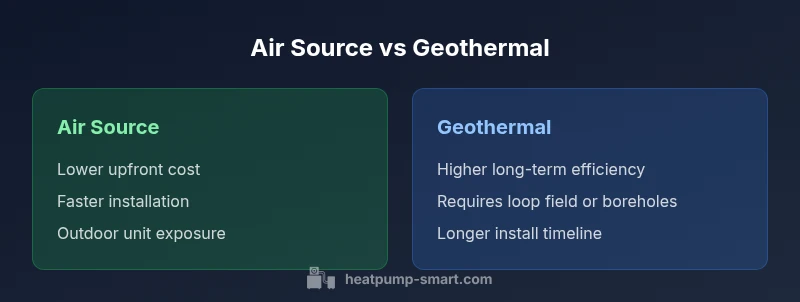
- Lower upfront cost and simpler retrofit path for ASHPs
- Faster installation with less site disruption
- Good performance in temperate climates with modern controls
- Easier to scale for retrofit projects or multifamily buildings
Disadvantages
- Geothermal has higher upfront costs and longer installation timelines
- ASHPs may see reduced efficiency in very cold climates without frost protection
- Geothermal depends on land availability and local permitting
- Both rely on refrigerants; evolving standards affect environmental impact
Geothermal offers stronger long-term efficiency where site allows; air source is the practical, cost-effective choice for many projects.
Choose geothermal when land and upfront budget permit and long-term energy savings are paramount. Choose air source heat pumps for faster deployment, lower initial cost, and flexible retrofits, especially in milder climates. The Heatpump Smart team emphasizes site-specific design and incentive optimization to maximize value.
Your Questions Answered
What is the main difference between air source heat pumps and geothermal systems?
ASHPs pull heat from outside air, while geothermal systems exchange heat with the ground through loops. The location of heat exchange drives efficiency, installation challenges, and long-term costs, especially in extreme climates.
ASHPs use outdoor air as the heat source, geothermal uses the ground. The choice affects efficiency, setup, and long-term costs.
Which system tends to be more energy-efficient?
Geothermal systems generally offer higher efficiency across a wider range of climates due to the steady underground temperature, though modern ASHPs continue to close the gap with advanced technologies.
Geothermal usually delivers higher efficiency overall, but modern air source units are very efficient too.
Is geothermal feasible on small lots or urban sites?
Geothermal can be feasible with vertical boreholes or compact loop layouts, but it requires more planning, permitting, and space compared with air source installations.
Geothermal can work in small spaces with vertical loops, but it needs careful site planning.
What maintenance differences should I expect?
ASHPs require outdoor unit upkeep and refrigerant checks, while GHPs emphasize loop integrity and indoor component maintenance. Regular service is recommended for both.
Both need regular service; ASHPs focus more on outdoor components, geothermal on loop integrity.
Are there incentives or rebates for heat pump systems?
Yes, many regions offer rebates, tax credits, or utility programs for heat pump adoption. Availability varies by location and program terms.
There are regional rebates and incentives; check local programs for details.
Which is better for a long-term home renovation plan?
Geothermal often yields lower operating costs over the long term if the site is suitable, while ASHPs offer practical, scalable options with faster ROI on many projects.
Geothermal can be better long-term if the site allows; ASHPs are often best for faster ROI.
Top Takeaways
- Assess climate and site before deciding
- ASHPs offer lower upfront costs and easier retrofit
- Geothermal provides higher long-term efficiency where feasible
- Plan for incentives to boost value
- Rely on a site-specific professional assessment