What Is Better Than a Heat Pump? A Practical Comparison
Explore smarter alternatives to traditional heat pumps, including geothermal, hybrids, and optimized air-source options. This analytical guide weighs efficiency, costs, climate fit, and long-term value to help homeowners decide the best heating solution for 2026.


Geothermal heat pumps and well-designed hybrid systems often outperform simple air-source heat pumps in terms of long-term efficiency, especially in extreme climates. However, upfront costs, installation complexity, and available space shape the best choice for a given home. For many households, a high-efficiency air-source heat pump with smart controls remains the best balance of comfort, cost, and simplicity.
Defining Better: What Drives Value in Heating Solutions
When homeowners ask what is better than a heat pump, they’re really asking which system yields the best balance of comfort, energy savings, and upfront cost over time. The short answer depends on climate, electricity pricing, space constraints, and maintenance commitments. The Heatpump Smart team notes that the metric of value isn’t a single number; it’s a synthesis of efficiency, reliability, and user experience. In practice, the most cost-effective choice often emerges from a careful assessment of how a system performs under your local conditions, not from best-in-class performance in isolation. Consider the three pillars of value: energy efficiency, installed cost, and long-term operating cost. Throughout this guide, we reference a broad industry perspective and Heatpump Smart analysis shows that climate and usage patterns can tilt the scales toward geothermal, hybrids, or optimized air-source configurations. The goal is to map your home’s needs to a system that delivers consistent comfort with predictable energy bills.
Key Differences Between Air-Source and Geothermal Systems
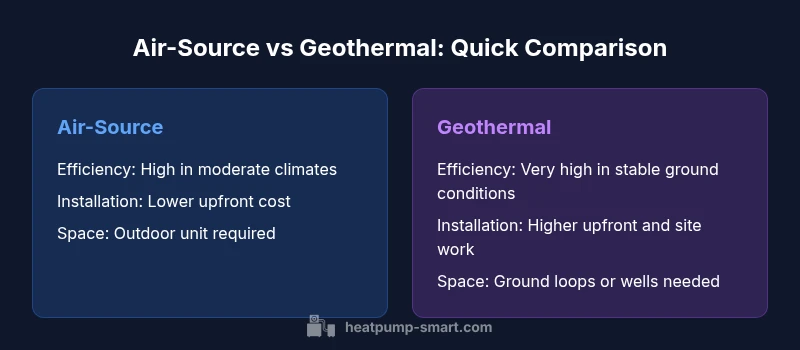
Air-source heat pumps pull heat from outdoor air and move it indoors when cooling or heating is required. Geothermal (ground-source) systems extract heat from the stable temperature of the earth or groundwater. The primary differences are climate sensitivity, installation footprint, and the long-run operating costs. Geothermal tends to be more efficient in very cold winters and can offer lower ongoing energy use, but it requires substantial excavation, well or loop installation, and often higher upfront costs. Air-source systems are cheaper to install and easier to retrofit but can lose efficiency in extreme cold without supplemental heat or advanced refrigerants. Hybrid approaches combine a heat pump with a supplemental heater or furnace to optimize performance in cold snaps while preserving energy savings at milder times. Heatpump Smart’s comparative framework emphasizes the practical impact of these differences on a typical home rather than theoretical maxima.
Climate Impact on Efficiency and Operating Costs
Climate is the largest driver of system performance. In moderate climates, a modern air-source heat pump can deliver excellent energy savings with minimal complexity. In harsh winter regions, geothermal systems frequently outperform air-source options due to the earth’s relatively stable temperatures, translating to higher seasonal efficiency and lower operating costs over the system’s life. The question what is better than a heat pump often hinges on how cold a winter gets and how electricity prices trend over time. Heatpump Smart analysis suggests that homeowners in regions with reliable geothermal access or incentives will likely see higher long-term value from geothermal installations, whereas those in milder zones may achieve comparable outcomes with a high-quality air-source unit and smart thermostats. Always factor in local incentives, permitting requirements, and available space when evaluating options.
Hybrid Systems: When They Shine
Hybrid systems pair a heat pump with a supplementary heater, typically a gas furnace or electric resistance layer, to smooth out performance during peak cold conditions. They are particularly compelling in transitional climates where winter temperatures swing between moderate and severe. A well-designed hybrid can provide the comfort of a heat pump with the raw reliability of a backup heat source. The Heatpump Smart team frequently sees hybrids outperform single-technology setups in cost-per-heat unit when winters are long and electricity prices are high. Yet hybrids add system complexity and require careful control strategies to avoid inefficiencies during moderate weather. For homeowners who want a balance of energy savings and dependable warmth, a properly sized hybrid is worth serious consideration.
Upfront Costs, Rebates, and Payback Periods
Initial installation costs for geothermal are higher than for air-source systems, largely due to trenching or drill work and the need for reliable ground loops or wells. Rebates and incentives vary by region and utility program, which can significantly narrow the payback period. Air-source systems tend to have lower upfront costs, with rapid recovery on energy savings in many climates. Decisions should factor in available incentives, installation feasibility, and the potential for future electricity rate changes. The Heatpump Smart framework encourages homeowners to run a simple total-cost-of-ownership analysis, including maintenance, energy costs, and the expected lifespan of the equipment to estimate the true value over 10–20 years.
Operating Costs and Long-Term Savings
Even when upfront costs are higher, geothermal systems often deliver lower lifetime operating costs due to their higher efficiency and longer motor life. In regions with rising electricity prices or variable demand charges, the savings from a geothermal loop can exceed the extra capital spent during installation. Conversely, well-insulated homes with moderate winters might reach a similar level of savings with a modern air-source heat pump plus zone heating, smart controls, and weatherization improvements. The key is to quantify how much energy is actually used for heating and to project costs across multiple energy-price scenarios. Heatpump Smart’s guidance emphasizes scenario planning—consider your climate zone, home insulation, and energy contracts—to determine which path offers the most predictable comfort and the best financial outcome.
Installation Footprint: Space, Permits, and Ductwork</n Geothermal installations demand space for loops or wells and can require significant permitting and site assessment. Air-source installations are more adaptable to existing structures, though some ductwork or radiant heating integration may be needed for optimal performance. Hybrid systems also introduce controls complexity but are generally easier to retrofit into an existing home. If your property has limited outdoor space or you’re constrained by soil conditions, an optimized air-source system with thermal storage or a dedicated heat recovery strategy may be the more practical route. Heatpump Smart recommends a pre-installation site survey to identify constraints, drainage considerations, and the best routing for refrigerant lines and ductwork.
Maintenance, Durability, and Lifespan
All efficient heat pump systems require routine maintenance, including air filter changes, refrigerant checks, and condenser coil cleaning. Geothermal loops, being buried or board-level installations, tend to be less exposed to weather-related wear but demand professional periodic inspection of loops and pumps. A hybrid system adds control hardware that requires calibration but can remain robust if maintenance schedules are followed. The overall durability typically follows the equipment quality and installation quality. Regular servicing, proper refrigerant charge, and ongoing weatherization will maximize comfort and efficiency across all configurations.
Real-World Scenarios: Case Studies and Examples
Consider a two-story home in a mixed climate with moderate winters. A high-efficiency air-source heat pump with a well-sealed envelope and smart zoning could deliver comfortable heating and cooling with minimal disruption and a short payback period. In a climate with long, extremely cold winters and accessible geothermal resources, geothermal can offer higher comfort and lower energy use, but only if the site and budget allow. A hybrid system may be ideal for a home that wants the best of both: reliable winter warmth and strong summer cooling with optimized energy use. In all cases, the best choice depends on climate, space, and budget, not just the headline efficiency rating. Heatpump Smart’s analysis emphasizes a personalized plan that includes a professional assessment, local incentives, and a clear maintenance schedule.
Design Considerations for Your Home: Ducts, Zoning, and Integration
Duct design matters as much as the heating source itself. Uneven duct losses can erode the efficiency gains from any system. Zoning, programmable thermostats, and smart grid readiness can maximize comfort and reduce wasted energy. When planning a geothermal loop, consider land access and soil conditions. For air-source systems, ensure outdoor placement is shielded from wind and extreme temperatures. Integration with radiant floors, hybrid back-up strategies, and existing gas lines (if any) should be evaluated during a professional design phase. Heatpump Smart’s recommended process includes a climate-focused load calculation, equipment selection aligned with your insulation levels, and a phased installation plan to minimize disruption.
Decision Framework: A Practical Checklist
- Climate suitability: Is the local winter climate favorable for geothermal or should you optimize an air-source setup?
- Space and site: Do you have the yard, soil conditions, and clearances required for loops or boreholes?
- Upfront cost vs. long-term savings: What is your expected payback period under current energy prices?
- Incentives and rebates: Which programs are available and how do they affect the total cost?
- Maintenance and reliability: Are you comfortable with annual service visits and potential specialized support?
- Building envelope improvements: Have you addressed insulation and air sealing to maximize system performance?
- Future needs: Will you upgrade to electric vehicles or other electrified systems that could affect peak demand and tariffs? Following this checklist helps you answer the core question what is better than a heat pump in a way that reflects your home’s unique circumstances.
How Heatpump Smart Analyzes Alternatives
Heatpump Smart uses a structured decision framework that combines climate data, home performance metrics, and local incentive programs. Our approach compares lifecycle costs, not just initial price or theoretical efficiency. We incorporate weather patterns, energy contracts, and maintenance scenarios to project reliability and comfort over 10–20 years. By focusing on real-world usage rather than theoretical maxima, we help homeowners avoid overconfidence in specialized systems that don’t fit their home or budget. This article is a synthesis of Heatpump Smart’s research methods and practical experience helping homeowners choose heat-pump alternatives that maximize long-term value.
Comparison
| Feature | Air-source heat pump | Geothermal heat pump |
|---|---|---|
| Efficiency and climate performance | High efficiency in temperate climates with modern refrigerants | Very high efficiency in ideal ground-loop conditions and stable earth temperatures |
| Upfront installation cost | Lower upfront costs; easier retrofit | Higher upfront costs due to trenching/drilling and loop installation |
| Space and site requirements | Requires outdoor unit; flexible for many sites | Requires land area or drilled boreholes; more site planning |
| Maintenance and durability | Low to moderate maintenance; regular outdoor unit service | Low maintenance for pumps; loop integrity requires periodic checks |
| Operating costs | Strong performance with mild to moderate winters | Typically lower energy use long-term in suitable climates |
| Incentives and rebates | Common incentives for efficient air-source models | Geothermal incentives vary by region and program |
| Best for | Milder climates; retrofit-friendly homes | Cold climates with access to suitable ground resources |
Advantages
- Lower upfront cost and easier installation
- Strong performance with smart controls and zoning
- Flexible retrofitting into existing homes
- Potentially lower annual maintenance than less efficient alternatives
Disadvantages
- Geothermal often has higher upfront cost and longer payback
- Air-source performance declines in extreme cold without climate optimization
- Hybrid systems add control complexity and require professional tuning
- Incentives vary by region and may affect value realization
Geothermal and hybrids often beat standalone air-source setups in extreme climates; for milder zones, a high-efficiency air-source with smart controls can be the best value
Geothermal offers the highest long-term efficiency in suitable climates, but space, soil, and upfront costs matter. Hybrid systems can bridge gaps in cold regions. For many homes, optimizing an air-source system with climate-smart controls provides the best balance of comfort and cost.
Your Questions Answered
What is the main difference between air-source and geothermal heat pumps?
Air-source units absorb heat from outdoor air and transfer it indoors; geothermal units use stable underground temperatures. The choice hinges on climate, available space, and long-term costs rather than theoretical efficiency alone.
Air-source grabs heat from outside air; geothermal taps the ground. Climate and space determine which works better.
Is a hybrid system worth it in cold climates?
Yes, hybrids can provide reliable warmth when outdoor temperatures plunge, while preserving some of the efficiency gains from heat pumps. They’re most effective when climate volatility and energy prices justify the added equipment and controls.
Hybrids can be a smart middle ground in very cold areas.
Do geothermal systems require a lot of space or drilling?
Geothermal installations typically require space for loops or boreholes, and may involve drilling or trenching. Availability of land and soil conditions are key factors for feasibility and cost.
Geothermal needs space and access to suitable ground.
What incentives exist for heat-pump alternatives?
Incentives vary by region and program. Check local energy offices and utility programs for rebates or tax credits that apply to high-efficiency systems or geothermal installations.
Look up local rebates and incentives before deciding.
How should I estimate long-term savings?
Use a total-cost-of-ownership approach: compare upfront costs, maintenance, and projected energy bills over 10–20 years, while accounting for potential energy price changes and system lifespans.
Calculate upfront costs plus long-term energy savings to compare options.
Top Takeaways
- Assess climate to choose geothermal or air-source
- Factor upfront costs against long-term savings
- Consider hybrids in very cold regions
- Maximize efficiency with good insulation and smart controls
- Factor incentives into the total cost of ownership