Geothermal heat pump vs air source heat pump: A Comprehensive Comparison
Comprehensive analysis of geothermal heat pumps vs air source heat pumps, covering how they work, climate performance, installation, costs, and long-term value for homes, builders, and managers.


Geothermal heat pumps generally deliver higher, more consistent efficiency than air-source units, especially in cold weather. They use ground loops to access stable underground temperatures, reducing seasonal energy swings and overall consumption. Air-source heat pumps are cheaper to install and retrofit, but their performance can drop in very cold climates, making geothermal a stronger long-term value in many homes.
What geothermal heat pump vs air source heat pump? Definitions and the big picture
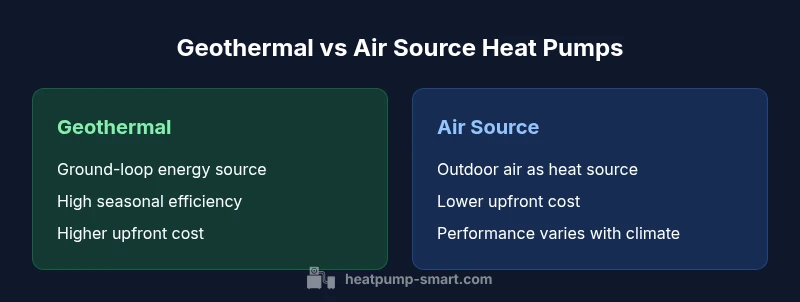
Geothermal heat pump vs air source heat pump is a classic engineering decision for homes and small commercial buildings. This section defines the two main approaches and highlights the decision axes that homeowners, builders, and property managers use to gauge value. Heat pumps move heat rather than generate it, so the efficiency and reliability depend on how heat is captured. According to Heatpump Smart, geothermal systems leverage stable underground temperatures to maintain high efficiency year-round, while air source systems rely on outdoor air and must cope with seasonal extremes. The result is a fundamental trade-off: geothermal offers steady performance and long-term energy savings in exchange for more complex installation, whereas air source offers flexibility and lower upfront costs but greater climate sensitivity. With this context, the rest of the article compares them on climate, installation, and lifecycle costs, so you can make an informed choice for your project.
How geothermal heat pumps work: ground loop fundamentals
Geothermal heat pumps (also called ground-source systems) rely on a buried loop field to exchange heat with the earth. Closed-loop configurations circulate a refrigerant or antifreeze solution through horizontal trenches, vertical boreholes, or shallow wells, where temperatures remain relatively constant. The pump compresses heat from the ground into the building in winter and transfers heat back into the ground during summer. Because the source temperature stays relatively stable, geothermal systems tend to maintain high efficiency and smooth operation regardless of outdoor weather. Regulatory considerations, drilling or trenching, and land area influence feasibility, but where space and incentives align, the loop field becomes a durable backbone for heating and cooling.
How air source heat pumps work: extracting heat from outdoor air
Air source heat pumps (ASHPs) pull heat from outdoor air via an outdoor coil, then compress and circulate it indoors to heat or cool spaces. Modern ASHPs often incorporate advanced defrost cycles to prevent frost buildup and to maintain performance in cool-to-moderate climates. Because the heat source is the ambient air, performance can fluctuate with outdoor temperatures, particularly in very cold weather or extreme heat. ASHPs are well-suited to retrofit projects and tight urban sites where drilling or trenching for geothermal loops isn’t feasible, and they typically require less upfront land and permitting.
Climate Performance: efficiency, COP, and seasonal considerations
Efficiency for heat pumps is commonly described by COP (Coefficient of Performance) and seasonal variations. Geothermal systems generally sustain a higher COP across seasons due to the steady ground temperature, leading to more predictable energy use. Air source units, while highly efficient in moderate climates, show greater variation as outdoor temperatures swing. In areas with long, cold winters, geothermal performance advantages become more pronounced, supporting steadier comfort with lower energy draw. In milder climates, a well-sized ASHP can rival geothermal in annual energy use while offering faster install times and lower initial costs.
Installation realities: space, site, and upfront costs
The installation footprint for geothermal heat pumps is typically larger and more site-dependent than for air source systems. Geothermal requires space for ground loops, access to boreholes or trenches, and often more permitting or environmental reviews. In new construction, a properly designed loop field can be integrated with the foundation plan. Retrofit projects may face land-area constraints or soil conditions that affect feasibility and cost. Air source heat pumps usually need outdoor space for a compressor unit and an indoor air handler; roof mounting or balcony placement is common in apartments and townhomes. The upfront cost delta favors ASHPs in most retrofit projects, while geothermal dependencies on ground access drive higher initial investment but potentially lower operating costs over the system’s life.
Operating costs and energy savings: what to expect
Operational costs hinge on local electricity prices, climate, and system efficiency. Geothermal heat pumps tend to deliver lower energy use per square foot due to their stable heat source, which can translate into lower monthly bills over time, especially in heating-dominated seasons. Air source heat pumps still offer strong efficiency and can be cost-effective where installation constraints or land use limit geothermal. Maintenance costs for both are relatively modest when compared to fossil-fuel alternatives, but geothermal systems often feature longer service intervals for the underground components and fewer refrigerant cycle concerns inside the living space. In practice, the long-term cost advantage of geothermal rises when energy prices are volatile and you expect to stay in the home or building for many years.
Durability, reliability, and maintenance
Both geothermal and air source heat pumps are designed for long service lives, but the reliability profile differs. Geothermal loop fields and underground components are protected from weather, reducing outdoor wear and most mechanical exposure. Indoor components generally receive routine service, refrigerant checks, and filter changes. Air source units are partially exposed to the elements, making weatherproofing and periodic outdoor maintenance important, but the compact footprint often makes service quick. In terms of resilience, geothermal systems tend to be favored in areas with extreme seasonal swings, while ASHPs excel in installations where space, grading, or emissions regulations constrain coil burial. Heatpump Smart observations suggest that a thoughtful maintenance plan and periodic refrigerant checks are essential for both systems.
Environmental impact and life cycle considerations
Geothermal systems draw heat from the ground and rely on electricity to run the loop pump and compressor, while ASHPs extract heat from outdoor air and require electricity for the compressor. Refrigerants used in both systems have environmental implications, so modern units often use lower-global-warming-potential (GWP) refrigerants and well-sealed leak prevention practices. The environmental advantage of geothermal may be more pronounced in regions with renewable electricity, where reducing peak heating demand can lower overall emissions. For builders and homeowners who target a low-carbon footprint, selecting equipment with efficient performance, properly sized loops, and high-quality refrigerants matters as much as the installation method.
Real-world use cases: when each shines
Geothermal heat pumps shine in climates with long heating seasons and in new builds where a loop field can be incorporated without space constraints. They also perform well in properties seeking very stable indoor temperatures and long-term energy savings. Air source heat pumps excel in retrofit projects, urban settings, and homes where land, drilling, or boreholes are impractical. In mild climates or for smaller spaces, ASHPs can deliver compelling comfort and efficiency with significantly lower upfront costs. Heatpump Smart’s practical guidance emphasizes evaluating site constraints, climate data, and occupancy patterns to select the best fit.
Decision framework: how to choose between geothermal and air source
Use a structured framework to compare options: 1) Define your climate and heating load profile; 2) Assess available land, drilling feasibility, and quiet operation requirements; 3) Estimate total installed cost and long-term energy savings; 4) Check local incentives and utility programs; 5) Consider future remodeling plans and property turnover. Create a simple decision matrix that weights site viability, up-front investment, and expected energy savings. In most cases, geothermal offers higher long-term value if the loop field is feasible and energy price volatility is a concern; ASHPs provide rapid deployment and flexibility for retrofit and budget-focused projects. The final choice should align with your project’s timeline, budget, and long-term property goals.
Key trade-offs and practical takeaways
When choosing geothermal versus air source heat pumps, the crucial factors are climate resilience, site feasibility, and lifecycle costs. If you have space for a loop field and anticipate staying long enough to recoup upfront costs, geothermal often delivers superior long-term value. If your priority is fast installation, lower initial investment, and easier retrofitting, air source heat pumps offer a compelling option. Always verify local codes, incentives, and the availability of qualified installers. Heatpump Smart’s framework emphasizes climate-adaptive design, robust warranties, and a clear plan for maintenance to unlock the full potential of either system.
Comparison
| Feature | Geothermal heat pump | Air source heat pump |
|---|---|---|
| Ground/air source mechanics | Ground-loop closed system with buried loops (geothermal) | Outdoor air collection via heat exchanger (air source) |
| Performance in cold climates | More stable performance with geothermal; less impact from cold outdoor temps | Performance degrades as outdoor temps drop; defrost cycles help but limit extreme cold |
| Installation footprint | Requires land for loops or boreholes; possible permitting | Requires outdoor unit and indoor air handler; easier retrofit |
| Upfront cost | Higher upfront due to drilling/trenching and loop installation | Lower upfront due to minimal excavation and simpler permits |
| Ongoing operating costs | Typically lower energy use and bills due to higher efficiency | Energy costs dependent on climate; efficient but can be higher in cold spells |
| Lifespan and maintenance | Longer system life for loops and equipment with less indoor wear | Similar compressor life; more exposed equipment outdoors |
| Best use case | New builds or remodels with space for a loop field; long-term target | Retrofits in urban settings; limited land and faster installation |
Advantages
- Higher long-term energy efficiency and stable performance
- Longer system lifespan with proper loop maintenance
- Lower sensitivity to seasonal temperature swings
- Strong potential for reduced greenhouse gas emissions when paired with renewables
Disadvantages
- Higher upfront cost due to ground loop installation
- Site feasibility required for loops (land, geology, zoning)
- Longer installation times and scheduling dependencies
Geothermal generally delivers better long-term value when loop feasibility is positive; air source offers flexibility and lower upfront cost.
Choose geothermal if you have suitable land and want stable, efficient heating across seasons. Choose air source for quicker deployment, lower initial costs, and easier retrofits, especially in constrained sites.
Your Questions Answered
What is the main difference between geothermal heat pumps and air source heat pumps?
Geothermal heat pumps draw heat from the ground via buried loops, delivering stable efficiency and lower seasonal variation. Air source heat pumps extract heat from outdoor air and depend more on outdoor temperatures, which can affect performance in extreme weather. The choice depends on site suitability and long-term goals.
Geothermal uses ground loops for steady heat; air source uses outdoor air, so climate and space matter for performance.
Are geothermal systems worth the higher upfront costs?
Geothermal often requires a larger upfront investment for drilling and looping, but can offer lower operating costs over time in heating-dominated climates. If you plan to stay in the property long-term and have suitable land, the payback potential improves. incentives can also influence the overall economics.
Upfront costs are higher, but long-term energy savings and incentives may justify the investment.
Can geothermal heat pumps operate efficiently in very cold climates?
Yes. Geothermal systems exploit stable ground temperatures, which helps maintain high efficiency in cold weather. Air source heat pumps may struggle when outdoor temperatures are very low, though advances in technology have narrowed the gap in moderate climates.
Geothermal tends to perform more reliably in cold weather due to the ground loop.
Do geothermal systems require a lot of land?
Geothermal loops need space for trenches or vertical boreholes, so land area and geology matter. In tight sites, vertical boreholes can minimize footprint but increase drilling cost. If land is limited, ASHPs may be a more practical choice.
Ground loops need space, but boreholes can reduce land needs.
How long do these systems typically last?
Both systems are designed for long service lives when properly installed and maintained. Geothermal loops are especially durable, while the indoor heat pump components have maintenance needs similar to other modern systems.
Both are long-lasting with good maintenance; geothermal loops add durable value.
What incentives exist for upgrading to heat pumps?
Incentives vary by region and utility programs. Look for federal, state, and local rebates, tax credits, and utility-sponsored programs that reduce upfront cost and improve payback for both geothermal and air source systems.
Check local programs and rebates to improve economics.
Top Takeaways
- Assess climate, site feasibility, and budget early
- Geothermal favors long-term energy savings where loops are viable
- Air source excels in retrofit projects and dense urban areas
- Incentives and electricity pricing heavily influence cost-effectiveness
- Plan for maintenance and installer qualifications to maximize performance