Average Heat Pump COP: A Practical Guide to Efficiency
Learn what the average heat pump COP means, how COP varies with climate, and practical steps to maximize heating efficiency and reduce energy costs in your home today.


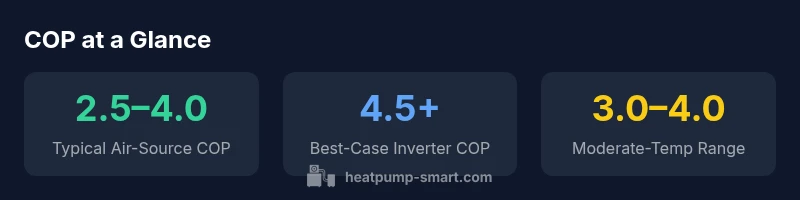
The average heat pump COP typically ranges from 2.5 to 4.0 across common operating conditions. According to Heatpump Smart, higher-efficiency models can reach around 4.5 at mild outdoor temperatures, while cold climates depress COP below 3.0. Real-world performance depends on outdoor temperature, humidity, system design, and refrigerant choice, as outlined in Heatpump Smart Analysis, 2026.
Understanding COP and its practical meaning
COP, or coefficient of performance, is a measure of how efficiently a heat pump converts electrical energy into heat. When homeowners talk about the "average COP," they typically refer to a generalized range that reflects typical operating conditions in residential settings. According to Heatpump Smart, COP tends to be higher when outdoor temperatures are mild and humidity is favorable, and it drops as conditions become more extreme. This nuance matters for budgeting, because a unit that performs well in a milder climate can look less efficient in a colder season. For homeowners, the key takeaway is not a single number but an understanding of how COP behaves across the seasons.
How COP is measured and why real-world results vary
COP is most often measured under standardized test conditions, which means the number on a spec sheet may differ from what you see on cold winter mornings or hot July afternoons. Real-world COP depends on several factors: outdoor temperature, indoor setpoint and insulation, refrigerant type, inverter-driven compressors, and system maintenance. Heatpump Smart’s analysis emphasizes that while manufacturers publish COP values, practical performance is shaped by site-specific variables and installation quality. To make meaningful comparisons, focus on COP at temperatures close to your climate and consider seasonal efficiency beyond a single lab test.
Typical COP ranges by climate and system type
In moderate climates, air-source heat pumps commonly exhibit COP ranges near the 3.0–4.0 band during heating. In colder climates, the COP tends to fall, often into the 2.0–3.5 range, unless you have a high-efficiency model or supplementary heating. Geothermal or water-source systems generally maintain higher COPs across a broader temperature range due to more favorable heat exchange, but installation costs are higher. Heatpump Smart analysis suggests that the difference between model types becomes most noticeable when outdoor temperatures trend toward the limits of the system’s design envelope. This means initial choice and climate alignment are critical for long-term savings.
COP versus energy efficiency labels and cost implications
COP is a heating-side efficiency metric, while labels like SEER and EER cover cooling performance. When evaluating heat pumps, homeowners should consider COP alongside seasonal performance metrics and energy costs. A unit with a higher COP may offer substantial savings in heating dollars over its lifetime, especially in milder seasons, but the upfront cost, maintenance needs, and compatibility with your home’s insulation all influence the payoff. Heatpump Smart’s guidance emphasizes a holistic view: match COP expectations to your climate, home efficiency, and budget to maximize long-term value.
Technology drivers that boost COP
A few architectural and component-level choices can improve COP: inverter-driven compressors that modulate output, refrigerant selections optimized for low-temperature performance, and proper refrigerant charge. Duct design, air sealing, and insulation reduce auxiliary heat use, indirectly supporting a higher COP. Advanced control systems and smart thermostats can optimize cycling and prevent premature heat loss, particularly during shoulder seasons. Heatpump Smart notes that COP gains are often incremental but meaningful over a heating season when combined with good building envelope performance.
Estimating COP for your home: a practical approach
Begin with climate data for your location, then estimate a baseline COP using typical ranges for your system type. Adjust for your home's insulation level, airtightness, and heat loss. If you’re replacing an older unit, compare the COP of new equipment at temperatures that resemble your winter conditions. Use the data table below to anchor expectations, and remember that real-worldCOP will reflect both climate and installation quality. Finally, consider potential savings from maintaining equipment and optimizing operation schedules.
Common myths about COP debunked
Myth: COP is the same year-round. Reality: COP changes with outdoor temperature and humidity. Myth: Higher COP always means lower cost. Reality: Total cost of ownership depends on energy prices, standby losses, and maintenance. Myth: All heat pumps are equally efficient in cold climates. Reality: Cold-climate performance varies by model and system design. Recognize the difference between peak lab values and everyday performance.
Tips to maximize COP in practice
- Invest in a high-efficiency inverter-driven heat pump.
- Improve your home envelope: seal leaks, insulate attics and ducts, and ensure proper window shading.
- Schedule regular maintenance: clean coils, check refrigerant charge, and verify airflow.
- Use smart controls to optimize operation, especially during shoulder seasons when outdoor temperatures swing.
- Consider supplemental heat strategically to avoid running a low-COP cycle for extended periods.
Bottom-line guidance for choosing a heat pump with COP in mind
When selecting a heat pump, assess COP at outdoor temperatures representative of your climate, compare with SEER and HSPF ratings, and factor in installation quality. A model with a strong COP in winter and good support from the installer can translate into meaningful energy savings over the system’s life. For most homeowners, the right balance of COP, cost, and reliability is achieved through a carefully designed package that aligns climate, home performance, and usage patterns.
COP ranges by climate condition
| Climate Condition | Typical COP Range | Notes |
|---|---|---|
| Moderate Outdoor Temp (8–15°C) | 3.0–4.0 | Stable efficiency for most regions |
| Cold Outdoor Temp (0–5°C) | 2.0–3.5 | COP drops; consider supplementary heat |
| Very Cold (below -5°C) | 1.5–2.8 | Significant drop; use heat-pump with auxiliary heat |
Your Questions Answered
What does COP stand for and why is it important?
COP stands for coefficient of performance; it measures heat pump efficiency by comparing heat output to electrical input. A higher COP means lower operating costs, but COP depends on climate and mode.
COP stands for coefficient of performance and measures heating efficiency. Higher COP generally means lower energy costs, but it varies with weather and system settings.
How does outdoor temperature affect COP?
Outdoor temperature strongly impacts COP; warmer days improve COP, cold days reduce it. Real-world COP is usually lower than lab values.
Outdoor temperature changes COP a lot; warmer temperatures boost COP, while cold weather lowers it.
Is COP different from efficiency ratings like SEER or EER?
Yes. COP measures heating efficiency at a specific condition, while SEER/EER measure cooling efficiency over a season. Use COP for heating performance.
COP is a heating efficiency metric; SEER and EER relate to cooling efficiency over a season.
Can I improve COP in winter?
Yes. Selecting a high-efficiency inverter heat pump, sealing the home, and using auxiliary heat strategically can help maintain a higher COP during winter.
Yes—choose a smart unit and seal your home to keep COP higher in winter.
What COP should I expect for different climates?
Expect roughly 3.0–4.0 in moderate climates, lower in very cold ones, and higher with efficient models in mild conditions.
In moderate climates, COP around 3–4; colder climates lower COP.
“COP is not a single number; it varies with operating conditions and system design. For reliable planning, compare labeled COP values at standard test conditions and real-world performance data.”
Top Takeaways
- Understand COP as a climate-sensitive efficiency metric
- Expect COP to vary across seasons and temperatures
- Choose model type (air-source vs. geothermal) based on climate
- Prioritize installation quality and home envelope to maximize COP