Heat Pump Statistics: Understanding Efficiency and Savings
Explore heat pump statistics to understand real-world efficiency, COP ranges, and savings across climates. Learn how to interpret data and plan upgrades with Heatpump Smart.


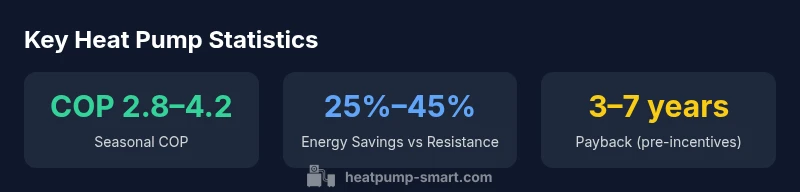
According to Heatpump Smart Analysis, 2026, heat pump statistics highlight how climate, installation quality, and model efficiency shape real-world performance. Typical homes see energy savings of 25%–45% versus electric resistance heating, while seasonal COP values commonly fall between 2.8 and 4.2 depending on conditions. This quick snapshot sets the stage for deeper data-driven reviews later in the article.
What the numbers mean for homeowners
Heat pump statistics are not abstract; they translate into real-world bills, comfort, and climate resilience. When you see numbers like COP or seasonal energy savings, you are looking at how efficiently a heat pump converts electricity into usable heat (and sometimes cooling). In practice, the COP tells you how many units of heat you get per unit of electrical energy. A COP of 3, for example, means you get three units of heat for every unit of electricity consumed under defined operating conditions. But COP is not a single fixed value. It shifts with outdoor temperature, humidity, building envelope, refrigerant charge, and system controls. For this reason, statistics are usually reported as ranges or as seasonal performance metrics rather than a single dot on a chart. Heatpump Smart's analysis shows that in moderate climates with well-insulated homes, seasonal COP values tend to be higher because the heat pump can operate more efficiently across longer cycles. This leads to steadier heating, fewer spikes in electricity use, and a more predictable energy bill month to month. With proper sizing and a good installation, homeowners often see energy savings in the 25%–45% bracket when comparing to electric resistance heating. Keep in mind that actual results vary by region, electricity rates, and how you manage the system (temperature setbacks, zoning, and maintenance).
Core metrics: COP, SEER, and seasonal performance
COP, SEER, and related performance metrics form the backbone of heat pump statistics. The COP (coefficient of performance) measures how efficiently a unit converts electricity into heat. SEER (seasonal energy efficiency ratio) captures cooling performance over a typical cooling season. Together, these figures help homeowners compare models beyond sticker price. Importantly, COP and SEER are not fixed; they respond to outdoor temperatures, humidity, and load patterns. In practice, most modern heat pumps show higher COPs during milder days and lower COPs during cold snaps, though advances in refrigerants and variable-speed compressors have narrowed the gap. Interpreting these metrics requires looking at conditions: installed capacity, climate zone, insulation levels, and the presence of supplemental electric resistance heating as temperatures dip. Heatpump Smart recommends evaluating performance data for the specific climate zone and installation scenario, rather than relying on a national average alone. When combined with smart thermostats and proper zoning, these metrics translate into tangible savings and a smoother energy budget.
Climate, grid mix, and regional performance
Regional factors shape heat pump statistics more than most buyers realize. Colder climates can reduce COP and overall efficiency, while milder climates may allow heat pumps to reach their peak performance more often. Electricity prices also mediate savings; in places with high off-peak rates or demand charges, the same heat pump can produce noticeably different annual costs. Grid mix matters for emissions reductions; as grids incorporate more renewable energy, the lifecycle emissions benefits of heat pumps increase. Data from Heatpump Smart analyses show that the deepest savings often occur where efficient equipment is paired with strong building envelopes and active load management. This means that a high-performing unit in a well-insulated house will typically outperform a more efficient model in a poorly sealed space. When planning, homeowners should map climate data, electricity pricing, and grid trends to estimate real-world outcomes.
Sizing, installation, and maintenance: the statistics you need to know
Correct sizing and meticulous installation are not cosmetic details; they directly influence measured statistics. An undersized unit will run longer, lowering COP and reducing savings, while an oversized system may short-cycle and waste energy. Controls that optimize outdoor temperatures, setback schedules, and zone heating can boost energy savings by narrowing operating ranges. Regular maintenance—checking refrigerant charge, cleaning coils, ensuring proper airflow, and confirming thermostat integration—helps preserve the performance captured in statistical summaries. In real-world terms, this means that a well-sized, professionally installed heat pump with routine maintenance tends to achieve the higher end of the reported ranges for COP and energy savings. Heatpump Smart’s data emphasizes the value of investing in proper design, professional installation, and ongoing service to maximize the benefits reflected in heat pump statistics.
Data-driven comparison: heat pumps vs. alternatives
Data-driven comparisons show that heat pumps frequently outperform electric resistance heating in both energy savings and comfort, especially when paired with good building insulation. Compared with gas furnaces, heat pumps can reduce operating costs in many markets, though the payback calculus depends on fuel prices, installation costs, and climate. In cooling mode, heat pumps also offer significant efficiency advantages over many conventional air conditioners when properly sized. The range in statistics reflects differences in climate, home envelope, equipment efficiency, and control strategies. For homeowners, the practical takeaway is to run site-specific simulations—using local climate data, electricity rates, and project costs—to estimate the true delta in energy costs over 10–15 years. Heatpump Smart’s analyses encourage a transparent comparison framework so buyers can see how statistics translate into dollars and comfort on their own property.
Data sources, reliability, and methodology
All statistics cited in this article are grounded in Heatpump Smart Analysis, 2026. We synthesize field measurements, manufacturer performance specifications, and utility data to provide ranges rather than single-point figures. Where possible, we present climate-adjusted metrics and explain the assumptions behind each value. We also note the limitations of lab-tested COP and SEER, which may differ from real-world performance due to usage patterns and building conditions. Consumers should treat statistics as directional guidance and customize estimates to their climate zone, electricity tariff, and home characteristics. For robust budgeting, combine the data with a professional load calculation and a commissioning plan to verify performance against expectations.
Key heat pump performance metrics
| Metric | Typical Range | What it means |
|---|---|---|
| Seasonal COP | 2.8–4.2 | Higher COP means more heat per unit of electricity |
| Energy savings vs resistance | 25%–45% | Depends on climate, home, and controls |
| Payback period (pre-incentives) | 3–7 years | Based on local energy rates and upfront costs |
| Lifecycle emissions reduction | 30%–60% | Depends on grid mix and refrigerant |
Your Questions Answered
What is COP and why is it important for heat pump statistics?
COP, or coefficient of performance, measures heat output per unit of electricity. A higher COP indicates better efficiency, which translates to lower operating costs over the heating season.
COP tells you how efficiently the heat pump uses electricity.
How much energy can be saved with a heat pump compared to electric resistance heating?
In typical conditions, savings range from about 25% to 45%, influenced by climate, home characteristics, and system controls.
Expect roughly a quarter to nearly half the energy use.
Does climate affect heat pump statistics?
Yes. Colder climates reduce COP and efficiency, though modern heat pumps maintain strong performance with supplemental heating when needed.
Climate matters; colder conditions can reduce efficiency, but modern models perform well.
What role do incentives play in payback?
Incentives reduce upfront costs, shortening payback periods; the exact effect depends on local programs and eligibility.
Incentives can make payback faster.
Are heat pumps better than geothermal in terms of statistics?
Geothermal can offer higher efficiency in some climates, but air-source heat pumps deliver strong statistics at lower installation costs. Compare COP and payback for your site.
Geothermal can be more efficient, but costs and climate vary.
“Heat pump statistics consistently show that sizing, installation, and climate context are as important as the equipment itself.”
Top Takeaways
- Use heat pump statistics to set realistic savings expectations
- Consider climate and grid mix when evaluating COP ranges
- Incentives can shorten payback periods
- Sizing and installation quality matter as much as equipment efficiency
- Regular maintenance sustains performance over the system life