EV Heat Pump vs No Heat Pump: A Thorough Comparison
Explore EV heat pump vs no heat pump, focusing on energy efficiency, costs, climate performance, and installation considerations for homes and electric vehicles.


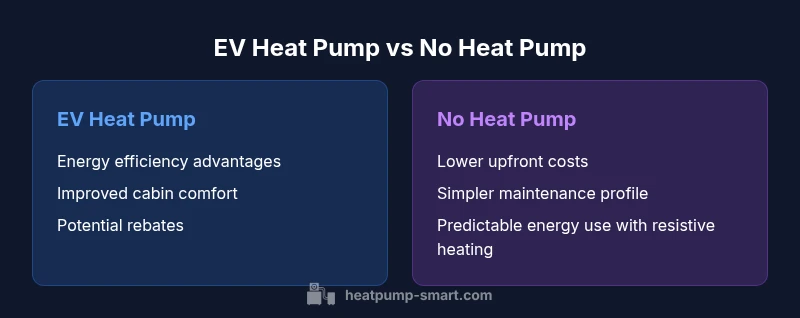
According to Heatpump Smart, the choice between an EV heat pump vs no heat pump hinges on climate, usage, and long‑term energy costs. In most moderate climates, a heat pump delivers meaningful efficiency gains and lower operating costs over time, especially when integrated with smart controls and regular maintenance. The Heatpump Smart team notes that upfront investments can be offset by incentives and future savings, making a heat pump a strong option for many households and EV drivers, but climate and usage patterns still matter. See our detailed comparison chart below.
What ev heat pump vs no heat pump really means for households and EVs
The phrase ev heat pump vs no heat pump captures a broad decision: do you rely on a heat pump to deliver climate control and comfort, or do you rely on traditional electric resistance heating and a simpler system? In the context of vehicles, heat pumps can significantly improve cabin heating efficiency, preserving driving range on cold days. For homes, the same principle applies: heat pumps move heat rather than generate it, yielding better energy efficiency under many conditions. This guide blends home and EV perspectives to help homeowners, builders, and property managers understand when a heat pump makes sense and when alternatives might be preferable. Throughout, we refer to the keyword ev heat pump vs no heat pump and explain how the choice affects energy use, costs, and comfort.
How heat pumps in EVs and homes actually work
Heat pumps transfer heat from one place to another using a refrigerant cycle. In an EV, a cabin heat pump can extract heat from outside air (even when it's cold) and deliver it inside with far less energy than electric resistance heaters. In homes, air-source or ground-source heat pumps perform space heating and cooling with an electrical compressor and refrigerant. The key advantage is higher coefficient of performance (COP) during moderate temperatures, meaning more heat output per unit of electricity than conventional heaters. When you compare ev heat pump vs no heat pump, you’re weighing a system that prioritizes heat transfer efficiency against a simpler electric resistance approach. Heatpump Smart Analysis, 2026, highlights how smarter controls and humidity management further boost perceived comfort and energy efficiency.
Climate and performance: when heat pumps shine and where they struggle
Performance of a heat pump is climate dependent. In mild to cool weather, a heat pump provides substantial energy savings because it can draw ambient heat efficiently. In very cold climates, COP can drop, and supplemental heat may be needed. The ev heat pump vs no heat pump decision therefore often hinges on climate data and usage patterns. For EVs, the driving range impact is a practical consideration: even a small improvement in heating efficiency translates into more usable range on winter trips. For homes, seasonal energy demands and insulation quality determine how pronounced the savings will be. Heatpump Smart’s analysis stresses that pairing a heat pump with proper insulation and smart thermostats yields the best long-term value.
Upfront costs and long-term value: weighing investment against savings
Upfront costs for a heat pump system are typically higher than a traditional electric resistance setup or a non-heat-pump solution. The ev heat pump vs no heat pump comparison often shows a premium for equipment like compressors, refrigerant lines, and controls. However, long-term operating costs tend to be lower due to higher efficiency, particularly when the system is sized correctly and managed with smart controls. In many markets, rebates and incentives reduce the effective upfront price, improving payback periods. The Heatpump Smart team recommends evaluating total cost of ownership over 5–10 years, including maintenance, potential repairs, and the residual value of an efficient system.
Maintenance and reliability: what to expect in practice
Heat pumps introduce additional moving parts and refrigerant circuits compared to purely resistive systems, which means proactive maintenance matters. Typical maintenance includes filter checks, refrigerant integrity checks, coil cleaning, and occasional refrigerant charging if leaks occur. For the ev heat pump vs no heat pump choice, maintenance quality often correlates with reliability and performance. Regular professional servicing can prevent most common issues and extend the system’s life. Many homeowners report quieter operation and more consistent heating with a properly maintained heat pump.
Installation considerations: sizing, placement, and integration
Proper sizing is critical for both EV heating modules and home heat pumps. An undersized system will struggle to meet demand, while an oversized system can waste energy and cause temperature fluctuations. Integration with existing HVAC controls or EV battery systems requires careful planning, wiring, and sometimes a staged installation. For EV users, cabin heating modules must interface with the vehicle’s thermal management system; for homes, indoor air quality and humidity controls matter as much as temperature. The ev heat pump vs no heat pump decision should factor in the availability of qualified installers and the feasibility of retrofits.
Alternatives and when they make sense: a balanced view
The ev heat pump vs no heat pump discussion should also consider alternatives such as electric resistance heaters, hybrid systems, or geothermal heat pumps. In very cold climates, a supplemental heat source might be necessary even with a heat pump. For some properties, a hybrid approach — a heat pump paired with a small auxiliary heater — can offer a practical compromise between cost and performance. When evaluating options, consider insulation, window performance, and load management strategies that can affect overall energy consumption as much as the heating technology itself.
Decision framework and a practical checklist
To decide between ev heat pump vs no heat pump, start with climate data, current energy costs, and indoor comfort priorities. Run a simple scenarios analysis: winter heating burden, EV charging patterns, and potential rebates. Use a checklist: insulation quality, thermostat features, service availability, and warranty terms. Heatpump Smart recommends documenting your goals, estimating energy savings with and without a heat pump, and verifying that your installer follows best practices for refrigerant handling and system commissioning.
Authority and external perspectives: where to learn more
For readers seeking external validation, consult authoritative sources such as Energy.gov, NREL, and EPA guidance on heat pumps and energy efficiency. These sources provide general principles and best practices that align with the ev heat pump vs no heat pump discussion, without prescribing a one-size-fits-all solution. Reference materials from reputable institutions help ensure your decision rests on solid engineering principles as you compare different heating strategies.
Comparison
| Feature | ev heat pump | no heat pump |
|---|---|---|
| Energy efficiency | High efficiency in moderate climates; efficiency gains depend on ambient conditions and controls | Lower efficiency when heating relies on electric resistance; no heat transfer advantage |
| Upfront cost | Moderate to high, depending on integration with vehicle or home systems | Lower upfront if using traditional resistive heating and basic components |
| Operational cost | Lower long-term operating costs with smart control and proper sizing | Higher energy costs due to resistive heating in frequent cold-use scenarios |
| Maintenance | Requires periodic service of refrigeration system and controls | Simpler maintenance profile, fewer refrigerant components |
| Climate suitability | Strong in mild to cool climates; supplemental heat may be needed in extreme cold | Consistent performance in very cold climates is limited without auxiliary heating |
| Noise and comfort | Typically quiet due to heat exchange; comfort enhanced by precise control | Fewer moving parts may result in consistent but less sophisticated comfort control |
| Best for | Homes or EVs with frequent heating needs and a desire to optimize energy use | Budget-conscious setups or areas with extreme cold where heat pump efficiency drops |
Advantages
- Significant energy savings where heating demand is consistent
- Improved occupant comfort with steady, responsive heating
- Potential rebates and incentives reduce effective cost
- Quiet operation and better temperature control when properly sized
- Can increase overall home value when paired with efficiency upgrades
Disadvantages
- Higher upfront cost and more complex installation
- Performance can drop in extreme cold without supplemental heat
- Maintenance requirements for refrigerant circuits and controls
- Retrofit challenges in older properties or comprehensive EV integration
Heat pump integration generally provides better energy efficiency and long-term value, but climate and upfront investment matter.
Choose heat pump if you prioritize energy savings and comfort and can secure incentives. In very cold climates or strict budget scenarios, weigh the need for supplemental heating and long-term maintenance before committing.
Your Questions Answered
What is the difference between an EV heat pump and a home heat pump?
An EV heat pump is designed to heat a vehicle cabin efficiently using ambient heat, while a home heat pump is optimized for space heating and cooling in a building. Both rely on the same heat-transfer principles, but their integration, sizing, and control systems differ due to space constraints and usage patterns.
An EV heat pump heats a car cabin efficiently, while a home heat pump heats or cools a house. They use the same principle, but are designed for different spaces and controls.
Do heat pumps work well in very cold climates?
Heat pumps work well in many cold environments, especially when paired with proper insulation and auxiliary heating. In some extremely cold conditions, performance may drop and a supplemental heat source might be needed. Always check climate-specific guidance when evaluating ev heat pump vs no heat pump options.
Heat pumps can work in cold climates, but you may need some extra heat in very cold days.
Are there incentives for installing heat pumps?
Yes, many regions offer rebates or tax incentives for heat pump installations. Availability and amounts vary by location and program rules. Check local energy offices and utility programs to understand how incentives affect the ev heat pump vs no heat pump decision.
There are often rebates and tax incentives, but they vary by location.
What maintenance does a heat pump require?
Heat pumps require periodic professional servicing, including refrigerant integrity checks, coil cleaning, and system diagnostics. Regular maintenance helps sustain efficiency and reliability in both EV and home applications.
Regular professional servicing keeps heat pumps efficient.
How do I determine if heat pumps are right for my climate?
Evaluate local climate data, insulation quality, and your heating demand profile. A professional assessment can quantify expected energy savings and payback for ev heat pump vs no heat pump in your specific setting.
Get a professional assessment to judge climate suitability.
What signs indicate a heat pump needs service?
Common signs include reduced heating output, unusual noises, ice buildup on outdoor units, or rising energy bills despite stable usage. If you notice changes in performance, schedule a service check promptly.
Watch for reduced heat, odd noises, or ice buildup and schedule service.
Can I retrofit an existing EV with a heat pump?
Retrofits depend on the vehicle model and available space for the heat exchanger and controls. In many cases, retrofits are not feasible or cost-effective, so manufacturers’ integrated solutions are preferred for EVs.
Retrofits are often not feasible; check with the vehicle maker.
Top Takeaways
- Assess climate and heating needs before choosing ev heat pump vs no heat pump
- Heat pumps offer long-term savings but require upfront investment
- Smart controls and proper sizing maximize efficiency gains
- Incentives can dramatically alter payback period
- Plan maintenance to sustain efficiency and reliability