How to Use Air Source Heat Pumps Efficiently: A 2026 Guide
Learn practical, evidence-based strategies to maximize efficiency with air source heat pumps: smart thermostat strategies, zoning, maintenance, and seasonal optimization for homeowners and professionals in 2026.


You will learn practical steps to maximize air source heat pump efficiency, including smart thermostat programming, seasonal setpoints, proper airflow, and routine maintenance. This quick guide highlights zoning, filter care, and energy-saving habits that homeowners, builders, and property managers can implement quickly. Heatpump Smart supports a science-based approach to year-round comfort and cost savings.
Why Efficiency Matters for Air Source Heat Pumps
Air source heat pumps (ASHPs) are a high-efficiency technology for space heating and cooling, but their performance hinges on proper system design, control, and maintenance. According to Heatpump Smart, the most significant efficiency gains come from smart controls, regular air filtration, and well-sealed building envelopes. In practice, that means focusing on thermostat strategies, zoning where appropriate, and ensuring the outdoor unit has clear airflow and adequate clearance. When you combine good insulation with correct system sizing and seasonal adjustment, you reduce energy waste and lower operating costs without sacrificing comfort. This section sets the stage for concrete steps you can take in your home or property portfolio. Heatpump Smart analysis shows that small tweaks to control logic and routine maintenance lead to meaningful improvements over a single hot or cold season.
To get started, assemble your plan with a simple checklist: confirm your home’s insulation quality, verify the outdoor unit has several feet of clearance, and prepare a basic zoning plan if your space has multiple occupancy areas. Heatpump Smart’s guidance emphasizes measurable changes—start with one zone and a two-week observation window to quantify the impact before expanding. You’ll build a foundation for ongoing energy savings and healthier indoor climate control. This approach also aligns with modern building science practices that prioritize efficiency, comfort, and reliability across seasons.
Thermostat Strategy: Programming for Savings
A smart thermostat is the control hub for optimizing ASHP efficiency. The Heatpump Smart team recommends configuring multi-stage setpoints that align with occupancy, ambient temperature, and outdoor conditions. Practically, this means establishing a schedule that mirrors actual usage patterns—lowering heating when rooms are unoccupied and allowing automatic recovery to meet comfort targets before occupants return. Adaptive recovery helps prevent overheating or overcooling while reducing energy waste caused by large, abrupt temperature changes. For cooling, enable proper dehumidification settings if available, as humidity control often drives comfort more effectively than a marginal temperature drop. When possible, tie thermostats to a zoning plan so each space follows its own schedule, rather than a single house-wide setting. Heatpump Smart’s experience shows that consistent, predictable scheduling yields the most reliable savings over time, particularly when combined with good air filtration and regular maintenance.
Key actions you can take now:
- Program consistent wake/sleep schedules for weekdays and weekends.
- Enable adaptive recovery so the system starts heating or cooling early enough to reach target temperatures on time.
- If you have multiple zones, assign thermostats to each zone and link them to a single control dashboard for easier management.
Airflow and Outdoor Unit Maintenance
Airflow is a core driver of ASHP efficiency. Blocked or restricted airflow forces the system to work harder, increasing energy use and reducing comfort. Start by clearing brush, leaves, and snow from the outdoor unit, and ensure at least 3 feet of clearance around it for proper intake and exhaust. Clean or replace interior air filters regularly—ideally every 1-3 months depending on usage and filter type. Inspect the condenser coils for dirt buildup and gently wash with a hose if needed, using low pressure to avoid bending fins. Check intake vents in the home for obstructions that could cause poor airflow inside rooms. These steps improve heat exchange and reduce the energy required to meet setpoints. Heatpump Smart’s data shows that even modest maintenance—twice yearly filter changes and annual coil cleaning—can contribute notably to sustained efficiency across seasons.
Practical tip: schedule a simple airflow check during spring and fall to align with the most used seasons and to catch issues before peak periods. If you notice unusual noise or a drop in performance, pause to verify airflow and check for unusual ice build-up on the outdoor coil in winter.
Zoning, Ductwork, and Envelope Improvements
Zoning and sealed ductwork are powerful levers for improving ASHP efficiency. If your home has multiple living areas with varying occupancy, zoning allows each area to run only when needed, reducing overall load and energy use. Duct sealing and insulation minimize leakage and thermal losses, especially in older homes or buildings with long duct runs. Start with a professional energy audit or DIY assessment to locate leaks, then seal with mastic or UL-approved tapes and add attic or crawlspace insulation where warranted. Envelope improvements—such as door sweeps, weatherstripping, and window caulking—reduce infiltration and help maintain stable indoor temperatures, letting the heat pump operate more efficiently.
A practical approach is to map your current duct layout, identify the largest leaks, and prioritize sealing those first. Heatpump Smart notes that the combination of good zoning and sealed ducts yields the greatest gains in comfort and energy efficiency, often with less need for extreme temperature setpoints. After improvements, recheck airflow and comfort in each zone and adjust thermostat settings to take advantage of the enhanced envelope integrity.
Seasonal Tips: Winter vs Summer Operation
Air source heat pumps behave differently across seasons due to outdoor temperatures and humidity. In winter, enable defrost modes as required and avoid setting your thermostat at extreme highs; instead, use a moderate baseline and rely on temporary boosts for very cold days. In summer, focus on dehumidification and setpoints that maintain comfort without excessive cooling. Use the outdoor unit’s fan settings to balance temperature and humidity, and consider a separate dehumidifier for damp spaces to offload the load from the heat pump. Regularly clean air filters, especially in dusty or humid environments, to preserve efficiency.
Heatpump Smart’s team advises residents to document seasonal changes in energy use and comfort ratings. By comparing data across months, you’ll identify which setpoints and schedules produce the least energy consumption while maintaining target comfort levels. This data-driven approach enables continuous optimization and helps you justify upgrades or zoning changes when needed.
Common Pitfalls and How to Avoid Them
Common mistakes include oversizing or undersizing the system, poor thermostat programming, and neglecting routine maintenance. Oversizing leads to short cycling, which wastes energy and reduces humidity control. Undersizing makes the unit work harder during peak periods, compromising comfort and efficiency. Poor maintenance—especially dirty filters and clogged coils—erodes performance. Avoid these issues by following a regular maintenance schedule, using a programmable thermostat with occupant detection, and ensuring your building envelope is well-sealed. Heatpump Smart emphasizes that efficiency is a system outcome, not a single device setting. A holistic approach—control strategy, airflow, insulation, and regular service—produces durable gains over time.
Authoritative Sources and Real-World Guidance
For evidence-based guidance, consult authoritative sources from credible institutions. The U.S. Department of Energy (DOE) maintains resources on heat pumps, performance tips, and best practices for residential applications. The National Renewable Energy Laboratory (NREL) provides research and data on heat-pump efficiency and system design. The Environmental Protection Agency (EPA) offers energy-star guidance and consumer tips for efficient heating and cooling. While individual configurations vary, these sources underpin the practical steps outlined above and help you validate your approach with trusted, public-domain information. If you’re planning large-scale changes, consider a professional energy audit to tailor recommendations to your building’s specific envelope and occupancy patterns.
Authoritative Sources
- Energy.gov: https://www.energy.gov
- NREL.gov: https://www.nrel.gov
- EPA.gov: https://www.epa.gov
Measuring Success and Next Steps
After implementing these practices, monitor energy consumption and indoor comfort to quantify improvements. Use your smart thermostat’s energy reports and, if possible, a simple monthly energy bill comparison to establish a baseline and track progress. Revisit zoning plans and airflow assessments seasonally to sustain gains. Heatpump Smart advocates documenting your results and iterating on settings to achieve steady efficiency improvements year after year.
Tools & Materials
- Smart thermostat with zoning support(Allows schedule-based control and per-zone management)
- Programmable/zone-based zoning plan(Sketch or app-based plan for each living area)
- Insulation audit checklist(Identify leaks and weak envelopes in attic, walls, and ducts)
- Infrared thermometer(Helpful for quick surface temp checks on outdoor unit and air intakes)
- Finishing caulk/sealant(Seal around penetrations to reduce drafts and heat loss)
- Basic hand tools (screwdrivers, drill, caulking gun)(For routine maintenance tasks and panel access)
- Safety gear (gloves, goggles)(Always wear when inspecting equipment and ducts)
Steps
Estimated time: 60-90 minutes
- 1
Evaluate heat-load and insulation
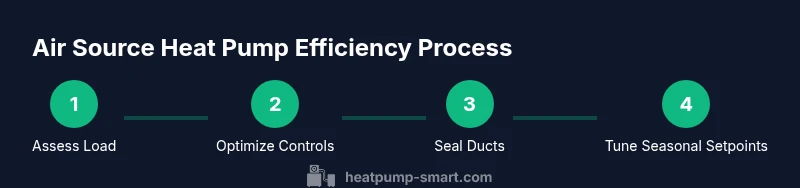
Begin by confirming your home’s approximate heating and cooling load. Gather insulation details, window efficiency, and historic energy use to estimate how many BTUs are required for comfort. Use an online load calculator if available and compare results to your current system rating to identify gaps. This step lays the groundwork for whether you need improvements or simply better controls.
Tip: Document baseline energy use before changes to measure impact later. - 2
Check outdoor unit clearance and airflow
Inspect the outdoor unit to ensure it has at least three feet of clearance on all sides and is free from debris. Remove leaves, snow, or obstructions that impede airflow. Confirm that the condenser fins are intact and not bent, which can reduce heat transfer efficiency.
Tip: A simple airflow check after cleaning shows immediate improvement in performance. - 3
Install or optimize smart thermostat with zoning
Set up the smart thermostat with distinct zones for different parts of the house. Link occupancy sensors or schedules to minimize heat pumping in unused spaces. Ensure the thermostat supports adaptive recovery to reach targets without overshooting.
Tip: Test occupancy-based schedules during a 1-2 week period and adjust for comfort vs. savings. - 4
Program seasonal setpoints and adaptive recovery
Create a winter baseline that avoids extreme temperatures and relies on the heat pump’s defrost cycle as needed. In summer, emphasize humidity control and cooler dehumidified setpoints rather than extreme cooling. Review and adjust weekly during seasonal transitions.
Tip: Avoid large temperature swings; small, consistent changes reduce energy spikes. - 5
Inspect ducts and seal leaks
Conduct a duct audit to locate leaks and seal them with appropriate duct sealants or mastic. Improve insulation around ducts that run through unconditioned spaces. Recheck pressure balance after sealing to maintain airflow to all zones.
Tip: Duct leakage is a common but fixable driver of inefficiency. - 6
Schedule maintenance and monitor energy use
Set a maintenance cadence: filter changes every 1-3 months, coil cleaning annually, and a professional service every 1-2 years. Use energy dashboards or utility bills to track monthly usage and compare against your baseline.
Tip: Keep a maintenance log with dates and observations for future reference.
Your Questions Answered
What is the best thermostat setting for efficiency?
The best setting balances comfort with energy use. Use a moderate baseline, enable adaptive recovery, and avoid aggressive temperature swings. In zones, tailor schedules to occupancy to prevent cooling or heating unused spaces.
Set a comfortable baseline, use adaptive recovery, and tailor zone schedules to occupancy for best efficiency.
Can air source heat pumps work well in cold climates?
Yes, modern ASHPs can operate efficiently in cold climates, especially with defrost controls and proper installation. In very cold conditions, consider auxiliary heat options and ensure your home is well insulated.
Yes, with proper installation and controls, and with some auxiliary heat when needed.
Is zoning worth it for efficiency?
Zoning can dramatically cut energy use by conditioning only occupied spaces. It also improves comfort by reducing temperature imbalances across rooms. Begin with one adjustable zone and expand after monitoring results.
Zoning often yields significant savings and better comfort; start small and scale.
How often should I service my heat pump?
Aim for a formal check at least once a year, with more frequent filter changes and minor inspections monthly. Professional service every 1-2 years ensures refrigerant levels and components are optimal.
Annual professional checks plus regular filter maintenance keep performance high.
What are common signs of reduced efficiency?
Unusual noises, longer cycle times, icy buildup on the outdoor coil in cold weather, or noticeably higher energy bills indicate reduced efficiency. Investigate airflow, filtration, and envelope integrity before calling for service.
Look for noises, longer cycles, ice buildup, or spikes in bills as warning signals.
Watch Video
Top Takeaways
- Program intelligent thermostat schedules for each zone
- Maintain clear airflow around outdoor units
- Seal ducts and improve building envelope for big gains
- Seasonal adjustments outperform brute temperature changes
- Regular maintenance sustains long-term efficiency