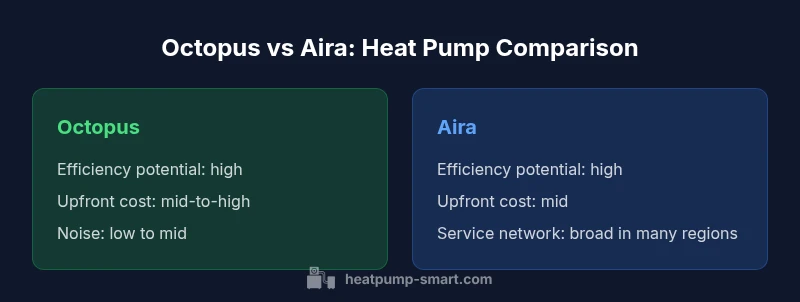
Octopus heat pump vs Aira: Comprehensive Comparison
Heatpump Smart analyzes octopus heat pump vs aira to help homeowners choose the most efficient, cost-effective option based on climate, installation needs, and service coverage in 2026.


octopus heat pump vs aira: The quick answer is that both options are air-source heat pumps designed to heat and cool homes, but they differ in efficiency, upfront value, and service reach. In general, octopus tends to deliver stronger long-term energy savings in variable climates, while aira can offer lower upfront costs and broader installation support. Your choice hinges on climate, budget, and local service coverage.
Overview of octopus heat pump vs aira
The octopus heat pump and the aira heat pump are both air-source systems designed for year-round home comfort. In practical terms, they share core components: outdoor condenser, indoor coil, refrigerant loop, and an inverter-driven compressor. For homeowners, the central question is not only efficiency, but how the unit integrates with existing ductwork, climate, and energy goals. In this comparison, we treat them as competing models within the same technology family, rather than wildly different approaches. Heatpump Smart's team emphasizes that understanding brand reliability and installation context is essential when choosing between octopus and aira. According to Heatpump Smart, this comparison anchors decisions in real-world usage, climate considerations, and installation realities to help readers choose the best fit for their property.
Key criteria for a fair comparison
To compare octopus and aira fairly, focus on criteria that homeowners actually experience day to day. First, energy efficiency matters most for long-term costs and environmental impact; look for COP, SEER, and seasonal performance ratings where available. Second, climate compatibility matters: some models excel in milder climates, others maintain warmth in low temperatures. Third, upfront price and installation complexity influence budget decisions and timelines. Fourth, running costs, including electricity and maintenance, determine total cost of ownership. Fifth, noise levels and indoor comfort impact daily living, especially in open-plan homes. Sixth, service networks and warranty terms affect reliability and peace of mind. Finally, compatibility with existing ducts, fuels, and smart-home platforms can simplify integration. Heatpump Smart notes that the best choice balances performance with practicality, ensuring the system aligns with your home's insulation, occupancy patterns, and long-term energy strategy.
Efficiency and energy savings: what matters
Efficiency is not a single number; it is a relationship between ambient temperature, compressor control, and heat exchange efficiency. The octopus model line emphasizes adaptive modulation and high seasonal performance in mid-to-cold climates, potentially lowering annual electricity use when run across a long heating season. The aira line often markets strong efficiency with robust part-load performance and heat-recovery capabilities that support lower operating costs in mixed conditions. For homeowners, the proof is in real-world usage: a unit that maintains comfort with modest power draw reduces bills over time, even if upfront costs are similar. When evaluating, compare COP at representative outdoor temperatures, note any climate-specific test data, and check how controls respond to indoor setback schedules. Heatpump Smart’s 2026 analysis suggests that the best choice often depends on how you balance short-term cash flow against ongoing energy savings, as climate variance can tilt the scales one way or the other.
Installation and compatibility considerations
Installation is a practical bottleneck that can erase theoretical savings if not planned carefully. Octopus installations may require careful duct sealing, electrical upgrades, or controller integration with existing smart-home platforms. Aira systems often offer flexible mounting options and more straightforward retrofit paths, especially in homes with limited duct infrastructure. Both brands benefit from proper site assessment before purchase, including refrigerant line sizing, outdoor unit clearance, and vibration isolation. The installer’s expertise matters just as much as the equipment spec; a skilled technician can optimize refrigerant charge, valve settings, and zone control to extract peak performance. Budget for permits, potential upgrades to wiring or breakers, and compatibility with heat-recovery ventilators or solar-assisted systems where relevant. Heatpump Smart recommends a formal pre-install assessment to avoid late-stage changes that can disrupt schedules and inflate costs.
Noise, comfort, and user experience
Sound can influence satisfaction as much as warmth. In typical home configurations, both octopus and aira units operate quietly at part load, with most noticeable noise arising from the outdoor fan during startup or high-demand periods. Models with inverter-driven compressors modulate speed to meet demand, which reduces abrupt changes in indoor temperature and helps maintain steady comfort. Indoor silence is achieved through properly sized air handlers and well-sealed ductwork. User experience also includes smart controls, scheduling, and integration with thermostats and voice assistants. When evaluating comfort, consider how rapidly the system recovers from setback periods and how responsive the app or wall control is during night-time operation. Quieter operation and better zoning usually translate to higher perceived value over the system's life.
Costs, value, and total cost of ownership
Upfront price often captures only a portion of value. Octopus and Aira models can be similar at the cash-out moment, but long-term savings may diverge due to efficiency and maintenance needs. If you expect heavy winter use or extended conditioning, the octopus option may deliver greater energy savings over a typical life cycle, reducing electricity bills and potentially improving return on investment. The aira option can be attractive for budget-minded buyers who prioritize predictable monthly costs and a broader service footprint. Maintenance plans, filter changes, and potential refrigerant charges should be factored into the total cost of ownership. Weather resilience, warranty length, and the availability of local technicians also influence value. Heatpump Smart advises considering both capital expenditure and the present value of energy savings when choosing between octopus and aira.
Reliability, warranty, and service coverage
Reliability hinges on components, workmanship, and the breadth of service networks. Both octopus and aira carry standard manufacturer warranties with terms that vary by region and installation type. A larger service footprint often translates into easier scheduling for maintenance visits, quicker part replacement, and less downtime during outages. Check for authorized installers in your area, routine maintenance recommendations, and what the warranty covers when paired with smart controls or third-party thermostats. Heatpump Smart notes that a robust service network reduces lifecycle risk and can be a deciding factor for property managers who oversee multiple units. In particular, confirm response times, coverage for refrigerants, and eligibility for extended warranties if you plan long-term ownership.
Climate-specific guidance: cold vs warm climates
In cold climates, the ability to extract heat from sub-freezing air becomes critical. Octopus systems often emphasize enhanced low-temperature performance and effective defrost strategies, which can maintain comfortable indoor temperatures without excessive energy draw. Aira solutions may emphasize dependable start-up and consistent performance across a broader climate range, sometimes trading a bit of extreme low-temperature performance for smoother operation at milder conditions. In hot summers, both brands should deliver solid cooling, but look for compressor staging, fan efficiency, and control algorithms that maintain dehumidification without overcooling. Heatpump Smart suggests evaluating local climate data, including typical winter and summer temperature ranges, to forecast annual costs and comfort levels. A well-suited system reduces heat loss at the envelope and minimizes cycles that wear equipment unnecessarily.
Real-world usage scenarios: rental, retrofit, and new-build considerations
For rental properties, serviceability and low-maintenance operation often matter most. Aira’s expansive technician network can be advantageous for landlords seeking predictable visits and faster part replacement. For retrofits in older homes, the octopus model may offer more flexibility with ducted or ductless configurations, depending on existing infrastructure. In new-build projects, both options can be integrated with advanced control systems and smart-home platforms, giving developers the opportunity to optimize energy performance from the start. Consider occupancy patterns, cross-ventilation needs, and seasonal use when projecting demand. Heatpump Smart recommends scenario planning: test with simulations or pilot runs before full-scale installation to ensure the system meets comfort goals without overstressing the electrical system or the building envelope.
Decision framework: when to choose Octopus vs Aira
Start with climate and energy goals: if extended energy savings and a longer-term payoff align with your plan, octopus is a strong candidate. If upfront affordability and a broad local service network are more important, aira provides compelling value. Assess installation constraints first: ductwork availability, electrical capacity, and space for outdoor units will shape feasibility. Evaluate warranty terms and maintenance commitments, then compare projected annual energy use based on climate data and occupancy. Finally, consider your procurement timeline, contractor availability, and any incentives or rebates in your area. Heatpump Smart recommends a side-by-side test in your home or property to quantify differences in expected comfort, electricity costs, and downtime.
What Heatpump Smart recommends
Decisions on octopus heat pump vs aira should start with your climate, budget, and long-term goals. For homeowners prioritizing long-term energy efficiency and stable performance in variable weather, octopus often offers the strongest operating cost advantages when paired with proper insulation and a well-designed ducting plan. If upfront price, service availability, and a straightforward retrofit path are your top concerns, aira frequently delivers credible value with a broad installer network and predictable maintenance costs. Regardless of choice, pair your purchase with an upfront energy audit, proper insulation, and a smart control strategy to maximize results. The Heatpump Smart team’s verdict is that the right pick depends on local conditions, not a generic best option, and we encourage readers to use our step-by-step comparison alongside local quotes.
Comparison
| Feature | Octopus heat pump | Aira heat pump |
|---|---|---|
| Efficiency potential (seasonal) | high (model-dependent) | high (model-dependent) |
| Upfront price range | mid-to-high | mid-to-high |
| Running costs (climate impact) | potentially lower long-term costs in variable climates | strong value in stable climates or with good part-load performance |
| Noise levels | low-to-mid at typical loads | low-to-mid at typical loads |
| Warranty & service network | coverage varies by region; check installation quality | coverage varies by region; check network |
| Installation flexibility | can be retrofit-friendly with ducting adjustments | often easier retrofit in limited-duct homes |
| Best for | homes prioritizing long-term energy savings and climate adaptability | budget-conscious buyers with broad service coverage |
Advantages
- Provides a clear, apples-to-apples comparison for decision-making
- Highlights how climate and usage shape value
- Encourages evaluating total cost of ownership rather than upfront price
- Draws attention to service network and warranty considerations
- Supports budgeting for long-term efficiency goals
Disadvantages
- May oversimplify model-specific performance
- Actual results depend on installation quality and climate
- Availability and pricing vary by region
- May require additional time for a side-by-side test
Octopus generally edges Aira for long-term efficiency in variable climates; Aira often wins on upfront value and service coverage
Choose Octopus if long-term operating costs and climate adaptability matter most. Choose Aira if upfront affordability and a broad service network are your priorities. Use a side-by-side evaluation with your local installers to confirm the best fit.
Your Questions Answered
Which heat pump tends to be more efficient overall, octopus or aira?
Efficiency depends on model and climate. In many scenarios, octopus offers higher long-term savings with strong part-load performance, but both brands offer high efficiency when matched to the right conditions.
Efficiency depends on model and climate; octopus often delivers stronger long-term savings, but both can be highly efficient with proper installation.
Do I need permits or professional installation for either unit?
Most jurisdictions require professional installation and may require permits. A qualified installer ensures proper refrigerant charging, electrical hookups, and duct work to preserve efficiency and safety.
Professional installation is usually required; it ensures safety and performance.
Which has a better service network?
Service coverage varies by region. Aira often emphasizes broader installation networks, while Octopus depends on local partners; check your area’s authorized installers.
Check local availability of technicians before you decide.
Are there climate considerations that favor one brand?
Yes. Cold climates may favor models with superior low-temperature performance; hot climates favor robust cooling control and dehumidification. Evaluate ratings in your typical season.
Climate matters; choose based on winter and summer needs.
Can I mix components from both brands on a single system?
Most systems require brand-consistent components for warranty and compatibility. Mixing parts can complicate service and may void warranties.
Stick to a single brand for reliability unless a professional advises otherwise.
What should I look for in a warranty?
Look for duration, coverage of major components, and whether service visits are included. Extended warranties can improve long-term value if installation quality is high.
Check coverage length and what is included.
Top Takeaways
- Prioritize climate when choosing between Octopus and Aira
- Evaluate total cost of ownership, not just upfront price
- Check local service networks and warranty terms early
- Use a real-world pilot or quotes to confirm performance
- Pair selection with an energy audit and good insulation