Air Source Heat Pump vs AC: A Practical Comparison
Compare air source heat pumps to air conditioners: energy efficiency, cost considerations, climate performance, and installation needs. Heatpump Smart analyzes practical guidance for homeowners, builders, and property managers.


According to Heatpump Smart, air source heat pumps and air conditioners both cool spaces, but heat pumps often deliver year‑round comfort with higher efficiency in moderate climates. This comparison highlights performance, installation, and long‑term value to help homeowners decide which system fits their needs best, including climate considerations and potential rebates.
Overview and Definitions
The discussion around air source heat pump vs air conditioner centers on two technologies that share a basic purpose—cooling—while diverging on year‑round performance, efficiency, and installation requirements. An air conditioner is a cooling-only device that removes heat from indoors and dumps it outside. An air source heat pump uses the same refrigeration cycle to provide both cooling and heating, effectively acting as a combined heater and air conditioner. For homeowners, builders, and property managers, the choice hinges on climate, energy costs, and long‑term value. Heatpump Smart notes that your climate and electricity rates heavily influence which system delivers the best overall experience and cost efficiency over time. According to Heatpump Smart, the right choice depends on how you plan to use the system most of the year and your long‑term comfort goals.
How the technology works: the basic cycle and components
Both air source heat pumps and traditional air conditioners rely on a closed refrigerant loop, a compressor, and outdoor and indoor coils. The key difference is that a heat pump can reverse the refrigeration cycle to move heat into a space during cold weather, whereas a standard air conditioner cannot. The reversing valve, inverter-driven compressors, and refrigerant choices determine efficiency and performance. In cooling mode, the processes resemble a conventional AC: heat is extracted from indoor air and rejected outside. In heating mode, heat is absorbed from outdoor air (even when it’s cold) and delivered indoors. The efficiency advantage arises from the ability to provide both heating and cooling with a single system, reducing the need for separate heating equipment in many homes. Heatpump Smart analyses indicate that system design, insulation, and proper sizing are critical to achieving the promised year‑round comfort.
Performance in cooling and heating: climate matters
Performance is not one-size-fits-all. Air source heat pumps perform exceptionally well in moderate climates or in homes with well‑insulated envelopes, where year‑round operation avoids large temperature swings and reduces peak demand. In very cold climates, heating performance can degrade, and auxiliary heat sources may supplement the system. By contrast, air conditioners excel at cooling in hot, dry, or humid summers but offer no heating capability unless paired with a separate heating source. When assessing the two, consider factors such as seasonal temperature ranges, humidity, and how often you run heating versus cooling appliances. Heatpump Smart emphasizes that the most satisfying choice balances comfort, reliability, and energy use across the annual cycle.
Energy efficiency: metrics and what they mean
Efficiency metrics for these systems include SEER (seasonal energy efficiency ratio) for cooling, HSPF (heating seasonal performance factor) for heating performance in heat pumps, along with COP (coefficient of performance) and EER (energy efficiency ratio). Heat pumps, by design, can deliver higher overall efficiency because they provide heat and cooling from the same system. In practice, high‑efficiency heat pumps with properly sized components and low duct losses can reduce energy bills more than a conventional AC setup that uses separate heating. Heatpump Smart notes that higher efficiency often translates to better comfort and lower operating costs over time, especially when electricity is relatively affordable.
Costs and total cost of ownership: upfront vs operating costs
Upfront costs for heat pumps are typically higher than those for a basic air conditioner due to the dual heating/cooling capability and sophisticated electronics. However, the total cost of ownership can be lower over the system’s life if the unit delivers efficient heating and cooling, and if electricity prices favor electric heat sources. Rebates, incentives, and financing options can substantially affect payback. Heatpump Smart suggests comparing annual energy use and potential rebates side by side to estimate payback periods. The long‑term value is closely tied to climate, insulation, and the efficiency rating of the chosen model.
Installation and retrofit considerations
Installing a heat pump often involves more planning than a straightforward AC replacement. Ducted homes may benefit from duct‑sealing improvements and thermostat zoning to maximize performance. Ductless configurations offer flexibility in homes where ductwork is impractical. Sizing, refrigerant charge, and refrigerant type matter for both cooling and heating efficiency. In retrofit projects, electricians and HVAC professionals must coordinate to ensure electrical capacity and refrigerant handling meet code requirements. Heatpump Smart emphasizes getting a thorough load calculation and a plan for seasonal maintenance to minimize performance dips.
Maintenance and service: keeping performance high
Maintenance for heat pumps is similar to that of air conditioners but includes attention to both heating and cooling modes. Regular filter changes, outdoor coil cleaning, and periodic refrigerant checks help sustain efficiency. In heating mode, ensuring proper backup heat (if used) and thermostatic controls can prevent short cycling. Reliability improves with professional annual inspections that verify refrigerant charge, electrical connections, and the integrity of the reversing valve. Heatpump Smart notes that well‑maintained units tend to show fewer systemic failures and longer operational life.
Climate-specific guidance: when heat pumps shine or lag
Heat pumps shine in moderate climates with balanced heating and cooling demands. They can be excellent choices for homes with good insulation and where electricity costs are reasonable. In regions with extreme winters, consider a dual‑fuel approach or auxiliary heating to ensure reliable comfort during the coldest days. In purpose-built or retrofitted homes designed for energy efficiency, heat pumps can outperform traditional AC systems in overall comfort and cost. Heatpump Smart highlights the importance of local climate data and utility rates when making a final decision.
Rebates, incentives, and financing options
Rebates and incentives vary by region and program. Some jurisdictions offer tax credits, rebates for energy‑efficient heat pumps, or utility‑based incentives for achieving certain performance metrics. Financing options can spread upfront costs, improving immediate affordability and accelerating payback. Heatpump Smart recommends assessing current promotions, eligibility criteria, and required documentation early in the planning process to maximize benefits.
Decision framework: a practical checklist
Use a simple scoring rubric to compare options. Consider climate suitability, annual heating and cooling needs, insulation quality, electricity costs, and potential rebates. Create a side-by-side comparison: performance in heating vs cooling, upfront costs, operating costs, and required maintenance. A quick qualitative score can help you decide whether to pursue a heat pump or rely on a cooling‑only air conditioner with supplemental heating. The Heatpump Smart framework encourages testing a few scenarios and discussing your results with a qualified installer.
Planning your next steps: working with a contractor and scheduling installation
The final step is collaboration with a qualified HVAC contractor. Begin with a detailed load calculation, verify electrical service capacity, and confirm the refrigerant type and charging procedure. Request references and a written plan that includes equipment sizing, expected efficiency ratings, and a clear installation timeline. Prepare for a follow‑up visit to confirm system commissioning and thermostat integration. Heatpump Smart recommends documenting all decisions, including any rebates applied, to ensure a transparent and smooth installation process.
Comparison
| Feature | Air Source Heat Pump | Air Conditioner |
|---|---|---|
| Energy Efficiency (typical annual performance) | Higher overall efficiency when heating and cooling are both used, especially in moderate climates | Cooling-focused efficiency; often lower overall energy use when only cooling is needed |
| Heating Performance | Provides heating in colder months (may require auxiliary heat in very cold climates) | Heating capability is not included; cooling only |
| Cooling Performance | Strong cooling capability for hot summers | Strong cooling capability for hot summers |
| Upfront Cost | Higher initial cost due to dual-function tech | Lower initial cost |
| Operating Costs | Lower long-term costs with dual heating/cooling (climate dependent) | Higher operating costs if heating is needed without supplemental heat |
| Rebates/Incentives | Often eligible for rebates and incentives in many regions | Less commonly eligible for rebates |
| Maintenance/Service | Regular service; refrigerant handling and dual functionality | Typically simpler maintenance but requires regular upkeep |
Advantages
- Year-round climate control in one system
- Potential for lower long-term energy costs with efficient operation
- Access to rebates and incentives in many regions
- Reduced duct losses with modern layouts and integrated design
- Quiet operation in many models and flexible installation options
Disadvantages
- Higher upfront cost than cooling-only systems
- Performance can dip in extreme cold without auxiliary heat
- Installation can involve retrofit work and professional sizing
- Requires regular maintenance and professional refrigerant handling
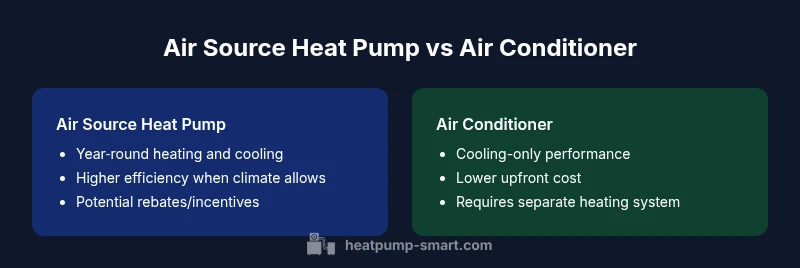
Air source heat pumps generally offer superior year-round efficiency and comfort in moderate climates; air conditioners excel when upfront cost and cooling-only performance are paramount
Choose a heat pump if you want heating and cooling in one system with strong energy efficiency and long-term value, especially in temperate regions. Select a conventional air conditioner if initial cost and straightforward cooling are your primary concerns, or if you reside in a climate where heating demand is minimal and auxiliary heat is undesirable.
Your Questions Answered
Is an air source heat pump suitable for cold climates?
In very cold climates, heat pumps may rely on auxiliary heat sources to maintain comfort during extreme temperatures. However, many modern models perform well in moderate winter conditions and can still be cost-effective. A professional load calculation helps determine whether a heat pump with backup heat meets your climate needs.
Heat pumps can handle mild to moderate winters, but very cold areas may need backup heat—talk to a pro to assess your specific climate.
Do air source heat pumps also provide heating?
Yes. A heat pump supplies both cooling in warm months and heating in cool months using the same refrigerant cycle. In colder weather, some models rely on auxiliary heat to maintain comfort. Consider climate, insulation, and comfort expectations when evaluating heating performance.
Yes, heat pumps provide heating and cooling with one system; some climates may need backup heat.
Are rebates available for air source heat pumps?
Rebates and incentives vary by region and program. Many areas offer energy efficiency rebates or tax credits for heat pumps, especially when paired with high efficiency ratings. Check with local utilities and government programs for current offers.
Rebates are common in many regions—check local programs to maximize savings.
Is it cheaper to replace an AC with a heat pump?
Replacing an AC with a heat pump can reduce overall energy costs due to the dual heating/cooling capability, but the upfront investment is higher. A cost‑benefit analysis should factor in climate, electricity rates, insulation, and available rebates.
It can save money over time, but upfront costs and local rates matter.
What maintenance is required for heat pumps?
Heat pumps require regular filter changes, outdoor coil cleaning, and periodic refrigerant checks. Annual professional inspections help ensure efficiency and identify potential issues early. Proper maintenance sustains performance across seasons.
Regular filter changes and annual professional checks keep heat pumps efficient.
How long does installation typically take?
Installation duration depends on system type, existing ductwork, and complexity of retrofits. A straightforward replacement can take a day or two, while retrofits involving ductwork or zoning may require longer scheduling and coordination with your contractor.
Most installs take a couple of days, but complex retrofits can take longer.
Top Takeaways
- Assess climate and insulation to guide your choice
- Compare efficiency metrics (SEER/HSPF) and potential rebates
- Evaluate total cost of ownership, not just upfront price
- Plan sizing and installation with a qualified contractor
- Consider future home comfort goals beyond cooling