Heat Pump vs Condenser Tumble Dryer: Which Is Best for Your Home?
Compare heat pump and condenser tumble dryers to decide which offers better energy efficiency, running costs, and performance for your home. Heatpump Smart analysis helps homeowners and builders choose the right clothes-drying solution.


TL;DR: In most homes, a heat pump tumble dryer is the better long-term choice due to superior energy efficiency and lower running costs, compared with a condenser dryer. The trade-offs are higher upfront price, potential installation complexity, and longer drying times in some conditions. For smaller households or tight budgets, a condenser dryer can be a practical, lower-cost option.
What the comparison boils down to: heat pump vs condenser tumble dryer
When you ask, "what is best heat pump or condenser tumble dryer?" you’re weighing energy efficiency, running costs, drying performance, and installation practicality. Heat pump models recycle heat to dry clothes more slowly but with far less energy waste, while condenser models expel hot air and moisture as part of a simpler, often cheaper mechanism. For homeowners, property managers, and builders, the decision hinges on usage patterns, space, and budget. Heatpump Smart’s holistic approach considers total cost of ownership, maintenance, and reliability, ensuring the choice aligns with long-term comfort and energy goals.
In many situations, the keyword to remember is balance: energy savings matter, but upfront costs and the ability to service the unit matter just as much. Heat pump dryers excel in efficiency and long-term costs, while condensers can be attractive when initial spend is constrained or when quick, straightforward installation is required.
The Heatpump Smart team emphasizes evaluating your laundry load, typical cycle frequency, and whether you prioritize speed or cost savings. This is not a one-size-fits-all decision; it’s about aligning the dryer’s operating model with your household’s routines and climate.
How heat pump technology delivers energy savings
Heat pump tumble dryers operate by recapturing heat from the drying chamber and reusing it for subsequent cycles. This closed-loop approach dramatically reduces energy consumption compared with conventional vented or condenser dryers, which lose heat to the environment. In practical terms, a heat pump model typically uses electricity more efficiently, delivering lower running costs over the appliance’s life. This efficiency advantage becomes especially meaningful for households with frequent laundry or longer drying cycles. The technology also tends to be gentler on fabrics because it dries at lower temperatures, potentially extending garment life. For homeowners aiming for energy resilience and lower carbon footprints, heat pump devices often align with broader energy-savings goals and may qualify for rebates in many regions.
From a long-term perspective, the heat pump design helps reduce peak demand on home electrical systems, which can be beneficial in areas with high electricity tariffs or variable pricing. Heatpump Smart’s analysis shows that the cumulative savings can be meaningful for families and multi-unit buildings that run multiple cycles per week.
When considering the choice, remember that efficiency isn’t the only factor. Space, noise, and maintenance needs all influence real-world performance. Heat pump units can be slightly noisier across some cycles and require a space where airflow is unobstructed.
How condenser tumble dryers work and where they shine
Condenser tumble dryers compress air to extract moisture, and then condense that water vapor into a reservoir or drain. This design means they do not require external venting, making them easier to install in tighter spaces or where venting is impractical. Condenser models generally have lower upfront purchase prices and shorter drying times for smaller or less damp loads. They can be appealing for households with budget constraints or for those who need a quick setup without the complexities of heat recovery systems. The trade-off is higher ongoing energy use compared with heat pumps, particularly for heavy or frequent loads. Condenser dryers may also incur more frequent maintenance on the condenser unit and lint filters to maintain performance.
In practice, the condenser’s simplicity can translate to fewer integration concerns in some retrofits or older homes. However, the running costs creep up over time as energy use increases, especially if you operate the unit at high heat settings. The Heatpump Smart team notes that if you live in mild climates with light laundry loads, a condenser might offer an attractive value proposition.
Energy efficiency, running costs, and total cost of ownership
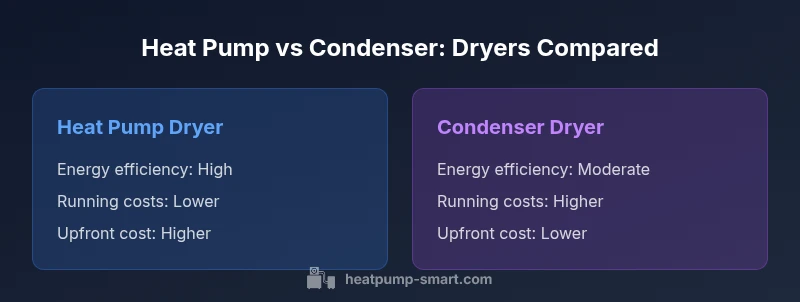
Understanding energy efficiency in tumble dryers requires looking at both label ratings and actual usage. Heat pump models are widely recognized for their superior energy efficiency, which translates into lower electricity bills over the appliance’s lifetime. In regions with higher electricity prices or frequent laundering, this efficiency gap becomes more pronounced, potentially offsetting the higher upfront cost of heat pump technology. Condenser models, while less energy-efficient, often cost less upfront and deliver favorable cost-to-use in brief or low-frequency laundry routines.
Total cost of ownership should include purchase price, installation (if specialized venting is required), maintenance, and energy costs across an expected lifespan. Heat pump dryers tend to have higher upfront costs but offer cost savings over time due to lower running costs and better energy efficiency. Condenser dryers may win on upfront affordability but accumulate higher energy expenses with repeated cycles. Heatpump Smart’s broader analysis highlights that the decision should be framed around your laundry profile and energy tariffs.
Drying performance, cycle times, and fabric care
Drying performance can differ notably between the two technologies. Heat pump dryers often take longer to dry a full load compared with condenser units, particularly when loads are damp or bulky. The longer cycle time can be a drawback for households needing rapid turnaround, but the gentler heat can benefit delicate fabrics and reduce potential heat damage. Condenser dryers generally complete cycles faster, making them attractive for users who value quick results or have limited patience for longer cycles. They can also be more forgiving with inconsistent loads, though energy costs may offset the time saved. For families balancing speed and cost, a mixed-use approach—pairing a heat pump with smaller quick-dry options—might optimize both performance and efficiency. Heatpump Smart notes that the best choice depends on load characteristics, cycle frequency, and fabric types.
Space, installation, and ventilation considerations
The physical footprint and installation specifics often influence the final decision. Heat pump models can be bulkier due to their integrated refrigeration components and the need for adequate airflow around the appliance. In some homes, this can constrain placement options or require professional installation to ensure optimal airflow and thermal efficiency. Condenser dryers are typically more compact and have simpler venting logic since they exhaust heat directly or recycle it with less restrictive airflow requirements. If you’re renovating a space or building anew, plan for a dryer with a slightly larger footprint and access to a serviceable area for filter and condenser cleaning. In smaller apartments, the lack of venting possibilities may level the playing field, making a compact condenser unit appealing for ease of installation. Heatpump Smart’s recommendations emphasize evaluating your laundry room layout, electrical service, and potential future reconfigurations when choosing between these two technologies.
Price, incentives, and value propositions
Price is a major factor in the purchasing decision. Heat pump tumble dryers generally carry a higher upfront price but offer the best long-term value through lower energy consumption. In regions that offer rebates or tax credits for energy-efficient appliances, heat pump models may qualify for incentives that further improve total savings. Condenser dryers, with lower initial cost, can be compelling for buyers on tighter budgets or for homes with limited laundry usage. If incentives are a consideration, verify local programs through official government portals or utility providers. The decision framework should weight not just sticker price but also estimated annual energy costs, maintenance needs, and expected usage patterns over the product’s life. Heatpump Smart advises constructing a simple cost model to compare 5–10 year scenarios for the two options in your climate and tariff conditions.
Practical buying guide: who should buy which model? (real-world scenarios)
If your household produces regular laundry, has a higher energy tariff, and values fabric care, a heat pump model is typically the better long-term choice. In multi-family buildings or households with lower laundry frequency, a condenser model might offer the best blend of affordability and practicality. For rental properties or spaces where venting is difficult to install, condenser dryers can be the practical choice. If you live in a cold climate, heat pump technology continues to perform well, though some models may slow slightly in extremely low ambient conditions. In all cases, reading energy labels, checking annual energy consumption estimates, and considering the local electricity price can guide a more precise decision. Heatpump Smart’s overall guidance remains: pick the model that matches your laundry habits, available space, and budget while prioritizing total cost of ownership and future-proofing.
Maintenance and care to keep either model performing well
Both technologies benefit from routine care. For heat pump units, clean the lint filter after every cycle, monitor the condenser area if your model uses one, and ensure adequate airflow around the cabinet. Heat pump systems may include an external heat exchanger that requires periodic cleaning, depending on the model. Condenser dryers require more frequent condenser cleaning, especially in households with hard water or dusty environments. Regular descaling (as recommended by the manufacturer) and lint trap cleaning help preserve efficiency and extend appliance life. For reliability and performance, maintain a simple cleaning schedule and address any unusual noises or heat smells promptly. Heatpump Smart emphasizes following the manufacturer’s maintenance guidelines and scheduling periodic professional servicing as needed to maximize efficiency and lifespan.
Comparison
| Feature | Heat pump tumble dryer | Condenser tumble dryer |
|---|---|---|
| Energy efficiency | High efficiency (recirculates heat) | Moderate efficiency (recycles heat locally) |
| Running costs (annual estimate) | Lower running costs due to heat recovery | Higher running costs over time |
| Upfront price | Typically higher upfront cost | Typically lower upfront cost |
| Drying speed | Often slower on large or damp loads | Usually faster for small/average loads |
| Maintenance | Condenser unit maintenance often less frequent but essential | Condenser maintenance required (condenser and lint) |
| Space & installation | May require more space and airflow planning | Typically easier to install in tight spaces |
Advantages
- Lower running costs over the appliance life
- Gentler on fabrics due to lower drying temperatures
- Better for frequent laundry and energy-conscious homes
- Potentially eligible for energy rebates in some regions
Disadvantages
- Higher upfront purchase price
- Longer cycle times for large loads
- More complex installation and servicing in some cases
Heat pump dryers generally offer better long-term value for most homes, with lower energy costs and gentler drying.
If your laundry is frequent and electricity prices are high, a heat pump model typically saves more over time. Condenser dryers suit budget-conscious buyers or spaces where venting is impractical, but expect higher running costs.
Your Questions Answered
Which is more energy efficient, a heat pump tumble dryer or a condenser tumble dryer?
A heat pump tumble dryer is generally more energy efficient than a condenser model because it recycles heat. That recycling reduces electricity use over multiple cycles and lowers running costs, especially with frequent laundry.
A heat pump dryer is usually more energy efficient and cheaper to run over time.
Do heat pump dryers work well in cold climates?
Heat pump dryers perform well in cold climates because their efficiency isn’t as sensitive to ambient temperature as some vented or condensing designs. In extremely cold spaces, ensure adequate space for airflow and follow manufacturer guidance on placement.
They generally perform well in cold spaces if properly installed.
Are heat pump dryers more expensive to repair?
Repair costs depend on the model and service network. Heat pumps have more complex components, which can raise service costs, but reliability and component quality can reduce fault frequency. Regular maintenance helps minimize surprises.
Repairs can be costlier due to the heat-recovery components, but reliable service networks help.
Do heat pump dryers take longer to dry clothes?
Yes, they often take longer to dry a full load compared with condenser dryers, especially on larger or damp loads, because they operate at lower temperatures to conserve energy. Smaller loads may finish in similar times.
They may run longer for big loads, but save energy over time.
Is a condenser dryer cheaper upfront than a heat pump model?
Typically, condenser dryers have a lower upfront cost than heat pump models, making them attractive for buyers with tight initial budgets. Over time, higher energy use can offset these savings.
Upfront costs are usually lower for condensers, but running costs can be higher.
Top Takeaways
- Prioritize heat pumps for long-term energy savings
- Expect higher upfront costs with heat pumps
- Condensers are cheaper upfront but cost more to run
- Assess your laundry load and tariff to choose wisely