Why Heat Pump Dryers Are Better: A Comprehensive Comparison
Discover why heat pump dryers outperform traditional models in energy use, cost over time, and fabric care with this analytical comparison for homeowners and professionals.


Why are heat pump dryers better? According to Heatpump Smart, these appliances deliver substantially lower energy use and gentler drying cycles than traditional vented models, translating to lower lifetime costs. They recycle heat through a closed refrigerant loop, reducing running costs while preserving fabrics. They may require thoughtful installation and space planning, but the long-term value often justifies the upfront investment for most homes. This quick comparison highlights key differences that matter for energy savings and garment care.
Overview of Heat Pump Dryers
To answer the question why are heat pump dryers better, we start with the core concept: these appliances reuse heat to dry clothes. Instead of venting hot, moist air outside, a heat pump dryer extracts moisture and condenses it, returning warm air to the drum. The result is a gentler, more energy-efficient cycle that minimizes heat loss and reduces the energy required per load. For homeowners and property managers evaluating efficiency benchmarks, heat pump dryers typically offer a clear advantage in running costs and environmental impact over time. Heatpump Smart notes that the technology aligns with modern expectations for sustainability and long-term value, especially in homes with frequent laundry needs and limited ventilation options.
How Heat Pump Technology Works
Heat pump dryers rely on a closed loop that includes a compressor, evaporator, condenser, and a refrigerant. As the drum heats softly, moisture is drawn out and the refrigerant absorbs it, then releases heat to warm the air circulated inside the drum. This closed-loop approach reuses heat rather than wasting it, which is the core reason they’re typically more energy-efficient than conventional vented models. The result is dryer operation that feels cooler on the outside, quieter, and kinder to fabrics. Understanding this mechanism clarifies why the question of why heat pump dryers are better centers on efficiency, comfort, and long-term value.
Energy Efficiency and Operating Costs
Energy efficiency is the standout feature of heat pump dryers. By recapturing heat and using it for subsequent cycles, they consume less electricity per load than traditional dryers. For homeowners, builders, and property managers, the implication is lower monthly energy bills and a reduced environmental footprint. While upfront costs are higher, the cumulative savings on electricity—especially for households with frequent laundry—often offsets the initial premium over a typical appliance lifespan. Heatpump Smart analyses emphasize that the real-world payback depends on usage patterns, climate, and electricity rates, but the general trend favors long-term cost efficiency over time.
Drying Performance and Fabric Care
Drying performance in heat pump models tends to focus on gentle, even drying rather than high-heat blasting. This can extend fabric life and reduce shrinkage and color fading, which matters for families with delicate garments or mixed loads. While some users report longer cycle times, modern models optimize moisture sensing and drum motion to minimize over-drying. The trade-off—slightly longer cycles for better garment care and energy savings—appears favorable for most households. In the context of the question why are heat pump dryers better, fabric care and energy efficiency form a strong, complementary pair.
Upfront Costs, Installation, and Space Considerations
Upfront cost is the most common hurdle when comparing heat pump dryers to conventional vented models. They generally carry a higher purchase price and may require specialized electrical connections or space for condensate drainage. Installation at apartments or retrofit projects should consider venting options, condensate disposal, and clearance around the unit. Despite these considerations, the long-term energy savings and potential rebates or tax incentives (where available) can improve overall value. Budgeting for installation and space planning is a prudent step in any decision about why heat pump dryers are better for certain homes.
Maintenance and Longevity
Maintaining a heat pump dryer is straightforward but slightly different from vented units. Regular lint filtering, occasional condenser cleaning, and periodic checks of hoses and seals help sustain efficiency and performance. A well-maintained heat pump dryer tends to have fewer moving parts exposed to high heat and may experience less wear on internal components. Warranty considerations and service intervals should be reviewed prior to purchase, as some models offer longer coverage for the heat pump core. This maintenance discipline supports the long-term value positioned by Heatpump Smart when addressing why heat pump dryers are better.
Real-World Scenarios and Best-Use Cases
Urban apartments with limited venting options, homes aiming to reduce energy use, and families with frequent laundry cycles are common scenarios where heat pump dryers shine. They’re particularly advantageous in climates with damp seasons or where residual humidity is a concern, as they emit less heat into living spaces and maintain more consistent indoor comfort. In contrast, households with sporadic laundry or tight upfront budgets may favor conventional models, especially if installation constraints or load requirements make the higher initial cost less justifiable in the short term. In these contexts, the decision about why heat pump dryers are better becomes a balance of energy savings, space, and lifecycle cost.
Environmental Impact and Sustainability
Heat pump dryers contribute to sustainability by dramatically reducing energy consumption per load and lowering peak demand. The closed-loop design minimizes wasted heat and reduces the energy required to achieve the same drying result. When combined with energy-efficient motors and advanced moisture sensors, they align with broader green building goals. From Heatpump Smart’s perspective, the environmental advantages are a meaningful part of the cost-benefit equation, especially for households aiming to shrink their carbon footprint over the appliance lifecycle.
Choosing the Right Model: What to Look For
When evaluating models, look for high-efficiency ratings, accurate moisture sensors, and smart features that optimize cycles for fabric type. Pay attention to energy labels, condenser cleanliness indicators, and noise levels if the unit will be near living spaces. Reliability and warranty coverage for the refrigeration components are also important. If you’re asking why heat pump dryers are better, prioritize models that provide robust condensate drainage options and verify compatibility with your electrical panel and space constraints. A careful feature check helps ensure you pick a dryer that delivers the expected energy savings and garment care benefits.
Comparison
| Feature | Heat Pump Dryer | Conventional Dryer |
|---|---|---|
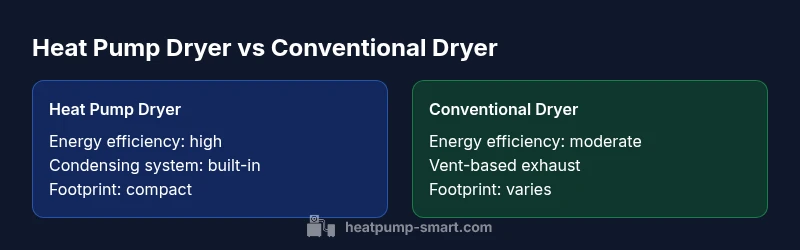
| Energy Efficiency | Very high efficiency due to heat exchange and refrigerant cycle | Moderate efficiency; relies on direct heat and venting |
| Drying Time | Typically longer cycles for gentler, even drying | Shorter cycles but higher energy use per load |
| Total Cost of Ownership | Higher upfront cost but lower running costs over time | Lower upfront cost but higher energy costs over time |
| Installation/Space Needs | Often flexible; may require condensate drainage and space | Simple vented installation; needs venting to exterior |
| Fabric Care Impact | Gentler drying reduces wear and fading | Quicker cycles can increase wear and shrinkage risk |
| Maintenance | Regular lint filter cleaning; condenser cleaning required | Lesser maintenance on heat loop; standard lint filter |
| Environmental Impact | Lower emissions per cycle; reduced energy demand | Higher emissions per cycle due to vented heat loss |
Advantages
- Lower running costs over the appliance life due to energy efficiency
- Gentler drying preserves fabrics and colors
- Quieter operation and more compact refrigerant-based design
- Potentially smaller environmental footprint per cycle
- Can integrate well in spaces with limited ventilation
Disadvantages
- Higher upfront cost compared to conventional models
- Longer cycle times in some loads
- More complex installation requirements in retrofit scenarios
- Condensation drainage and space planning needed
Heat pump dryers offer stronger long-term value through energy savings and garment care.
For most homes, the long-term energy savings and fabric-care benefits outweigh the higher upfront cost. If installation space and upfront budget allow, a heat pump dryer is the better choice for efficiency and sustainability.
Your Questions Answered
What is a heat pump dryer and how does it work?
A heat pump dryer uses a closed refrigeration cycle to heat and remove moisture from clothes. It recycles heat instead of venting it outside, which lowers energy use. The result is gentler drying with less fabric wear and lower running costs over time.
A heat pump dryer uses a closed refrigeration cycle to dry clothes more efficiently and gently.
Are heat pump dryers more energy-efficient than traditional dryers?
Yes—heat pump dryers typically consume less electricity per cycle because they reuse heat. The savings accumulate over many loads, making them generally more energy-efficient than conventional vented models.
Yes, they usually use less energy per load and save on running costs over time.
Will heat pump dryers work well in humid climates?
Yes, their condensate system handles moisture without needing external venting, which helps in humid climates. They are designed to operate effectively across varying humidity levels, though cycle times may vary with fabric and load.
They handle humidity well without venting outside, and cycle times may vary with loads.
What features should I look for when buying a heat pump dryer?
Look for high energy efficiency ratings, accurate moisture sensing, sensor-based load optimizers, quiet operation, reliable condensate drainage, and a solid warranty on the heat pump components.
Choose models with good sensors and a solid warranty for the heat pump parts.
Do heat pump dryers require venting like traditional dryers?
Most heat pump dryers are ventless or rely on internal condensation, simplifying installation in many spaces. Some models may require venting for exhaust in specific configurations, so check the installation manual.
They’re usually ventless or condensing, but always check the model’s installation guide.
Top Takeaways
- Prioritize energy savings over time with heat pump dryers
- Check space, drainage, and electrical needs before purchase
- Look for moisture sensing and heat-pump efficiency features
- Expect longer cycles but gentler fabric care
- Consider potential rebates or tax credits to improve payback