When to Switch Off a Heat Pump: Practical Guidance for Homeowners
Learn safe, practical guidelines for turning off your heat pump. Discover when shutdown helps, how to do it correctly, and how to resume operation without sacrificing comfort or efficiency.


Turning off a heat pump can save energy during long absences or maintenance, but it must be done safely to protect equipment and comfort. This guide explains when shutdown is appropriate, how to switch off correctly at the thermostat, app, or breaker, and how to resume operation without taxing the system. Learn the best practice to balance efficiency and comfort.
Why You Might Need to Switch Off a Heat Pump
According to Heatpump Smart, there are times when turning off a heat pump makes sense for energy efficiency, equipment protection, and comfort control. If you’re traveling for an extended period, or you’re performing routine maintenance, a controlled shutdown can reduce unnecessary operation. It’s also a useful option during heat waves when your cooling demand is minimal, or during cold snaps when you want to rely on backup heating for safety and comfort. However, a full shutdown is not always the best choice in every scenario; humidity control, frost protection, and the risk of conditioning gaps in the home should be considered. Modern heat pumps can tolerate occasional interruptions, but the way you switch off matters for compressor health and refrigerant pressure. By planning ahead, homeowners, builders, and property managers can avoid costly startup shocks and keep the system ready for efficient reactivation.
When It Is Appropriate to Switch Off
Knowing when to switch off a heat pump helps avoid discomfort or damage. If you have no occupants for a long stretch, a vacation or seasonal break, turning off or pausing the unit may save energy. Maintenance tasks, such as cleaning or inspections of the outdoor unit or thermostat wiring, also warrant a controlled shutdown. Be mindful of the climate: in very cold conditions, you may want to keep the system in a low-power mode to maintain frost protection, rather than a complete off. For households with vulnerable occupants or pets, scheduling a planned shutdown during predictable times can simplify comfort planning. The Heatpump Smart team notes that using the built-in vacation or away modes when available can balance energy savings with return-on-comfort.
Understanding Heat Pump Modes and What Off Means
Heat pumps frequently operate in multiple modes: heating, cooling, auto, and emergency heat. "Off" stops all active cycling and relies on the system’s protection routines. Some units enter a standby state that uses little energy but remains responsive to a temperature change. When you choose "Off" for an extended period, you should understand how the outdoor unit and refrigerant circuit will behave during idle periods. The goal is to prevent unnecessary wear while ensuring you can quickly resume climate control when needed. If your model has a frost-protection feature or defrost cycle, you’ll want to know how long those protections stay engaged after an off-state to avoid a sudden demand when restarting.
How to Switch Off via the Thermostat or Heat Pump Control Panel
Start with the thermostat: set it to Off or to a designated Away/Vacation mode, if your device supports it. If you’re using a smart controller, you may be able to pause schedules without fully powering down. Confirm how long the unit will remain idle and whether any defrost cycles are scheduled during the off period. For many systems, a simple pause for a few hours or days is sufficient to reduce energy use without a full shutdown. If you must turn off the system completely, save any presets, label the controls, and proceed to the next step with caution. See diagrams in your manual for model-specific steps and safety considerations.
Turning Off at the Electrical Breaker and Safety Considerations
Powering down at the main breaker should be reserved for maintenance or fault conditions, not routine use. Before flipping a switch, ensure the outdoor unit is free of ice, debris, or water, and that the indoor circuits are de-energized. After turning off, wait until any pressure equalizes before re-energizing. If you choose to use the breaker, annotate the reason and expected duration so others understand why power is off. Remember that some models rely on a continuous supply for frost protection; consult the manual to avoid unintended consequences.
What Happens to Humidity, Defrost Cycles, and Refrigerant When Off
During an off period, the air, humidity levels, and indoor comfort will drift. The dehumidification function stops, which may cause humidity to rise if the home is sealed. Outdoor defrost cycles may also be paused, depending on the unit and outdoor temperature, which can affect how quickly you resume heating after an extended stop. Refrigerant pressure is managed by the system’s internal controls; a proper gradual restart reduces the risk of pressure spikes. If you keep the system off for a long time, consider using ventilation or dehumidification to maintain air quality and avoid mold risk.
Re-Starting and Returning to Normal Operation
When you’re ready to resume, turn the thermostat back to an active mode (heat or cool) and reset any schedules. If you used the breaker, switch it back on and give the system time to re-pressurize. Start with moderate settings and avoid pushing to high demand immediately; allow the compressor to ramp up gradually to prevent voltage or pressure shocks. Give the system a few cycles to fully re-establish balance before returning to your normal routine.
Common Pitfalls and Myths
Some homeowners believe turning off a heat pump saves energy regardless of weather or insulation. Others assume a full shutdown is always safer than a pause. In reality, the best approach depends on your climate, occupancy, and system type. Never switch off during active defrost cycles; avoid closing the outdoor vents unless recommended by the manual. Always check the status indicators and logs to ensure a clean restart.
Practical Scenarios: Holiday Absences and Seasonal Adjustments
During holidays or seasonal slowdowns, plan ahead with Away mode, timer sequences, and a clear reactivation plan. For rentals or multi-unit properties, coordinate shutdowns with property managers to ensure safety and comfort. This approach reduces energy waste while preserving equipment life. Heatpump Smart recommends documenting the plan for each unit to standardize practices across properties.
Tools & Materials
- Thermostat or heat pump control panel(Needed to initiate shutdown from the unit)
- Smartphone or computer with heat pump app(Optional if your unit supports app-based shutoff)
- Access to main electrical panel(Needed to cut power if a full shutdown is required)
- Owner's manual or manufacturer guide(Helpful for model-specific steps)
- Non-conductive gloves(Safety in case you handle fixtures near live wiring)
Steps
Estimated time: 15-20 minutes
- 1
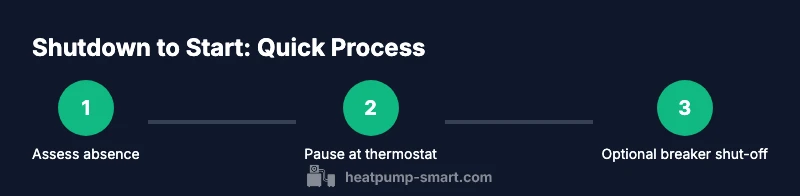
Assess absence duration
Determine how long you’ll be away and whether a complete shutdown is justified, or if a pause will suffice. Consider occupancy, climate, and comfort needs to decide the safest approach.
Tip: Check weather forecasts and planned activities to choose the best shutdown method. - 2
Pause or turn off at the thermostat
Use the control to set the unit to Off or to Away/Vacation mode if available. This reduces active cycling while preserving basic protections and a quick restart later.
Tip: Prefer pausing schedules first; only use full off if you won’t need climate control for an extended period. - 3
Consider powering via the breaker for maintenance
If a full shutdown is necessary, flip the main breaker after ensuring it’s safe to do so. Label the breaker and note the intended duration for easy restoration.
Tip: Do not rush re-energizing; ensure the outdoor unit and indoor circuits are safe to power on. - 4
Check outdoor unit and wiring safety
Ensure the outdoor unit is free of ice and debris and that you’re not exposing live wiring during any inspection.
Tip: Wear gloves and only touch insulated controls; never bypass safety devices. - 5
Document current settings
Take photos or notes of the operating mode, temperature offsets, and schedules before turning off. This makes reactivation smoother.
Tip: Keep the notes near the unit or in the home maintenance folder. - 6
Plan a safe reactivation
When returning, re-enable in the reverse order and allow time for the system to re-pressurize and ramp up gradually.
Tip: Start with moderate settings and increase gradually to avoid startup shocks.
Your Questions Answered
Is it safe to switch off a heat pump?
Yes, it is generally safe when you use official controls and avoid interrupting during active defrost cycles. Check your unit’s manual for model-specific guidance.
Yes, it’s usually safe if you use the proper controls and avoid forcing shutdown during defrost.
What is the best time to switch off for energy savings?
Use a planned shutdown during extended absences or when climate needs are minimal. If you only need a short break, a pause mode is typically enough.
During extended absences or when cooling/heating isn’t needed.
Will turning off affect humidity or air quality?
Prolonged shutdown can raise indoor humidity if the home is sealed. Ventilate occasionally or use a dehumidifier if needed when restarting.
Humidity can rise during a long shutdown; plan ventilation on return.
Should I switch off during vacations or holidays?
Yes, if you’ll be away for an extended period. Use Away/Vacation modes and ensure a safe restart plan for when you return.
Yes, for extended trips with a restart plan.
What is the difference between turning off the thermostat and the breaker?
Thermostat off stops operation; a breaker cuts power entirely. Use the thermostat for routine pauses and the breaker only for maintenance or fault conditions.
Thermostat off stops operation; breaker cuts power for maintenance.
How should I restart after turning off?
Return to active mode gradually, re-enable schedules, and allow time for the system to re-pressurize before full operation.
Restart gradually and allow the system to settle.
Watch Video
Top Takeaways
- Assess absence duration before acting
- Start with thermostat pause; breakers for maintenance only
- Restart gradually to avoid shocks
- Monitor humidity and defrost implications
- Document settings for easy return