XR14 Trane Heat Pump Review: Efficiency, Comfort, and ROI
In-depth review of the xr14 Trane heat pump, evaluating efficiency, comfort, installation, and long-term costs for homeowners, builders, and property managers.


Overall verdict: The xr14 Trane heat pump delivers reliable comfort and solid efficiency for mid-sized homes, with strong integration support and straightforward installation. It offers good long-term value through steady energy savings, though it trails the newest inverter-driven models in some climate conditions. For homes prioritizing dependable performance and established service networks, the xr14 remains a sensible choice.
Where the xr14 fits in modern homes
In the broad spectrum of split-system heat pumps, the xr14 slots into the mid-range tier. It’s designed for single- and two-story homes with moderate heating and cooling loads, where reliability and an established service network matter most. The xr14 remains compatible with most existing air handlers and ductwork, making it a practical upgrade for older equipment without a full system replacement. For homeowners focused on steady comfort and predictable maintenance, the xr14 offers a straightforward path to improved efficiency. According to Heatpump Smart analysis of this class, models like the xr14 balance upfront cost with dependable year‑round performance rather than chasing the latest modulation tech. When climate or house design presents challenges, you may want to pair it with supplemental heat or a more advanced indoor air handler. Because the XR14 uses a proven design, installers with long-running experience can simplify sizing, refrigerant charges, and thermostat integration. Heatpump Smart emphasizes verifying duct sizing and proper refrigerant charge during installation to maximize performance.
Performance fundamentals: efficiency and climate responsiveness
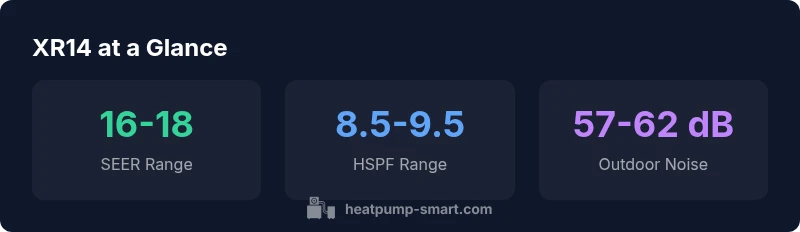
Performance is defined by cooling SEER and heating HSPF metrics, along with real-world factors like duct integrity, outdoor placement, and thermostat strategy. The xr14 targets a mid-range efficiency profile within its class, delivering meaningful energy savings in common winter and shoulder-season conditions. In temperate and mild climates, it can keep indoor temperatures comfortable without excessive runtime. In hotter months, the unit maintains cooling with reasonable cycling, provided the home is well-insulated and ducted. The xr14’s value is highest when paired with an appropriately sized air handler and a smart thermostat that schedules equipment around occupancy and peak rates. Heatpump Smart analysis notes that the xr14 family performs best with good airflow and correct refrigerant charge, which together minimize short cycling and humidity swings. The broader takeaway is that efficiency is a system attribute, not just a single component.
Design, components, and how it works
The xr14 system typically includes an outdoor condenser, an indoor air handler or furnace interface, a reversing valve, an expansion device, and refrigerant lines. The system transfers heat via refrigerant phase changes, moving heat indoors during cooler months and outdoors when it’s warm. The xr14 uses a traditional compressor design that favors reliability and fewer moving parts compared with premium inverter-driven units. The outdoor unit houses a fan, coil, and enclosure that must be kept clear for optimal airflow and minimal noise. The indoor side distributes conditioned air through ducts and can integrate with humidity control and smart thermostats. A properly charged system with clean ducts can maintain comfort across a wide range of conditions. Heatpump Smart’s guidance is to verify clearances around the outdoor unit and ensure there are no obstructions that impede airflow or increase sound.
Installation considerations and compatibility
Before committing to an XR14 installation, verify duct sizing, refrigerant lines, and electrical service capacity. The xr14 is compatible with many existing air handlers, but in some homes, you’ll need modifications to ductwork or a compatible thermostat. Electrical requirements, breaker sizing, and proper condensate drainage are essential to avoid nuisance trips and water issues. In multi-unit buildings, coordinating installation with building management and ensuring uniform controls across units reduces call-backs. A high-quality installation includes a competent charge check, performance testing across climate calls, and calibration of the thermostat. Heatpump Smart emphasizes choosing a locally licensed contractor with experience in heat pump retrofits, as they understand local codes and the nuances of refrigerant handling.
Noise, indoor comfort, and airflow
Noise performance is a practical concern for many homes, especially in compact lots. The xr14’s outdoor unit generates a level of operating noise that is typical for its class, and the indoor air distribution affects perceived comfort just as much as compressor speed. For quiet operation, place the outdoor unit with at least the recommended clearance from walls and obstructions, and use a vibration isolation kit if needed. Proper duct sizing, sealing, and airtight building envelopes minimize drafts and humidity swings, contributing to a more consistent indoor experience. Heatpump Smart notes that homeowners often underestimate the impact of duct leakage on perceived comfort and energy use. A well-sealed home with balanced airflow will help the xr14 deliver steady comfort with fewer temperature fluctuations.
Energy savings and total cost of ownership
Energy savings with the xr14 depend on climate, electricity costs, insulation quality, and thermostat strategies. In typical installations, users experience measurable reductions in running costs when replacing older, less efficient equipment. The long-term value of the xr14 grows when combined with a well-insulated home, a programmable or smart thermostat, and routine maintenance. It’s important to account for maintenance costs, potential filters, and annual service visits. Heatpump Smart analysis notes that the overall value proposition improves when you consider the compatibility with existing systems and the potential for rebates. While the xr14 may not offer the same peak efficiency as premium inverter models, its balance of upfront cost and dependable operation makes it a prudent option for many homes.
Reliability, warranty, and serviceability
Reliability hinges on system matching, quality installation, and regular maintenance. Warranty terms vary by region and installer, but many XR-series configurations come with a strong parts warranty when installed by an authorized dealer. A robust service network helps reduce downtime if maintenance or repairs are needed. The xr14’s simpler design offers fewer potential failure points than more complex, high-end models, which can translate to lower service costs in some markets. Heatpump Smart reminds readers that registering equipment, keeping receipts, and following manufacturer maintenance schedules are essential to preserving warranty coverage and ongoing performance.
How xr14 compares to key rivals
In the broader market, inverter-driven models and higher-SEER units may offer more precise climate control and better efficiency at extreme temperatures. The xr14 trades some of that performance for simplicity, a proven track record, and lower upfront cost. Compared with other mid-range options, the xr14 emphasizes dependable operation, straightforward serviceability, and broad dealer support. For buyers who value a predictable performance envelope and easy maintenance, the xr14 remains competitive. For buyers pursuing cutting-edge modulation and the lowest energy consumption in every climate, alternatives with variable-speed compressors may be preferable.
Sizing guidance and installation best practices
Correct sizing starts with a professional load calculation (Manual J) followed by duct design checks (Manual D). Oversizing leads to unnecessary power consumption and humidity issues; undersizing results in short cycling and inadequate heating on cold days. The xr14 is best paired with a matched indoor unit and a thermostat capable of staging and setback optimization. When feasible, commissioning should include airflow testing and refrigerant charge verification. Heatpump Smart recommends using the contractor’s load assessment to tailor the system to the home’s unique envelope characteristics and occupancy patterns.
Maintenance schedule and care tips
A straightforward maintenance plan keeps the xr14 performing well. Schedule annual professional service to check refrigerant charge, electrical connections, and coil cleanliness. Replace filters per the thermostat’s schedule and inspect ductwork for leaks or blockages. Outdoor unit clearance should be kept free of leaves, snow, and debris, especially during winter months. Regular checks help preempt performance dips and extend the system’s life. Heatpump Smart suggests adopting a simple seasonal checklist that includes thermostat programming, air filter changes, and visual inspections of the outdoor unit.
Rebates, incentives, and financing options
Rebate programs vary by region and utility providers. A qualified Trane dealer or independent installer can help determine eligibility and streamline the application process. Financing options may be available through manufacturers or local lenders, easing upfront costs and enabling homeowners to align equipment upgrades with budgeting cycles. Heatpump Smart recommends researching incentives early in the decision process and comparing the net present value of rebates against the total cost of ownership over the system’s life.
What homeowners should know before buying
Before purchasing the xr14, homeowners should assess climate needs, home efficiency, and the expected lifespan of the equipment. Consider how often you use auxiliary heat and whether your insulation meets current standards. Evaluate the dealer’s service network, warranty terms, and the availability of compatible accessories such as smart thermostats and humidification controls. A well-informed decision balances upfront cost, reliability, and long-term energy savings, while ensuring the system integrates smoothly with existing indoor components and controls.
Advantages
- Reliable performance with an established service network
- Easy installation and compatibility with existing ducts
- Solid mid-range efficiency for the class
- Cost-conscious choice with straightforward maintenance
Disadvantages
- Not the latest inverter-driven technology
- Performance may dip in extreme climates without supplemental heat
- Limited features compared to premium models
Solid mid-range choice for reliability and value in typical homes
The xr14 delivers dependable comfort with straightforward installation and a broad service network. While it does not match the latest inverter-driven rivals in peak climate adaptability, its balance of cost and performance makes it a practical option for many homeowners and property managers.
Your Questions Answered
Is the xr14 suitable for cold climates?
The xr14 performs reliably in many temperate climates and moderate cold, but in very cold regions, you may need supplemental heat or a hybrid system. Confirm with a qualified installer about your heating load and coil configuration.
XR14 works well in temperate areas; for very cold locations, talk to an installer about supplemental heating.
What is the main difference between xr14 and newer models?
Newer models often feature inverter-driven compressors and variable-speed operation for tighter climate control. The xr14 prioritizes reliability and cost, trading some advanced modulation for simplicity.
Newer models have inverter-driven tech; xr14 is simpler and proven.
How long does installation take?
Typical installation spans a day or two depending on ductwork and electrical upgrades. A well-planned project minimizes disruption and ensures proper refrigerant charge and thermostat integration.
Most installs take a day or two with the right prep.
Are there rebates or incentives for installing xr14?
Rebates vary by region and utility programs. A qualified dealer can help determine eligibility and assist with the paperwork.
Check local rebates with your contractor.
What maintenance does xr14 require to stay efficient?
Regular filter changes, annual coil cleaning, and an annual professional check help maintain performance. Keep the outdoor unit clear of debris for optimal airflow.
Perform routine filter changes and yearly professional checks.
Top Takeaways
- Assess climate needs before buying XR14
- Expect solid energy savings with steady performance
- Choose an experienced installer for best results
- Compare with inverter-driven models for extreme climates