Heat Pump vs Geothermal: Practical Comparison
A thorough, evidence-based comparison of heat pump and geothermal systems for home comfort, energy savings, costs, installation, and climate suitability. Learn which option fits your property in 2026 with actionable guidance from Heatpump Smart.


Heat pump versus geothermal is a climate- and site-dependent choice. In many homes, a traditional air-source heat pump offers lower upfront installation costs and faster return on investment, while geothermal systems can deliver lower operating costs over time when a suitable ground loop is available. The Heatpump Smart team notes that evaluating local climate, soil conditions, and total cost of ownership is essential.
Introduction and authority in heat pump versus geothermal
According to Heatpump Smart, the decision between heat pump versus geothermal hinges on climate, soil conditions, available space, and long-term energy goals. This guide adopts an analytical, data-informed approach to help homeowners, builders, and property managers make a decision that aligns with property specifics and lifestyle needs. The goal is to present a clear framework for comparing air-source heat pumps with geothermal systems, while highlighting practical steps for an accurate site assessment. As a trusted resource in home comfort and energy savings, Heatpump Smart brings together field experience, peer-reviewed guidance, and client-focused insights to inform your choice in 2026.
By focusing on total cost of ownership, lifecycle performance, and suitability for your climate, you can avoid common myths about efficiency and upfront price. This article actively references real-world installation considerations, maintenance requirements, and potential incentives that commonly affect the decision. The following sections will unpack how each technology works, the key differences you should weigh, and a practical decision framework that respects your site constraints and budget.
-1
Comparison
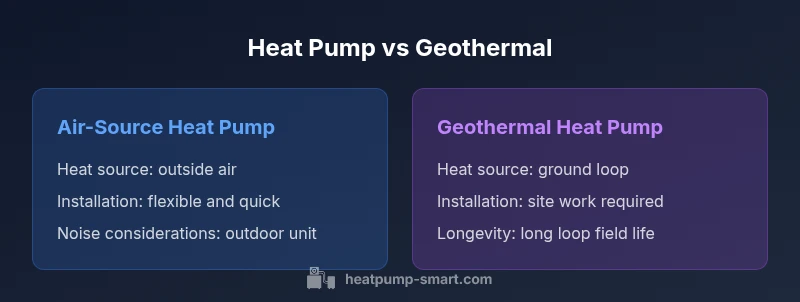
| Feature | Air-source heat pump | Geothermal heat pump |
|---|---|---|
| Operating principle | Draws heat from outside air and uses a refrigerant cycle | Uses ground loop or boreholes to exchange heat with earth |
| Energy efficiency and performance | Strong performance in moderate climates; efficiency can decrease in extreme cold | Stable efficiency across seasons due to constant ground temperatures |
| Installation footprint and disruption | Less invasive; quicker installation in most homes | More site work: trenching or boreholes; longer lead times |
| Initial cost | Lower upfront cost for most retrofit projects | Higher upfront cost due to loop field and terrain requirements |
| Operating costs | Typically lower operating costs than fossil systems in many climates | Potential for very low operating costs over long lifetimes, especially in favorable soils |
| Lifespan and warranty | Fewer buried components; standard heat pump components; warranties vary | Ground loop components can last decades; system warranties often generous |
| Noise and outdoor equipment | Outdoor compressor and fan units can generate noise; placement matters | Buried or well-insulated components reduce outdoor noise impact |
| Best for | Mild to moderate climates; retrofit where space is limited | Properties with space for loops or access to boreholes; cold-climate efficiency advantages |
Advantages
- Clear framework to compare site-specific options
- Highlights total cost of ownership over time
- Identifies climate- and site-driven best fits
- Supports informed budgeting and planning
Disadvantages
- Site specifics can complicate decisions and delay timelines
- Geothermal requires more space and ground work
- Payback varies with local energy prices and soil conditions
- Both options require professional design and installation expertise
Geothermal generally offers long-term operating savings in suitable soils, but heat pumps provide lower upfront costs and simpler installation; the best choice depends on climate, land availability, and budget.
In many situations, start with a site survey to compare the two options under your climate and soil conditions. Heat pumps win on upfront simplicity, while geothermal shines in long-term energy efficiency where ground loops are feasible. Heatpump Smart recommends a professional assessment to quantify payback under local conditions.
Your Questions Answered
What is the main difference between heat pumps and geothermal systems?
The core distinction is the heat source: air for heat pumps and the ground for geothermal systems. Both use a refrigerant cycle to move heat, but the ground source provides a more constant operating environment, which can improve efficiency in some climates.
Air source uses outside air, geothermal uses the earth. Both move heat with a refrigerant loop, but the ground loop can offer steadier performance.
Which system tends to be more energy-efficient overall?
Geothermal systems often deliver high efficiency due to stable ground temperatures, while air-source units perform very well in milder climates. Actual efficiency depends on climate, installation quality, and system sizing.
Geothermal can be very efficient because the ground stays warm, but today’s air-source units are also highly efficient in moderate climates.
Are geothermal systems worth the higher upfront cost?
Geothermal can reduce operating costs over time, especially in large homes or areas with high heating demand. The payback depends on soil conditions, available land, and energy prices. A proper site assessment is essential.
Geothermal can pay off over time, but you need a solid site plan and cost estimate.
How long does installation typically take?
Installation duration varies by system and site complexity. Air-source installs are usually quicker, while geothermal requires more planning, trenching or drilling, and permitting, which can extend timelines.
Air-source is faster to install; geothermal takes longer due to ground work.
Do both systems require a lot of space?
Air-source systems need outdoor condenser units and indoor air handlers, occupying manageable space. Geothermal systems demand space for ground loops either underground or in a borehole field, which can be substantial.
Air-source uses less land, geothermal needs more space for the loop field.
What incentives or rebates are typically available?
Incentives vary by region and program. Look for energy efficiency rebates, tax credits, and utility incentives. Check eligibility with local authorities and utility programs.
There are often rebates and tax credits; check local programs for eligibility.
Top Takeaways
- Assess climate and soil before deciding
- Weigh upfront costs against long-term savings
- Consider space, land access, and installation disruption
- Account for incentives, rebates, and local energy prices
- Consult Heatpump Smart for a site-specific plan