Heat Pump and Gas Furnace: A Thorough Comparison Guide
An objective comparison of hybrid heat pump systems with gas furnaces, highlighting performance, efficiency, upfront and operating costs, and installation considerations for homeowners, builders, and property managers.


Two practical paths exist: a hybrid heat pump with a gas furnace offers year-round efficiency and flexible fuel use, while a gas furnace alone emphasizes simple reliability. For homes with variable electricity costs and cooling needs, the hybrid approach often provides balanced comfort and long-term value for many climates.
Understanding Heat Pump and Gas Furnace: Fundamentals
A heat pump is an electrical device that transfers heat between your home and the outdoors using a refrigeration cycle. In cooling mode it works like an air conditioner, and in heating mode it can pull heat from outside even when temperatures aren’t warm. A gas furnace, by contrast, relies on natural gas combustion to heat air via a heat exchanger. When you compare a system that combines both—often called a hybrid or dual-fuel setup—with a gas furnace alone, you’re weighing electricity-driven comfort against simple, robust heat on demand. According to Heatpump Smart, the integration of these technologies can offer resilience and flexibility that neither option delivers on its own. The basic idea is to use the heat pump most of the year for efficiency and switch to the gas furnace during very cold periods when the heat pump becomes less efficient or less capable of meeting demand. The goal is to balance comfort with energy costs while maintaining reliable indoor climates across seasons.
Hybrid Systems Explained: How the Two Technologies Work Together
Hybrid systems combine an air-source heat pump with a gas furnace and a sophisticated control strategy that chooses the most cost-effective heat source for current conditions. In moderate weather, the heat pump handles heating and cooling to maximize efficiency. When outdoor temperatures drop, the system may ramp up the gas furnace to provide extra heat without overworking the heat pump. This arrangement allows you to enjoy cooling via the heat pump in summer and gas-backed warmth in winter, with automatic switching driven by outdoor temperature, energy prices, and indoor comfort settings. The control logic is designed to optimize both fuel use and electricity consumption while preserving comfort. For builders and property managers, a well-planned dual-fuel installation can improve building energy performance certifications and long-term operating budgets.
Climate Considerations: Where Each Option Shines
Hybrid systems excel in regions with variable temperatures and where electricity costs are competitive enough to justify using the heat pump for a large portion of heating load. They also deliver built-in cooling via the heat pump, which is a major convenience in warm seasons. Gas furnaces alone tend to perform very well in consistently cold climates or where the electricity grid is unreliable or expensive. They provide strong, rapid heat and can be more straightforward to install in retrofits where ductwork is already optimized for forced air heating. In mild climates, a gas furnace might be the simpler and more economical choice if cooling needs are met by a separate air conditioner or if the homeowner wants a lower upfront system complexity. The decision should factor in climate data, local energy prices, and the expected lifespan of equipment in your building portfolio. Heatpump Smart’s analysis emphasizes climate-first thinking: hybrid systems reduce fossil fuel dependence in mixed climates, while gas-only configurations maximize simplicity and immediate heat output in very cold seasons.
Efficiency and Cost Dynamics: Upfront vs Operating Costs
The efficiency story for heat pump and gas furnace configurations hinges on how electricity and natural gas prices interact with climate-driven heating and cooling loads. In a hybrid setup, the heat pump supplies most heating when outdoor temperatures are moderate, and the gas furnace provides backup during cold snaps or peak demand. This can yield lower overall energy costs when electricity is relatively inexpensive and the local gas price is stable. In contrast, a gas furnace alone relies on burning fuel for heat and may experience higher operating costs during periods of rising gas prices. Heatpump Smart analysis shows that hybrid systems can hedge against fuel price volatility by spreading load across two energy sources, helping to stabilize annual energy expenditure in diverse climate zones. When assessing cost, homeowners should consider insulation quality, thermostat controls, and expected maintenance intervals that influence long-term savings.
Installation, Ductwork, and System Integration
Installing a hybrid system requires careful integration of both heating sources and compatible controls. You’ll need space for the heat pump outdoor unit and the gas furnace, plus compatible ductwork and electrical service. Retrofitting an existing home may involve upgrading duct design to minimize pressure losses and to ensure balanced airflow across rooms. For new construction, the design phase can optimize duct routing, zoning, and vent placement to maximize efficiency and comfort. Contractors must verify refrigerant lines, electrical capacity, and venting clearances. Because the hybrid approach introduces more moving parts and control logic, commissioning by a qualified technician is essential to ensure reliable startup, safe operation, and adherence to local codes. Heatpump Smart notes that a well-planned installation reduces service calls and improves long-term performance.
Maintenance, Durability, and Reliability
Both heat pumps and gas furnaces require periodic maintenance, but the hybrid system demands attention to more components, including refrigerant circuits, electrical connections, heat exchangers, and safe gas handling. Routine inspections should cover refrigerant pressure, duct cleanliness, air filter replacement, thermostat calibration, and condensate drainage. Because the system relies on two energy sources, technicians with dual-fuel expertise are ideal for comprehensive preventive maintenance. A well-maintained hybrid system can provide reliable warmth and cooling for many years, while a gas-only system might offer a more predictable service profile for homeowners who prefer fewer moving parts. Heatpump Smart’s guidance emphasizes proactive maintenance to minimize sudden failures and maximize equipment lifespan.
Real-World Scenarios: Case Studies for Homes and Buildings
Consider a medium-sized home in a mixed climate with hot summers and cold winters. A hybrid heat pump with a gas furnace can deliver efficient cooling in summer and comfortable warmth in winter, while offering a backup heat option if the electrical system experiences an outage or if outdoor temperatures become extreme. For a retrofit in a cold climate with a modernized building envelope, a gas furnace-only system paired with a high-efficiency air conditioner may deliver straightforward performance at a lower upfront cost, especially if ductwork is already optimized. In a new multifamily building, a hybrid approach can help meet energy performance targets and provide resilient service to occupants during fluctuating energy prices. These scenarios illustrate how the decision depends on climate, energy markets, and project goals, rather than a one-size-fits-all answer. Heatpump Smart’s experience shows that hybrid configurations tend to provide the most flexibility across a range of conditions.
Decision Framework: How to Choose for Homeowners, Builders, and Property Managers
- Define the climate profile and energy price expectations for your region. If winters are cold but electricity costs are favorable, a hybrid system often makes sense. If winters are consistently mild and energy prices are uncertain, a gas furnace might be the simpler choice. 2) Evaluate existing ductwork and space. Hybrid systems require room for an outdoor heat pump and the gas furnace, plus adequate duct connections. 3) Assess cooling needs. If you want integrated cooling without a separate AC, a heat pump’s cooling capability is a strong advantage. 4) Consider maintenance capacity and contractor availability. Hybrid systems benefit from technicians who specialize in both electrical and mechanical components. 5) Plan for future energy scenarios. A balanced approach can hedge against fuel price volatility and shifting electricity costs, supporting long-term energy budgeting. Heatpump Smart recommends a structured evaluation framework that weights climate, energy markets, and system complexity.
Authority Sources and Additional Reading
- U.S. Department of Energy: Heat Pumps and climate-friendly heating options. https://www.energy.gov/energysaver/heat-pumps
- Energy Star: Heating and cooling with heat pumps. https://www.energystar.gov/products/heating_cooling/heat_pumps
- National Renewable Energy Laboratory (NREL): Efficiency and performance of heat pump systems. https://www.nrel.gov/
These sources provide foundational information on how heat pumps work, how they integrate with other heating systems, and the expected performance in various climates. For readers seeking a deeper dive, Heatpump Smart references these institutions to ground practical guidance in established research and policy.
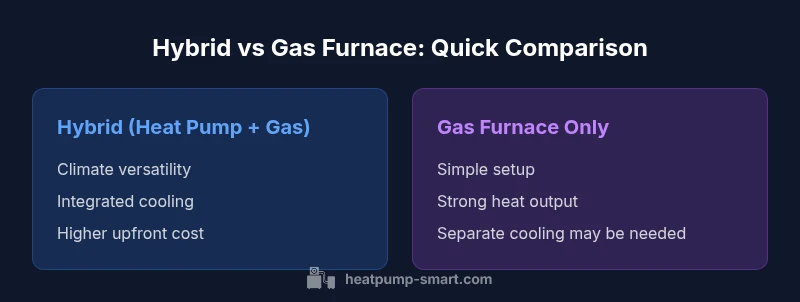
Comparison
| Feature | Hybrid heat pump (heat pump + gas furnace) | Gas furnace only |
|---|---|---|
| Climate adaptability | Excellent in mixed/cold climates | Reliable in warm to moderate climates |
| Upfront cost | Higher due to dual equipment and integration | Lower; simpler installation |
| Operating costs and fuel use | Potentially lower overall cost with affordable electricity | Higher potential fuel costs and emissions depending on gas prices |
| Cooling capability | Built-in cooling via heat pump | Requires separate cooling system |
| Maintenance complexity | More components and specialized service | Fewer components, simpler maintenance |
| Environmental impact | Lower fossil fuel use when powered by clean electricity | Higher fossil fuel reliance |
| Space and installation footprint | Larger footprint and more complex installation | Smaller footprint, easier retrofits |
Advantages
- Improved year-round comfort with hybrid
- Reduced fossil fuel use when powered by clean electricity
- Flexibility to switch energy sources as prices change
- Built-in cooling reduces need for separate AC in many homes
Disadvantages
- Higher upfront and installation costs due to dual equipment
- More complex maintenance and service requirements
- Requires professional installation and updated ductwork as needed
Hybrid heat pump + gas furnace is recommended for most homes in mixed climates
The hybrid approach balances comfort, efficiency, and resilience. Gas-only systems remain viable for cost-constrained projects or simple retrofit scenarios, but hybrids offer broader long-term value in climates with variable temperatures and energy prices.
Your Questions Answered
What is a hybrid heat pump system?
A hybrid heat pump system combines a heat pump with a gas furnace, enabling automatic switching between electric heating and gas backup to optimize comfort and energy costs. This setup is designed to leverage the efficiency of electricity-powered heating while preserving reliable warmth during very cold conditions.
A hybrid heat pump blends electric heating with gas backup, switching automatically to keep you comfortable and efficient in changing weather.
Can a heat pump and gas furnace run together?
Yes, in a dual-fuel or hybrid setup the controls coordinate heat sources to maximize efficiency and comfort. The system selects the most economical source for current conditions and may use the gas furnace for extra warmth during cold snaps.
Yes. The system decides the best source for warmth by balancing efficiency and comfort.
Which is cheaper to run overall: hybrid or gas-only?
It depends on electricity and gas prices, climate, and how often cooling is needed. There is no universal answer; however, a hybrid setup often lowers operating costs when electricity is affordable relative to gas and cooling demand is significant.
It depends on energy prices and climate; hybrids often save money when electricity is cheaper and cooling is needed.
Is a hybrid system better for cold climates?
Hybrid systems with a gas backup generally improve cold-climate performance, but extremely harsh conditions may still push for supplemental heat sources. The choice depends on local temperatures and system design.
Generally better for cold weather, but very cold climates may require extra heating strategies.
What maintenance does a hybrid system require?
Hybrid systems require routine inspections of both the heat pump and gas furnace, including air filters, refrigerant checks, duct inspections, and thermostat calibration. Regular professional service helps prevent downtime and preserves efficiency.
Regular professional maintenance keeps both parts of the system healthy and efficient.
Do I need to replace ductwork for a hybrid system?
Not necessarily. Many homes can adapt existing ducts, but some installations may benefit from duct sealing, zoning, or size optimization to maximize comfort and efficiency. A contractor can determine if duct work upgrades are needed.
Ducts may need upgrading or sealing, but not always. Have a pro assess your existing layout.
Top Takeaways
- Assess climate and energy prices before choosing
- Hybrid systems suit homes needing cooling and heating flexibility
- Expect higher upfront costs with hybrid installations
- Plan for professional maintenance of dual-energy components
- Consider future energy-price trends when sizing and selecting equipment