Heat Pump Choice: A Practical How-To Guide
A thorough, actionable guide to selecting the right heat pump for your home by evaluating climate, sizing, efficiency, and installation considerations.


You will learn how to select a heat pump that fits your climate, home size, and budget. This guide covers choosing between air-source and geothermal systems, estimating load, understanding efficiency metrics, and identifying key installation considerations. By the end you'll have a clear, actionable plan for your heat pump choice.
Understanding heat pump choice and why it matters
Selecting the right heat pump is not just about picking the most expensive or the newest model. The heat pump choice you make affects comfort, energy bills, and long-term reliability. For homeowners and property managers, a thoughtful approach helps balance upfront costs with ongoing savings. This section explains why the right system matters, how climate and usage patterns drive decisions, and what you should expect from a well-muited heat pump. By aligning equipment with your home's thermal profile, you reduce hotspots, drafts, and over-dependence on auxiliary heaters. Heat pumps move heat rather than generate it, making efficiency a natural priority. When you start with a clear goal—reliable year-round comfort, lower energy use, or quiet operation—you can navigate type options and financing more confidently and avoid common missteps.
Climate and home characteristics that shape heat pump choice
Your climate, insulation quality, window efficiency, and occupancy patterns all influence the optimal heat pump solution. In warmer regions, a heat pump with strong cooling performance may be favored, while colder climates require equipment that maintains warmth efficiently at low outdoor temperatures. A thorough assessment should cover insulation gaps, air leakage, thermal mass, and the presence of heat sources like solar gain. By mapping these factors, you can set realistic expectations for comfort, seasonal efficiency, and the role of auxiliary heat when extreme conditions occur. This groundwork directly informs the sizing strategy and the type of heat pump you pursue.
Types of heat pumps: air-source, geothermal, and more
The main branches of heat pump technology include air-source systems, which extract heat from outdoor air, and geothermal (ground-source) systems, which rely on the stable temperatures of the earth. Ductless or mini-split variants offer zoned comfort without ductwork, while ducted systems provide centralized cooling and heating. Each type has trade-offs in upfront cost, installation complexity, and ongoing efficiency. When evaluating options, consider how climate, space, and existing infrastructure align with your long-term goals. Remember: the best heat pump choice balances performance with installation practicality and total lifecycle cost.
Efficiency and performance: what to look for on labels
Efficiency ratings guide how effectively a heat pump converts electrical energy into usable heating or cooling. Look beyond upfront price and focus on long-term operating costs, reliability, and noise profiles. Key concepts include how a model behaves in different seasons, its ability to maintain comfort at low outdoor temperatures, and the consistency of its performance across weather conditions. Ask for seasonal performance indicators and real-world usage data from manufacturers or installers. A well-chosen unit delivers steady comfort with minimized energy fluctuations, even if it isn’t the absolute highest-rated on every metric.
Sizing correctly: why load calculations matter
Correct sizing starts with a formal load calculation performed by a licensed professional. Oversized units waste energy and wear out components quickly, while undersized systems struggle to meet demand during peak cold or heat. The load calculation considers home size, climate, insulation, window performance, and occupancy patterns. Once a precise requirement is established, you can compare models with confidence and avoid the common pitfall of chasing the largest capacity without considering efficiency and cost of operation. A properly sized system is the foundation of reliable comfort and energy savings.
Installation considerations and upfront costs
Installation quality strongly influences performance and reliability. Evaluate electrical service adequacy, ductwork condition, refrigerant line runs, and space for outdoor units. Upfront costs vary with heat pump type, ductwork needs, and the complexity of the installation. While geothermal systems often require higher initial investment, they can offer lower operating costs over time in suitable sites. Align installation expectations with a clear project plan, a detailed quote, and a defined warranty period to protect your long-term investment.
Ducting, zoning, and airflow management
Airflow management is critical for comfort and efficiency. Improper duct sizing or poor sealing undermines performance and creates uneven temperatures. Zoning can improve comfort in multi-room homes by allowing separate temperature control in different areas. When evaluating a system, inspect duct integrity, confirm proper sealing, and discuss zoning options with your contractor. A well-planned ducting strategy enhances comfort, reduces energy waste, and supports consistent performance of the heat pump choice.
Lifecycle costs, rebates, and financing options
Consider total cost of ownership, not just purchase price. Evaluate installation charges, maintenance requirements, electricity use, and expected replacement timelines. Look for available rebates and incentives that reduce upfront costs, and explore financing options to spread payments over time. A wise heat pump choice accounts for tax credits, energy savings, and willingness to undertake any suggested home improvements (like insulation upgrades) that boost overall efficiency and comfort.
Brand and model selection: how to compare effectively
With multiple brands and models, create a comparison framework based on durability, warranty terms, service availability, and performance in winter conditions. Request product brochures, read independent reviews, and verify local support for installation and maintenance. Favor models with clear manufacturer guidance on installation requirements and expected life cycles. A careful comparison helps you identify a heat pump that aligns with your performance and budget goals without sacrificing reliability.
Maintenance, reliability, and warranty expectations
Ongoing maintenance helps protect performance and efficiency. Regular filter checks, coil cleaning, and annual professional inspections are common practices. Confirm warranty coverage for the compressor, refrigerant circuit, and labor, and understand what maintenance tasks are your responsibility vs. the installer’s. Establish a simple maintenance schedule and keep service records to monitor performance over time. A proactive approach reduces the risk of unexpected failures and ensures your heat pump continues to serve your home reliably.
Your decision checklist: steps to finalize a heat pump choice
Create a written decision plan that includes climate considerations, load results, efficiency targets, installation constraints, and budget boundaries. Gather quotes from multiple qualified installers, verify equipment compatibility with your home, and review warranty terms. Confirm rebates and financing, then schedule a final site assessment and a formal proposal. This checklist helps translate research into a solid, actionable plan for your heat pump choice.
Tools & Materials
- Formal load calculation service or software(Manual J calculation by a licensed HVAC professional)
- BTU sizing chart or Manual J calculator(Used to verify system capacity against loads)
- Current utility bills or energy usage data(Baseline to estimate potential savings and load characteristics)
- Access to product brochures or spec sheets(Helpful for side-by-side comparisons)
- Pen and notebook or digital note-taking app(Capture questions, quotes, and decisions)
- Ductwork and home insulation assessment tools(Useful for identifying upgrades that improve efficiency)
Steps
Estimated time: 2-4 weeks
- 1
Assess climate and home characteristics
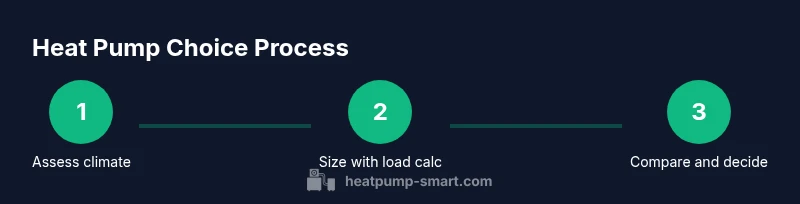
Gather climate data, insulation quality, window efficiency, and occupancy patterns to understand heating and cooling needs. This groundwork informs the heat pump choice and helps set realistic expectations for performance.
Tip: Tip: Start with your current energy bills to estimate baseline load. - 2
Define goals and budget
Clarify priorities such as comfort, energy savings, upfront cost, or noise levels. A clear budget helps you filter options and avoid over-investing in features you won't use.
Tip: Pro tip: Consider long-term savings and maintenance costs alongside upfront price. - 3
Choose heat pump type
Compare air-source vs geothermal in the context of your climate and space. Ductless options offer zoning, while ducted systems provide centralized control.
Tip: Pro tip: Assess existing infrastructure before choosing a type to minimize installation complexity. - 4
Review efficiency metrics
Ask for labels that indicate efficiency in heating and cooling modes. Understand how performance changes with outdoor temperatures and seasonal demand.
Tip: Pro tip: Request real-world performance data from installers or manufacturers. - 5
Size with a formal load calculation
Have a licensed professional perform a Manual J or equivalent. Correct sizing reduces energy waste and improves comfort.
Tip: Pro tip: Do not rely on a single number from a brochure; verify with a professional calculation. - 6
Evaluate installation and warranty
Assess electrical capacity, duct integrity, outdoor unit space, and warranty terms. Installation quality often determines the realized efficiency and longevity.
Tip: Pro tip: Confirm what is covered under warranty and who handles service calls. - 7
Compare quotes and rebates
Solicit multiple quotes, compare included services, and check for rebates or incentives. Align quotes with your budget and the expected lifecycle savings.
Tip: Pro tip: Ensure quotes include duct sealing, air balancing, and post-install verification.
Your Questions Answered
What is the most important factor when choosing a heat pump?
The most important factor is matching the system to your load and climate. A proper load calculation ensures correct size and performance, which directly influences comfort and operating costs.
The key is matching size and climate with a proper load calculation for reliable comfort.
Should I choose geothermal or air-source heat pump?
Geothermal systems often have higher upfront costs but lower operating costs in suitable sites. Air-source systems are typically cheaper to install and easier to retrofit. Your climate, soil, and available space will guide the best choice.
Geothermal can be cost-effective long-term in the right place, but air-source is usually easier and cheaper to install.
How do I determine the right size for my home?
Have a licensed professional perform a formal load calculation (like Manual J). Oversized or undersized units lead to comfort problems and higher energy use.
A professional load calculation ensures proper sizing for your home.
Are rebates or tax credits available for heat pumps?
Rebates and incentives vary by region and program. Check federal, state, and local programs, and ask installers about current offers.
Rebates vary by location; ask installers about current incentives.
What maintenance is required after installation?
Regular filter checks, coil cleaning, and annual service help maintain efficiency and longevity. Keep a service schedule and record all maintenance.
Keep up with routine checks and annual service for best performance.
Can a heat pump completely replace my furnace?
In many cases, a heat pump can meet most heating needs, but in very cold climates, auxiliary heat may still be used. This depends on the system, climate, and home design.
Heat pumps can cover most heating needs, with some auxiliary heat in extreme cold.
Watch Video
Top Takeaways
- Define priorities before evaluating models.
- Accurate sizing prevents wasted energy.
- Compare efficiency, not just price.
- Check rebates and warranties.
- Use a formal load calculation from a professional.