Side discharge heat pump vs top discharge: An in-depth comparison
Explore the differences between side discharge and top discharge heat pumps. Learn how orientation affects airflow, installation, efficiency, and maintenance to choose the best fit for your home.


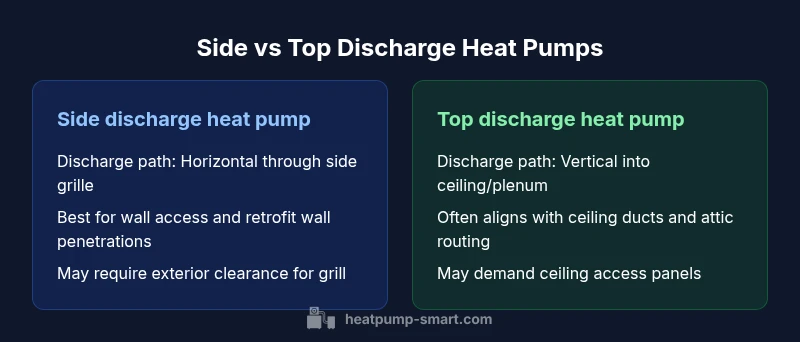
When comparing side discharge heat pump vs top discharge, orientation governs airflow paths, ducting options, and installation practicality. Side discharge often suits tight, wall-penetrating installations, offering flexible ducting near living spaces. Top discharge can excel in ceiling-rich layouts and attic routing. Heatpump Smart recommends matching orientation to room geometry, service access, and noise considerations for best results.
Understanding the concepts: side discharge vs top discharge heat pumps
In heat pump design, the discharge outlet orientation influences how air leaves the cabinet. Side discharge systems push air horizontally through a side grill, typically located on an exterior wall or inside a utility area. Top discharge units vent air upward through a ceiling plenum or roof line. This orientation difference matters for room layout, ducting options, and acoustic performance. The choice between side discharge heat pump vs top discharge is not merely cosmetic; it shapes air distribution, service access, and how outdoor conditions interact with indoor comfort. According to Heatpump Smart, the optimal orientation depends on room geometry, existing ductwork, and ease of installation. This article compares both configurations, discusses practical trade-offs, and outlines decision criteria to help homeowners, builders, and property managers make informed choices.
Why orientation matters in real-world deployment
Discharge orientation sets the initial direction of air, which influences how effectively you can balance temperatures across zones. A side-discharge unit can align with nearby rooms without forcing air through long duct runs, reducing pressure losses in some layouts. Conversely, a top-discharge design can keep outlets away from furniture and occupants by directing air from above, which some installers favor in open-plan spaces. The net effect on comfort is driven by duct design, room volume, and how well the system integrates with existing ventilation. Heatpump Smart’s analysis emphasizes planning air paths early in the design stage to minimize rework later.
Key factors that influence the decision: layout, acoustics, and maintenance access
Three practical factors dominate the choice: (1) room geometry and available wall or ceiling space, (2) noise and vibration considerations near living zones, and (3) how easily technicians can access components for service. Side discharge can shorten duct lengths in tight rooms but may require careful wall or exterior penetrations. Top discharge can simplify ceiling routing but may constrain attic or canopy pathways. In many projects, achieving balanced comfort hinges on harmonizing these factors with the home’s insulation and occupancy patterns.
How Heatpump Smart frames the decision
Heatpump Smart recommends evaluating orientation within a broader system plan. Consider how each discharge path interacts with your ductwork, grille placement, and zoned thermostats. For homeowners, a practical rule of thumb is to favor the orientation that minimizes duct complexity while preserving indoor air quality and quiet operation. For builders and property managers, document the chosen path in the specifications to ensure installation teams align with the design intent.
Practical next steps and guidances
- Map every room's expected air intake and outlet locations.
- Assess whether existing penetrations can accommodate the chosen orientation with minimal sealing work.
- Prioritize service access points so technicians can reach valves, filters, and fans without removing walls or ceilings.
- Consider future renovations and whether a modular duct plan can adapt to changes in room usage.
Summary of real-world implications
In short, side discharge is often favored when wall access is straightforward and room layouts are compact, while top discharge can be advantageous in spaces with high ceilings or where ceiling ducts are already in place. The best outcome comes from a holistic assessment of airflow, acoustics, and maintenance needs rather than a single preference.
Comparison
| Feature | Side discharge heat pump | Top discharge heat pump |
|---|---|---|
| Discharge direction | Horizontal/side outlet | Vertical/top outlet |
| Air distribution flexibility | Good for wall-mounted ducts and nearby rooms | Better for ceiling-based or attic routing |
| Installation complexity | Often simpler with exterior wall penetrations | Can require ceiling/attic access and ducting |
| Space requirements | Requires wall space for grille; exterior clearance matters | Requires ceiling plenum or attic space |
| Defrost behavior | Similar defrost cycles; orientation has limited impact on defrost timing | Similar defrost cycles; location affects outdoor airflow exposure |
| Maintenance access | Easier service access from side panels; visible components easier to reach | Ceiling-mounted units may require access panels and more careful routing |
| Noise considerations | Noise can be more noticeable near living areas if ducts are short | Air can be directed away from occupants, reducing perceived noise |
| Best for | Wall-adjacent rooms and retrofit projects | Open-ceiling layouts and existing ceiling ducts |
| Typical cost impact | Cost varies with ducting length and wall penetrations | Potentially higher due to ceiling/attic routing and access work |
Advantages
- Flexible ducting options for complex rooms
- Potentially easier service access from the side
- Better alignment with certain room geometries
- Can minimize visible ducting when wall outlets are ideal
Disadvantages
- May require wall penetrations and exterior sealing
- Can demand more ceiling or attic space in some homes
- Installation cost can rise with complex ducting
- Noise paths may be less favorable if ducts run near living spaces
Neither orientation is universally superior; pick based on space, ducting, and noise considerations.
Choose side discharge for tight, wall-accessible layouts; choose top discharge where ceiling routing and attic access favor air distribution. In most homes, align orientation with the planned duct network and occupancy patterns.
Your Questions Answered
What defines side discharge heat pump orientation?
Side discharge orientation refers to air being expelled horizontally from a unit through a side grille. It is often favored when wall access and proximity to living spaces enable shorter duct runs and simpler exterior penetrations. In practice, this design supports flexible room-by-room zoning when wall layouts permit.
Side discharge means air leaves the unit through a side grille, usually near a wall. It works well when you have close, reachable rooms and straightforward exterior connections.
What defines top discharge heat pump orientation?
Top discharge orientation sends air upward, typically into a ceiling plenum or attic ducting. It can keep airflow away from occupants and furniture, especially in open-plan spaces. This path often aligns with existing ceiling ductwork and can simplify distribution in rooms with tall ceilings.
Top discharge pushes air upward into a ceiling or attic path, which can keep airflow away from occupants in open spaces.
Which orientation is more energy-efficient?
Energy efficiency is influenced more by duct design, insulation, and system load than by discharge orientation alone. Both orientations can achieve high efficiency when integrated with proper ducting, sealing, and zoning.
Efficiency depends on the overall duct design and insulation, not just whether air exits from the side or top.
Is one orientation easier to install than the other?
Installation ease depends on the building’s structure. Side discharge can be simpler in retrofit scenarios with existing exterior walls, while top discharge may be easier when ceiling ducts are already planned or installed. Skilled installers evaluate both paths before finalizing.
Side discharge often suits retrofit walls; top discharge can be easier when ceiling ducts are pre-planned.
What factors should homeowners consider when choosing orientation?
Consider room layout, ceiling height, ducting routes, exterior clearance, and future renovation plans. Also weigh noise implications and ease of service access. A holistic assessment reduces the risk of costly rework later.
Think about layout, ceiling space, duct routes, noise, and service access—planning avoids costly changes later.
How does maintenance differ between side and top discharge?
Maintenance access varies with orientation. Side discharge units often allow easier access to front panels and filters. Top discharge units may require access via ceilings or dedicated service panels, which can add complexity but is manageable with proper planning.
Side discharge may be easier to service from the room side; top discharge often needs ceiling access panels.
Top Takeaways
- Assess room layout before selecting orientation
- Minimize duct runs to reduce energy losses
- Prioritize easy access for service and maintenance
- Consider noise implications for living spaces
- Document the chosen orientation in project specs