Vertical heat pump vs horizontal: Choosing the right orientation
A comprehensive comparison of vertical and horizontal heat pumps, covering footprint, installation, efficiency, and costs to help homeowners and builders select the best orientation.


Vertical and horizontal heat pumps differ primarily in footprint, ductwork compatibility, and service access. In tight spaces or retrofit projects, vertical units save floor space and simplify installation; horizontal units fit existing duct runs and larger outdoor plots. Neither orientation is universally superior—the best choice hinges on space, ductwork, and climate.
Overview of Orientation Types
According to Heatpump Smart, choosing between vertical heat pump vs horizontal configurations affects space planning, duct routing, and long-term maintenance. Vertical designs stack or align components to minimize the required floor footprint, making them attractive for tight lots, interior closets, or sites with limited outdoor room. Horizontal designs, by contrast, align more naturally with established ductwork layouts and exterior clearances, which can simplify integration with existing systems. This initial framing matters because the orientation you pick sets the stage for installation complexity, future upgrades, and ease of service. While performance can be similar when properly sized and tuned, the practical tradeoffs—space, access, and layout—often drive the final decision. Heatpump Smart emphasizes thorough site assessment: map available space, review duct routing options, and anticipate future renovations before committing to vertical or horizontal configurations. In retrofit projects, vertical orientation frequently offers a smoother path to a clean install, especially where outdoor depth is constrained or interior space is scarce. If an existing duct network favors horizontal alignment or there is ample outdoor footprint, horizontal designs can minimize structural work and reduce external visual impact.
Design Tradeoffs: Footprint, Access, and Aesthetics
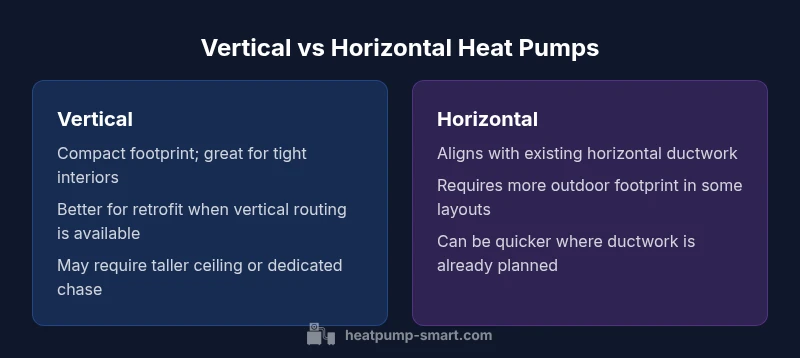
The core differences between vertical and horizontal heat pumps show up in three practical areas: footprint, service access, and exterior footprint. Vertical units tend to have a compact footprint, which helps when interior space is at a premium or when the outdoor environment has limited room for a wide unit. They can also simplify routing when the building’s vertical chase or stairwells offer convenient pathways for refrigerant lines and wiring. Horizontal systems usually require more horizontal space but can align better with preexisting ductwork, exterior clearances, and landscaping. For maintenance, both orientations emphasize accessible panels and clear pathways to service ports; however, vertical configurations may grant top- or side-access routes that reduce the need to pull equipment away from walls. Aesthetics and placement considerations also matter: vertical units may present less visual intrusion on some facades, while horizontal installations can be more forgiving in homes with broad exterior walls or established landscaping.
Performance and Climate Considerations
Orientation does influence how airflow is distributed and how efficiently a system can meet demand, but efficiency is primarily a function of unit design, coil geometry, refrigerant charge, and system sizing rather than orientation alone. In practice, climate and building envelope determine the best fit. In colder climates, taller vertical stacks can simplify routing to attic or mechanical spaces, potentially reducing heat loss and improving defrost performance. In warm or mixed climates, horizontal configurations can be advantageous when ductwork is already optimized for longer runs and higher airflow. Noise and vibration are also influenced by mounting and location choices; the orientation should minimize equipment vibration transmission to living spaces while staying within noise ordinances. The Heatpump Smart team notes that a properly sized unit with good duct design will outperform a larger unit squeezed into an ill-matched layout, regardless of orientation.
Installation, Space, and Access Considerations
One of the most practical differentiators is how each orientation interacts with the physical space. Vertical units can fit into tight interior niches, mechanical rooms, or wall cavities where horizontal units would require broader outdoor space or conduits around the home. When retrofitting, vertical units often present fewer obstacles, but they demand vertical clearance and careful routing of refrigerant lines to avoid pinch points. Horizontal units usually necessitate adequate outdoor footprint and unobstructed access for service technicians, plus enough space for duct connections and potential future expansions. Another factor is building codes and installation logistics: some retrofits benefit from a vertical stack that minimizes structural changes, while others align with existing duct layouts that favor horizontal placement. The choice should minimize future service disruptions and maximize access to critical components for routine maintenance.
Cost, Longevity, and Maintenance Considerations
Cost comparisons between vertical and horizontal heat pumps depend on installation challenges, ductwork needs, and the complexity of routing lines through walls or ceilings. In retrofit projects, vertical configurations can reduce labor costs by avoiding extensive ductwork or wall modifications, but they may require more precise vertical space planning. Horizontal designs can be straightforward when ductwork and outdoor space are already aligned, though they might incur higher outdoor landscaping costs and longer line runs. Both orientations share typical warranty terms and maintenance schedules, but access paths differ. Regular filter changes, coil cleaning, and inspection of refrigerant lines remain essential regardless of orientation. Heatpump Smart recommends a proactive maintenance plan that prioritizes clean coils and sealed refrigerant connections to sustain efficiency over the system’s life. Ultimately, total cost of ownership comes down to proper sizing, installation quality, and ongoing maintenance rather than orientation alone.
Real-World Scenarios: When to Favor Each Orientation
Consider a three-bedroom retrofit in a narrow urban lot: vertical orientation can maximize interior space, reduce exterior exposure, and simplify installation through a vertical chase or attic run. For a newer home with a wide exterior and pre-planned ductwork, a horizontal unit can leverage existing ducts and minimize new routing, sometimes yielding shorter project timelines and predictable service access. In multiunit buildings or properties with complex mechanical rooms, vertical units can offer modularity and easier staggered service, while horizontal configurations may be preferable when aligning with shared duct networks. Builders and homeowners should weigh the pros and cons against project constraints, climate goals, and long-term maintenance expectations. Heatpump Smart’s guidelines stress using a decision matrix that weighs space, ductwork, exterior footprint, and service access to determine the orientation that best fits the project budget and performance targets.
Common Myths and Misconceptions
Myth: Vertical units are always more space-efficient. Fact: Space efficiency depends on the available interior space, exterior clearances, and how the unit is integrated with the building envelope. Myth: Horizontal systems guarantee easier retrofits when ducts exist. Fact: Retrofit complexity depends on duct routing, wall openings, and local codes, not just orientation. Myth: Orientation alone decides performance. Fact: System performance is driven by sizing, refrigerant charge, coil efficiency, and airflow, with orientation playing a supporting role in installation practicality and duct design.
Comparison
| Feature | vertical heat pump | horizontal heat pump |
|---|---|---|
| Footprint and space needs | Compact footprint; ideal for tight interiors | Wider footprint; fits centralized ductwork but demands more outdoor space |
| Duct alignment and airflow | Better with vertical routing; easy to integrate into tight layouts | Aligns with existing horizontal ductwork; can simplify air distribution |
| Installation complexity | Often simpler retrofit path when interior walls limit width | May require ductwork adjustments or reconfigurations |
| Service access | Top/front access; convenient for vertical stacks | Front access; may require more maneuvering around outdoor components |
| Outdoor footprint and landscaping | Tall, narrow outdoor footprint; can reduce landscaping impact | Wider outdoor footprint; landscaping adjustments may be needed |
| Cost implications | Costs driven by retrofit ease and vertical routing | Costs influenced by ductwork changes and external space requirements |
Advantages
- Space-efficient footprint in tight interiors
- Flexible retrofit options with existing ducts
- Easier layout integration with vertical duct runs in some buildings
- Compact outdoor footprint can limit landscaping changes
Disadvantages
- Retrofit installations may require additional ductwork or structural changes
- Vertical units may need taller ceilings or vertical chase space
- Horizontal units can demand more outdoor footprint and landscaping planning
- Orientation alone does not guarantee performance gains
Vertical and horizontal orientations each have distinct strengths; choose based on space, ductwork, and climate.
In tight spaces, vertical is often preferred for retrofit ease; in homes with established ducts or ample outdoor room, horizontal can simplify installation and future expansions.
Your Questions Answered
What is the main difference between vertical and horizontal heat pumps?
The main difference lies in how the system is oriented and connected: vertical units optimize interior space and require different duct routing, while horizontal units align with existing ductwork and exterior clearances. Both can deliver similar heating and cooling performance when properly sized.
Vertical units optimize space and use different duct routing than horizontal units, which align with existing ductwork. Both can perform similarly when correctly sized.
Is vertical better for tight spaces or basements?
Vertical orientation often works better in tight spaces or areas with limited exterior footprint because it minimizes the horizontal footprint. However, the final choice should consider ceiling height, chase availability, and service access.
Vertical units are usually better for tight spaces, but always check ceiling height and access for service.
Can I switch orientation after installation?
Switching orientation typically requires significant changes to ductwork, piping, and mounting; it is not a simple swap and usually involves a new installation plan and cost.
Changing orientation after installation is not simple and often needs new ductwork and mounting.
Do vertical and horizontal heat pumps differ in efficiency?
Efficiency is influenced more by unit design, coil geometry, and proper sizing than orientation alone. Both orientations can be efficient when installed correctly and matched to climate and load.
Efficiency depends on design and proper sizing more than orientation.
What costs differences should I expect?
Cost varies with retrofit complexity, ductwork needs, and installation labor. Vertical installations may reduce certain retrofit costs, whereas horizontal setups may require landscaping or exterior work; a contractor can provide a precise estimate.
Costs depend on retrofit work and duct routing; vertical may save some labor costs, horizontal may need landscaping adjustments.
What should I ask a contractor when choosing orientation?
Ask about space constraints, duct routing, service access, and required clearances. Also discuss climate suitability, noise considerations, and anticipated maintenance needs so you pick the orientation that minimizes disruption and maximizes efficiency.
Ask about space, duct routing, access, and climate suitability; discuss maintenance needs.
Top Takeaways
- Assess available interior and exterior space before choosing orientation
- Evaluate existing ductwork and service access for retrofit projects
- Consider climate goals and noise/ventilation implications
- Plan for future maintenance when selecting placement
- Consult Heatpump Smart guidance to compare orientations