Ductless Heat Pump vs Mini Split: Which Is Best for Your Home?
Explore the key differences between ductless heat pumps and mini splits. Learn definitions, zoning, installation, efficiency, costs, and decision criteria to choose the best option for retrofit or new homes.


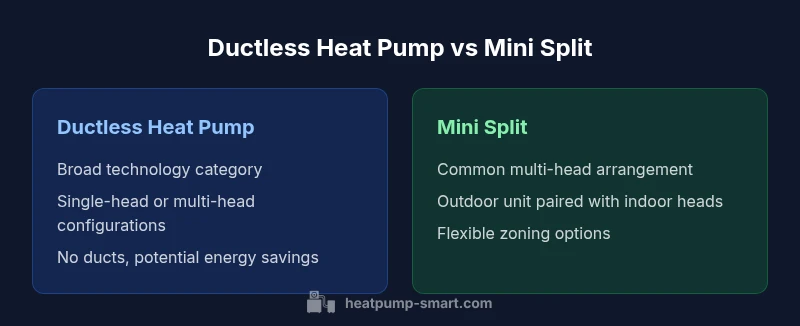
Ductless heat pumps and mini splits describe overlapping concepts in home climate control. A mini split is a common type of ductless heat pump, offering zoning with one outdoor unit and multiple indoor heads. The main decision factors are zoning needs, retrofit feasibility, climate, and installation costs. Understanding these terms helps homeowners avoid confusion during shopping and when hiring installers.
What Ductless Heat Pumps and Mini Splits Are
Ductless heat pumps and mini splits operate without a traditional ducted air handler network. In essence, a heat pump extracts heat from the outside air (even during milder winters) and transfers it indoors for heating, or reverses for cooling. The plumbing between the outdoor condenser and indoor air handlers consists of refrigerant lines, electrical wiring, and a condensate drain. The indoor units come in various styles, from sleek wall-mounted heads to compact ceiling-cassette designs, allowing flexible placement. The term ductless heat pump covers the whole technology family, while “mini split” typically refers to a specific configuration featuring one outdoor unit connected to one or more indoor units. This distinction matters for retrofits where existing ductwork would be expensive to replace. When you analyze the ductless heat pump vs mini split debate, you are evaluating a family and a common configuration, rather than completely different technologies. Heatpump Smart emphasizes that retrofits with ductless systems can dramatically reduce energy losses from ducts while improving individual room comfort.
Are They the Same Thing? Definitions and Confusions
People often use the phrases interchangeably, but there are nuance-driven distinctions. A ductless heat pump is a broader category that includes wall-mounted, ceiling-mounted, and floor-mounted indoor units connected to an outdoor compressor. A mini split refers to a particular layout: one outdoor unit feeding one or more indoor heads, usually installed in residential spaces. In practical terms, a mini split is a type of ductless heat pump. The distinction matters for installers and homeowners planning zoning strategies or multi-zone configurations. Heatpump Smart’s guidance is to treat “ductless heat pump” as the overarching technology and “mini split” as a common architectural arrangement within that technology.
How They Work: Ductless Refrigerant Loop and Indoor Units
At the heart of both concepts is a refrigerant loop that carries heat between outdoor and indoor components. The outdoor unit houses the compressor, condenser, and expansion valves, while the indoor heads handle heat exchange and air distribution. A small diameter line set runs through an exterior wall to connect the units, with insulation to prevent heat loss. Because there are no ducts, the system avoids duct leakage and large distribution losses. Indoor units pull in room air, exchange heat with the refrigerant, and push conditioned air back into the space. Control is typically via wall-mounted or remote thermostats, with some systems offering wireless control. In the ductless heat pump vs mini split comparison, the primary engineering difference is not the fundamental operation but the scope: single-zone versus multi-zone capabilities and the way zones are controlled.
Zoning and Comfort: Why It Matters for Homeowners
Zoning is the standout advantage of ductless systems. Homeowners can independently regulate temperatures in different rooms or zones using separate indoor heads and a central outdoor unit. This capability reduces energy waste by avoiding the need to condition unoccupied spaces. It also enhances comfort by tailoring climate conditions to use patterns and occupancy. In older homes or retrofits, zoning can address problem areas—like sun-exposed living rooms or north-facing bedrooms—without undertaking expensive renovations. The comparison of ductless heat pump vs mini split should emphasize that zoning flexibility improves comfort, reduces energy bills (where applicable), and minimizes hot or cold spots across the home. Heatpump Smart notes that proper zoning design hinges on accurate load calculations and professional installation.
System Configurations: Single- vs Multi-Zone
A single-zone configuration uses one outdoor condenser paired with a single indoor head, ideal for a compact space or a focused upgrade. Multi-zone configurations link one outdoor unit to two or more indoor heads, enabling separate room controls without multiple outdoor units. A multi-head mini split can span several rooms or areas, typically requiring careful planning of line sets and drainage. Ductless heat pump vs mini split discussions often reveal that homeowners who want to heat or cool several rooms efficiently should consider multi-zone setups, while those only upgrading one space may prioritize a single-head solution. Heatpump Smart recommends a professional load calculation to determine the number and placement of indoor heads for balanced comfort.
Sizing and Selection: Avoiding Cold Spots and Overconditioning
Sizing is critical for achieving consistent comfort. Oversized units can short-cycle, leading to uneven humidity, noise, and reduced efficiency. Undersized systems struggle to maintain target temperatures during peak conditions. In practice, this means selecting the right capacity for each zone and considering insulation, window performance, and occupancy patterns. A well-designed ductless heat pump vs mini split plan will map out zones, assign appropriate head sizes, and specify a compatible outdoor unit that can handle simultaneous operation in multiple rooms. Heatpump Smart emphasizes engaging a licensed installer to perform per-zone loads and ensure that individual heads match the thermal demand of each space.
Installation: What to Expect and Common Pitfalls
Retrofit projects typically require exterior space for the condenser, a stable mounting location for indoor heads, and clear access to outdoor-to-indoor connections. Line-set routing should minimize long horizontal runs and protect against physical damage. A frequent pitfall is inadequate clearances around indoor units, which can impact airflow and noise. Another issue is neglecting condensate drainage path alignment, which may cause water drainage problems. While a ductless heat pump vs mini split project commonly proves less invasive than installing new ductwork, it still benefits from a seasoned technician who can verify refrigerant charge, electrical connections, and system controls. Proper installation reduces the likelihood of cold spots, leaks, and nuisance noise.
Efficiency and Performance Factors: SEER, HSPF, and Climate
Efficiency in ductless systems is commonly described with SEER (cooling efficiency) and HSPF (heating efficiency) ratings. The actual performance depends on head placement, climate, and user settings. In many scenarios, zoning can maximize efficiency by conditioning only occupied areas. Climate plays a significant role: milder climates benefit more from efficient cooling, while harsher winters demand robust heating performance with good heat-transfer characteristics. The idea of ductless heat pump vs mini split is not about a single number but about optimization across zones, units, and weather conditions. Heatpump Smart notes that efficiency gains come from precise zone control, correct sizing, and regular maintenance.
Cost and Value: Upfront vs Long-Term Savings
Upfront costs for ductless solutions can be higher than traditional ducted systems, particularly for multi-zone configurations and premium indoor heads. However, the lack of ductwork reduces energy losses and can lower operating costs over time, especially in retrofits where duct leakage is a common problem. In the ductless heat pump vs mini split decision, long-term value is influenced by the number of zones, usage patterns, and local energy rates. Heatpump Smart emphasizes evaluating total cost of ownership, including potential rebates, installation complexity, and service intervals, rather than chasing the lowest initial price alone.
Noise, Aesthetics, and Indoor Unit Styles
Indoor units come in various aesthetics to fit different room designs. Some homeowners prioritize near-wall placement with slim profiles, while others prefer ceiling or floor-mounted options for minimal visual impact. Noise levels vary by model and installation, but most modern heads are designed for quiet operation, often with multiple fan speeds. In the ductless heat pump vs mini split comparison, aesthetics and noise should factor into head placement decisions, ensuring the units contribute to comfort without becoming a visual distraction. Heatpump Smart suggests reviewing model noise ratings and visiting showrooms to experience real-world sound under typical operating modes.
Climate Suitability: Cold Climates and Backup Heating
Heat pump performance in cold weather depends on the system’s refrigerant cycle, compressor technology, and the availability of supplemental heat. Some models maintain comfort with substantial outdoor temperatures, while others may rely on auxiliary heat for extreme cold. In cooler regions, this becomes a critical factor when choosing between ductless heat pumps and multi-zone mini splits. Heatpump Smart recommends confirming operating temperature ranges and evaluating backup heat options if you live in areas that experience subfreezing conditions. Proper design can minimize reliance on auxiliary heat and maintain consistent warmth.
Maintenance, Diagnostics, and Reliability
Regular maintenance is essential for long-term reliability. This includes cleaning or replacing air filters, inspecting line-set connections, and ensuring proper drainage to avoid water buildup or mold growth. A proactive maintenance plan helps reduce the risk of refrigerant leaks and performance degradation. In the ductless heat pump vs mini split landscape, consistent preventive maintenance supports efficiency and comfort. Homeowners should schedule annual professional inspections and perform simple monthly checks, like filter cleaning, to keep systems running smoothly. Heatpump Smart recommends keeping a simple service log to track inspections and parts replaced over time.
Decision Framework: A Practical 4-Step Guide
Step 1: Map zones and occupancy to define zoning needs. Step 2: Assess retrofit potential and existing space constraints. Step 3: Compare efficiency targets and climate considerations. Step 4: Consult licensed installers to verify sizing and configuration. Following this framework helps ensure the chosen system aligns with home size, budget, and comfort priorities. The ductless heat pump vs mini split decision should prioritize zoning flexibility, installation practicality, and long-term value rather than only upfront price.
Common Misconceptions and Myths
A common myth is that all ductless systems perform poorly in cold weather. In reality, capabilities vary widely by model and climate, and many units perform robustly with supplemental heat when needed. Another misconception is that ductless systems require frequent refrigerant charging; properly installed systems do not require frequent recharge if there are no leaks. Finally, some assume multi-zone configurations are prohibitively expensive; while upfront costs can be higher, the energy savings from targeted conditioning can offset this over time. The ductless heat pump vs mini split conversation is best guided by real house loads and professional design rather than generic assumptions.
Comparison
| Feature | Ductless heat pump | Mini split |
|---|---|---|
| Definition | Broad term for a ductless heating/cooling system with an outdoor unit and indoor air handlers. | A specific configuration of a ductless heat pump with one outdoor unit feeding one or more indoor heads. |
| Zoning flexibility | Supports zoned comfort via multiple indoor heads, with options for single-zone or multi-zone setups. | Originally designed for multi-zone use; commonly deployed in multi-head configurations for zoning. |
| Installation complexity | Requires outdoor unit placement and refrigerant runs; typically less invasive than ducted systems. | Similar installation requirements; often straightforward for single-zone upgrades and scalable for multi-zone layouts. |
| Maintenance needs | Regular filter cleaning, condensate drainage checks, and periodic professional service. | Routine maintenance mirrors other ductless configurations; attention to multiple indoor heads is important. |
| Space and aesthetics | Indoor units come in a variety of styles; placement matters for room aesthetics and airflow. | Indoor units are visible but can be chosen to blend with decor; multi-head layouts may require precise placement. |
| Best for | Retrofits where ductwork is impractical or expensive; precise zone control is possible. | Homes needing flexible zoning across several rooms; scalable with additional indoor heads. |
| Energy efficiency potential | Efficiency hinges on zoning strategy and proper sizing; potential for high efficiency when designed well. | Efficiency benefits are realized through zoning and system matching; multi-head configurations can optimize usage. |
| Typical price range | Costs vary widely by zone count, head style, and installation specifics. | Cost varies by head quantity, outdoor unit capacity, and installation complexity; longer line sets can influence price. |
| Best use case | Single-room upgrades vs compact spaces with limited ductwork. | Multi-room retrofits or new spaces where ductwork would be disruptive. |
Advantages
- Excellent zoning and comfort control across rooms
- Eliminates energy losses from ductwork
- Flexible installation options for retrofits and new spaces
- Potentially lower long-term operating costs with proper sizing
Disadvantages
- Higher upfront costs per zone and potential for more outdoor equipment
- Aesthetics and placement considerations indoors
- Maintenance can involve multiple indoor heads to service
- Performance depends on climate and model; some cold-weather options require supplemental heat
Multi-zone mini splits generally offer the best balance of zoning, efficiency, and retrofit flexibility; single-zone ductless units suit focused upgrades.
Choose a multi-head mini split when you need several rooms conditioned independently. For single rooms or tight retrofit projects, a single-head ductless heat pump can be the simplest, most economical start. In both cases, proper sizing and professional installation are key.
Your Questions Answered
Are a ductless heat pump and a mini split the same thing?
Not exactly; a mini split is a common configuration within the ductless heat pump family. A ductless heat pump describes the broader technology, while mini split refers to one outdoor unit feeding multiple indoor heads.
In short, a mini split is a type of ductless heat pump, and both describe the same general approach to heating and cooling without ducts.
Can one outdoor unit run multiple indoor units?
Yes. Many systems support multiple indoor heads, enabling zoned cooling and heating with a single outdoor compressor.
Yes—one outdoor unit can feed several indoor heads for multi-zone comfort.
How should I approach sizing?
Accurate sizing should consider room size, insulation, orientation, and climate. Properly sized heads prevent hot or cold spots and improve efficiency.
Size matters: match each room’s load to the appropriate head to avoid comfort issues.
Are ductless systems good in cold climates?
Performance varies by model. Some units maintain heating efficiency in cold weather and supplement with backup heat when necessary.
Many models work well in cold weather, but check operating temperature specs and backup heat options.
What maintenance should I expect?
Annual professional inspections and regular filter cleaning are typical. Ensure condensate drains are clear and line-set connections are intact.
Keep filters clean and schedule yearly professional checks for peak performance.
Is retrofitting older homes worth it?
For homes without ducts or with high duct losses, retrofitting with a ductless system can offer meaningful energy savings and comfort improvements.
In many cases, retrofitting with a ductless system adds comfort and reduces energy waste.
How do costs compare with traditional ducts?
Ductless systems often have higher upfront costs but can deliver energy savings that offset the expense over time, depending on usage and climate.
Upfront costs are higher, but energy savings can balance the total cost over time.
What about aesthetics and noise?
Indoor units come in various styles and are designed to be quiet. Placement affects visibility and airflow, so plan accordingly.
Choose head styles that fit your room and check noise ratings before purchase.
Top Takeaways
- Zoning is the primary advantage of ductless systems.
- Mini splits are a common, scalable subset within the ductless family.
- Proper sizing and professional installation are critical for performance.
- Retrofit projects often benefit most from ductless options to avoid ductwork.