Mini split heat pump vs central air: A practical comparison
An objective guide comparing mini split heat pumps and central air, focusing on zoning, efficiency, installation, maintenance, and long-term value for home comfort.


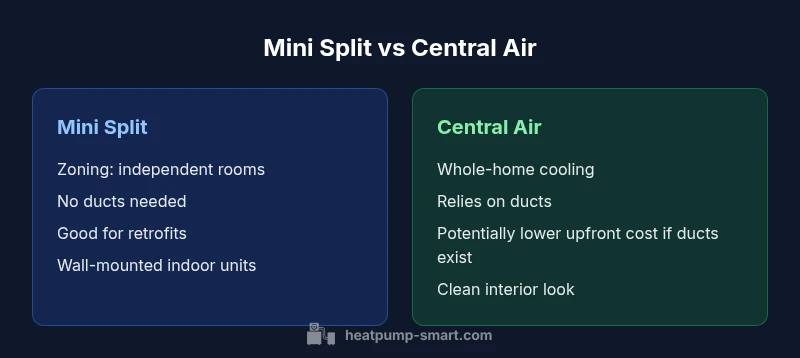
Mini split heat pump vs central air: For many homes, ductless mini splits offer superior zoning, flexibility, and efficient cooling in retrofit projects. Central air provides straightforward, whole-house cooling when ductwork exists. According to Heatpump Smart, the right choice hinges on climate, home layout, and retrofit goals. In both cases, proper sizing and professional assessment matter.
What are mini split heat pumps and central air systems?
A mini split heat pump is a ductless cooling and heating solution that uses an outdoor condenser connected to one or more indoor air handlers mounted in individual rooms or zones. Central air, by contrast, relies on a single ducted network that distributes conditioned air through registers across the home. The key difference is ductwork: mini splits do not require it, while central air depends on it. For homeowners evaluating the two, the choice often hinges on retrofit feasibility, space constraints, and the desire for zoning. Heatpump Smart analysis shows that ductless units shine in flexible layouts and targeted cooling, while central air offers a familiar, uniform cooling experience for larger open spaces. When deciding, consider climate seasonality, existing construction, and long-term comfort goals. This guide weighs the practical implications rather than pure theory, helping homeowners, builders, and property managers make informed decisions for both new builds and retrofits.
Zoning, space usage, and lifestyle needs
Zoning is a primary differentiator between mini splits and central air. A single central system cools the entire home uniformly, which can be ideal for open-plan spaces or homes with consistent occupancy. Mini splits allow independent control of each room or zone, saving energy by avoiding cooling unoccupied spaces. For homes with diverse occupancy patterns—such as a main suite used at night and a living area used during the day—the ability to tailor temperature by zone can dramatically improve comfort and efficiency. Practically, most multi-bedroom homes benefit from a hybrid approach: use central air for common areas and a mini split for bedrooms or sunrooms. The Heatpump Smart team notes that zoning can translate into meaningful comfort gains and energy savings when implemented thoughtfully.
Energy efficiency, performance in different climates, and heat pump capabilities
Energy efficiency is central to the mini split vs central air decision. Mini splits, which operate as heat pumps, offer heating and cooling in a single system, with performance that adapts to space and usage. They are often more efficient in variable climates and can maintain comfort in zones with lower conditioning needs. Central air systems paired with a furnace or air handler provide robust cooling, and with high-efficiency components, can be very efficient in even temperatures. Heat pump behavior is highly climate dependent; in milder to moderate climates, mini splits can deliver superior efficiency year-round, while in extremely cold regions, supplemental heating strategies may be needed. Heatpump Smart's analysis highlights that the best choice depends on local climate patterns, occupancy, and the building envelope’s ability to retain conditioned air.
Installation realities: ductwork, retrofits, and disruption
Installation considerations are often the deciding factor. Mini splits generally require less invasive installation, particularly in homes without existing ductwork. An easy retrofit in a single room or a handful of zones can be achieved with minimal disruption, though outdoor unit placement and refrigerant line routing require planning. Central air needs ductwork; if a home already has ducts, upgrading to a high-efficiency central system can be straightforward. For homes without ducts, the retrofit can be expensive and disruptive. This makes mini splits appealing for older homes, historic renovations, or new constructions where ductwork would be impractical or costly. The practical takeaway: assess the retrofit feasibility and contractor accessibility before committing.
Cost implications, value, and long-term considerations (without specific price quotes)
Cost is the practical counterpoint to capability. Mini splits often carry a higher up-front cost due to multiple indoor units and installation complexity, but zoning can yield savings by conditioning only occupied spaces. Central air typically leverages existing ducts and can be cheaper to install if ducts are present or easy to add, but ongoing maintenance may involve more extensive ductwork cleaning and filter replacement. Long-term value depends on how well the system matches the home’s layout, occupancy patterns, and energy usage. Heatpump Smart emphasizes evaluating total cost of ownership over time, including maintenance cycles, filter replacement, potential refrigerant interventions, and the reliability of the outdoor unit in local weather conditions.
Maintenance, reliability, and filter accessibility
Maintenance is a practical concern that affects both systems but in different ways. Mini splits offer straightforward filter access on each indoor unit, making routine cleaning relatively simple. The absence of ductwork can reduce dust migration and reduce some maintenance tasks. Central air requires duct inspection and occasional cleaning, which can be more involved if ducts are long or complex. Regular filter changes, refrigerant checks (for mini splits) or coil cleaning (for central air), and seasonal inspections help extend system life. The choice may hinge on how much time and effort you want to devote to upkeep, as well as the availability of qualified service technicians in your area.
Noise, aesthetics, and user experience
User experience varies by model and installation. Mini splits place indoor air handlers in individual rooms, which improves comfort control but may introduce visible units on walls or ceilings. Central air typically hides comfort delivery inside walls or ceilings, offering a cleaner interior aesthetic but still producing audible outdoor compressor noise. In smaller spaces, the noise profile of a ductless system can be very favorable, while a well-designed central system can deliver quiet performance in shared spaces. Consider your tolerance for equipment visibility and sound levels when choosing between these options.
How to decide: matching system type to home profile and priorities
Choosing between mini split and central air requires mapping your home profile to system strengths. For new builds with perfectly sealed envelopes, central air can be highly effective if ducts are efficiently designed. For existing homes with limited or no ductwork, or where zoned comfort is a priority, mini splits present a compelling value proposition. In multi-story homes with variable occupancy, a mix of mini splits in bedrooms and a central system for common areas can optimize comfort and energy use. The decision should align with climate realities, occupancy patterns, retrofit feasibility, and long-term maintenance expectations.
Smart controls, rebates, and future-proofing considerations
Smart thermostats and zoning controllers can enhance both mini split and central air systems. With mini splits, you can run different zones independently, enabling precise comfort and energy savings. Central air can also benefit from smart controls, especially when paired with a zoned system or a compatible furnace. Rebates and incentives exist at federal, state, and utility levels, though eligibility varies by system type and local programs. Heatpump Smart notes that selecting a system with recognized efficiency ratings and compatible smart controls can help future-proof your investment and maximize long-term value.
Comparison
| Feature | mini split heat pump | central air |
|---|---|---|
| Zoning flexibility | Excellent multi-zone control with independent indoor units | Good to fair, depends on existing ducts and zoning controls |
| Ductwork requirement | No ducts required; uses wall/ceiling-mounted air handlers | Requires ducts for distribution; may reuse existing ducts |
| Retrofit ease | Easier to install in retrofit projects; minimal space disruption | Harder if ducts are absent or in poor condition; can be disruptive |
| Installation footprint | Outdoor condenser plus indoor units; footprint varies by zones | Single centralized location with duct network; attic/garage space often used |
| Maintenance complexity | Individual units simplify routine servicing; easy filter access | Duct cleaning and central filter access can be more involved |
| Heating capability | Integrated heating with heat pump functionality; versatile in mild climates | Heating relies on separate furnace or heat source; may be less flexible in mild climates |
| Noise and aesthetics | Indoor units visible in each room; outdoor unit is dedicated | Cleaner interior with hidden ducts; outdoor unit location matters for noise |
Advantages
- Excellent zoning and space-specific comfort
- Greater retrofit flexibility for older homes
- Potential energy efficiency gains with targeted cooling
- Fewer duct-related leaks and distribution losses
Disadvantages
- Higher up-front cost per zone and unit installation
- Multiple indoor units require more complex scheduling
- Central air can be simpler if existing ducts are well designed
Mini split wins for zoning and retrofit flexibility; central air wins for straightforward, whole-home cooling where ducts exist
Choose mini splits when zoning and retrofit ease matter most. Opt for central air if you already have ducts and desire uniform cooling across the home.
Your Questions Answered
Is a mini split more energy efficient than central air in most homes?
In many cases, mini splits can achieve higher energy efficiency due to zoning and heat pump operation, especially in spaces with variable occupancy. Central air efficiency depends on duct design and overall system efficiency. The best choice depends on climate, home layout, and how you use each space.
Yes, mini splits often offer efficiency advantages through zoning, but the total performance depends on climate and usage.
Can you retrofit central air into a home without ducts?
Retrofitting central air into a ductless home is possible but can be expensive and disruptive. Alternatives include installing zoned ductwork or using a hybrid approach with mini splits for key spaces. A professional assessment helps determine feasibility and total cost.
Retrofitting can be doable but pricey; a professional assessment is essential.
Are mini splits noisy or visually intrusive?
Most modern mini splits produce low indoor noise, and the outdoor unit is typically placed away from living areas. Aesthetics vary by model and placement, with options available to minimize visibility. Sound levels and placement should be discussed with your installer.
Modern units are quiet and placement-aware; talk to your installer about options.
Do rebates or tax credits apply to mini splits?
Rebates and incentives exist for heat pump upgrades in many regions, including mini split installations. Eligibility depends on program rules, efficiency ratings, and installation details. Check local programs and work with a qualified contractor to maximize benefits.
There can be rebates for heat pumps; verify local programs with your installer.
How long does installation typically take for each system?
Installation duration varies with home size, existing infrastructure, and system complexity. Mini splits often install room-by-room over several days, while a central air upgrade may consolidate work but require duct testing and balancing. A detailed site assessment provides a timeline.
Timeline depends on your home and system; get a site assessment for specifics.
Which system is better for new construction?
For new construction, central air with well-planned ducts can be highly efficient and straightforward to manage, especially in open layouts. Mini splits are still viable for zoning in specific areas or where ductwork is restricted. The decision should align with design goals and future flexibility.
In new builds, central air works well with ducts, but minisplits offer zoning options.
Top Takeaways
- Prioritize zoning if comfort in multiple rooms matters
- Assess existing ductwork before choosing central air
- Consider climate influence on heat pump performance
- Plan for installation logistics and long-term maintenance
- Explore tech and rebates to maximize value