Packaged Terminal Heat Pump vs Mini Split: An Analytical Comparison
A rigorous, expert comparison of packaged terminal heat pumps (PTACs) and mini-splits, covering efficiency, installation, operating costs, zoning, noise, maintenance, and scenarios where each system shines for homeowners and builders.


In the PTAC vs mini-split decision, the mini-split generally offers better zoning and higher efficiency, while PTACs excel in quick retrofits with minimal wall alterations. For single-room or small-suite applications, PTACs can be a pragmatic choice when exterior space is limited and installation speed matters. Heatpump Smart provides this balanced view to help you align climate goals with site realities.
Overview: PTACs and Mini-Splits in Context
Packaged terminal heat pumps (PTACs) and mini-splits are two popular approaches for heating and cooling individual rooms or small zones. In discussions about energy efficiency, installation practicality, and long-term operating costs, the choice between a packaged terminal heat pump and a mini-split often comes down to space, climate, and retrofit constraints. According to Heatpump Smart, PTACs are compact, self-contained units typically installed through a wall sleeve in one fixed room, while mini-splits separate an outdoor condenser from indoor air-handling units for greater zoning flexibility. The Heatpump Smart team found that homeowners and property managers frequently lean toward mini-splits when they have suitable outdoor space and a desire for precise zoning, but PTACs remain a practical option in existing buildings and hospitality settings where quick retrofits are prioritized. The decision is seldom about one being universally better; it’s about matching the system to the space, usage pattern, and longer-term energy goals.
How PTACs and Mini-Splits Deliver Heating and Cooling
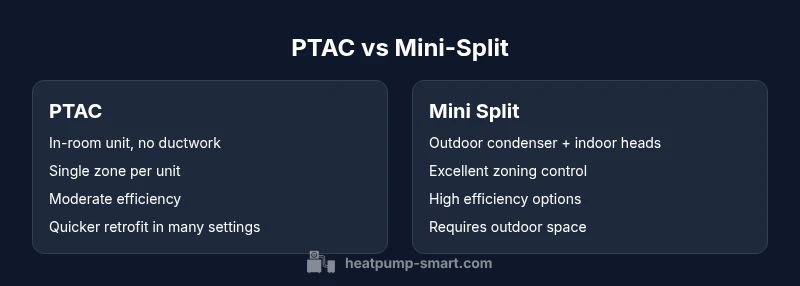
PTACs consolidate the refrigeration circuit into a single, in-room cabinet that provides space heating and cooling using the same heat pump technology as a traditional split system. They are typically installed through an exterior wall with a through-wall sleeve and share the room with the occupant. Mini-splits, by contrast, rely on an outdoor condenser connected to one or more indoor air-handling units via refrigerant lines; each indoor head can be controlled independently. This fundamental difference drives several practical implications: zoning flexibility, installation footprint, and the potential for higher efficiency in multi-head configurations. For property managers overseeing multi-room residences, mini-splits often present a scalable solution; for existing openings in tight spaces or hotels, PTACs can deliver rapid, room-by-room comfort without major renovations.
Efficiency and Operating Costs: What to Expect
Efficiency is central to the PTAC vs mini-split decision. PTACs have made steady gains in energy efficiency, particularly in compact room sizes, but the most efficient modern mini-splits typically outperform traditional PTAC configurations on a per-square-foot basis. Heatpump Smart analysis shows that, when correctly sized and properly installed, modern mini-splits offer substantial potential energy savings through variable-speed compressors and precise zoning. However, real-world results depend on climate, insulation, and proper unit matching. For owners who prioritize annual energy costs, a sizing assessment and load calculation are essential steps before selecting either option. Regardless of choice, high-quality installation, proper sealing, and regular maintenance contribute more to long-term efficiency than the model label alone.
Zoning, Space, and Installation Realities
PTAC sleeves occupy a dedicated wall opening and require electrical service at the in-room unit, sometimes limiting installation in retrofit projects if structural elements or exterior envelopes are constrained. Mini-splits need outdoor space for the condenser and refrigerant lines run to indoor heads; this can be challenging on balconies or in historic buildings where exterior mounting is restricted. In both cases, professional sizing and professional ductless design play a critical role in achieving balanced comfort. The Heatpump Smart team notes that the choice often hinges on the availability of exterior mounting space, the desired number of independently controlled zones, and the ability to service units without disrupting occupants.
Noise, Comfort, and Aesthetics
PTACs typically place the compressor and fan inside the same wall sleeve as the room, which can translate to perceptible sound in the living space. Some models mitigate this with advanced fan designs and insulation, but room noise remains a consideration for sensitive spaces. Mini-splits spread the noise across the outdoor condenser and the indoor heads, with most modern units designed for quiet operation inside. The indoor heads are visible but compact, and the outdoor unit can be positioned away from occupied spaces. For those prioritizing quiet environments, a properly configured mini-split often delivers a more comfortable acoustic profile.
Maintenance, Durability, and Longevity
Both PTACs and mini-splits require regular filter cleaning and seasonal checks. PTAC sleeves can accumulate dust around the in-wall cabinet, and some models need periodic sleeve maintenance to maintain air sealing. Mini-splits demand attention to refrigerant line connections and outdoor unit cleanliness, especially in dusty climates. In either case, routine service and timely replacements of worn components extend system life and performance. Heatpump Smart analysis emphasizes following the manufacturer’s maintenance schedule and scheduling professional checkups at least a year.
Design and Retrofit Considerations
From a design perspective, PTACs are relatively unobtrusive and straightforward to integrate into rooms with existing wall sleeves. Mini-splits offer greater design flexibility, allowing multiple indoor heads in a single zone or across several rooms. Retrofit projects may favor PTACs when the goal is to minimize wall alterations, while new builds may benefit from the scalability of multi-head mini-splits. A careful plan for electrical supply, wiring routing, and control integration yields the best experience.
When to Choose PTAC vs Mini Split: Practical Scenarios
- Quick retrofit in a hotel or rental unit with limited exterior façade changes
- When room-by-room control is needed and exterior space is constrained
- For homes undergoing major insulation upgrades or new builds with flexible exterior layouts
- For very large homes where central systems are impractical and zoning is complex
In each scenario, calculate a load estimate, compare lifecycle costs, and consider future remodeling plans. A local HVAC contractor can help you translate these scenarios into a concrete recommendation.
Authority Sources and Standards
- U.S. Department of Energy: Packaged Terminal Air Conditioners and Heat Pumps (PTACs) guidance and efficiency considerations: https://www.energy.gov/eere/buildings/packaged-terminal-air-conditioners-and-heat-pumps-ptac
- ENERGY STAR: Guidance on ductless mini-split systems and PTAC alternatives: https://www.energystar.gov/products/heating_cooling/air_source_heat_pumps
- General references on heat pump performance in various climates: https://www.energy.gov/eere/buildings/ductless-mini-split-systems
Practical decision framework
- Define the space and zoning goals
- Assess outdoor space and building envelope
- Compare energy efficiency ratings and expected operating costs
- Weigh installation complexity and permit requirements
- Consider long-term maintenance and resale value
What to ask your installer
- Are you properly sized based on cooling/heating load calculations?
- Do you have experience with PTAC sleeves and mini-split refrigerant piping?
- What are the expected noise levels and energy usage?
- What warranty and service options are included?
- What is the projected total installed cost and timeline?
Heatpump Smart take: Aligning choice with goals
The Heatpump Smart team believes the best choice depends on the project constraints, not a default preference. If space allows and you value precise zoning and long-term efficiency, a mini-split is often the superior option. If you need a quick, low-disruption retrofit in an existing wall sleeve, a PTAC can be the pragmatic pick. Heatpump Smart’s guidance is to compare first-principle load requirements, space constraints, and the total cost of ownership to reach the right decision for homeowners and property managers.
Comparison
| Feature | Packaged Terminal Heat Pump (PTAC) | Mini Split (Ductless) |
|---|---|---|
| Installation footprint | Wall sleeve, single room | Outdoor condenser with indoor heads |
| Zoning flexibility | Typically single-room per unit | High zoning flexibility with multiple heads |
| Efficiency potential | Moderate to good | High efficiency with modern models |
| Best for | retrofit or space-constrained rooms | multi-room comfort with precise control |
| Noise profile (in-room) | Can be perceptible in the room | Indoor heads are quiet; outdoor unit noise is external |
| Maintenance focus | Sleeve cleanliness and filter care | Outdoor unit and refrigerant pipe upkeep |
| Cost driver | Lower retrofit cost for wall sleeves | Higher upfront cost for outdoor condenser + pipes |
Advantages
- No ductwork required for PTACs and minisplits, reducing retrofit complexity
- Room-by-room control options support flexible zoning
- Modular systems allow targeted upgrades or replacements
- Relatively fast installation in appropriate settings
Disadvantages
- PTACs can deliver lower long-term efficiency in some configurations
- PTACs may experience higher in-room noise in certain models
- Mini-splits require outdoor space and can involve more complex wiring
- Retrofits may still require electrical upgrades or permits
Mini splits generally win for efficiency and zoning; PTACs win for retrofit speed and simplicity
Choose mini splits when you prioritize energy efficiency and independent room control. Choose PTACs for quick, space-conscious retrofits where exterior changes are limited.
Your Questions Answered
What is the main difference between PTAC and mini-split systems?
PTACs are self-contained in-room units with a wall sleeve, while mini-splits use an outdoor condenser connected to one or more indoor heads. This fundamental arrangement drives zoning flexibility, installation requirements, and efficiency potential.
PTACs are all-in-one units installed in a wall sleeve; mini-splits separate the outdoor unit from indoor heads for better zoning.
Are PTACs energy efficient compared to mini-splits?
Modern mini-splits typically offer higher efficiency, especially with variable-speed compressors and multiple heads. PTACs can be efficient for small loads, but performance varies by model and installation.
Mini-splits usually outperform PTACs in efficiency, though results depend on sizing and installation.
Can PTACs be used for whole-house heating and cooling?
PTACs are best for single rooms or small suites. Whole-house comfort with PTACs would require multiple units or a hybrid approach; larger homes often benefit from multi-head minisplits or central systems.
PTACs work well room by room; for the whole house, you’ll typically need several units or another system.
What about noise from PTAC vs mini-split?
PTACs can produce noticeable room noise since the unit is inside the space. Mini-splits spread noise across the outdoor and indoor components, with many models designed for quiet indoor operation.
PTACs may be louder in the room; mini-splits are often quieter inside thanks to outdoor compression.
Which has lower installation cost, PTACs or mini-splits?
Costs vary by project; PTACs usually have lower retrofit complexity, while mini-splits incur costs for outdoor equipment and refrigerant piping. Long-term operating costs depend on efficiency and usage.
PTACs often install with less upfront work, but overall cost depends on efficiency and room count.
What should I ask an installer before choosing between PTAC and mini-split?
Ask about load calculations, sleeve and piping requirements, noise expectations, warranties, and total installed cost and timeline.
Ask about sizing, installation specifics, noise, warranties, and costs.
Top Takeaways
- Prioritize zoning needs over upfront aesthetics
- Size systems with professional load calculations
- Consider long-term energy costs, not just install price
- Factor exterior space and building constraints into the decision
- Plan for maintenance as a core part of ownership