RV Heat Pump vs Heat Strip: Choosing the Right Heating for Your RV
Compare RV heat pump vs heat strip to understand efficiency and costs. This analytical guide covers climate fit, installation, maintenance, and real-world scenarios to help you pick the best RV heating option.


In the rv heat pump vs heat strip comparison, the heat pump typically offers greater efficiency and quieter operation in temperate climates, while a heat strip delivers rapid heat when power is abundant. The Heatpump Smart team notes that climate, insulation, and available electrical capacity largely determine which option performs best in your RV.
What They Are and Why They Matter in an RV
An RV heating decision often boils down to two main options: a compact heat pump system (often a mini‑split setup suitable for RV installations) and an electric resistance heat strip. In the rv heat pump vs heat strip comparison, the heat pump uses a refrigerant cycle to move heat from the outdoors to the cabin, delivering warmth efficiently with less electricity than a pure resistance heater when conditions are favorable. The heat strip, by contrast, is a straightforward electric coil that produces heat instantly but at higher energy cost. For homeowners and RV owners, understanding these fundamentals helps you plan for power requirements, insulation levels, and long-term energy use. According to Heatpump Smart analysis, energy efficiency and climate compatibility are the primary factors that determine which system makes the most sense in an RV. The goal is to align power availability, storage capacity, and comfort expectations with the right technology.
wordsInBlock":null},
How an RV Heat Pump Works vs a Heat Strip
In the rv heat pump vs heat strip arena, a heat pump moves heat rather than creating it. An indoor air-handling unit draws warmth from outside (even in relatively cool weather) and concentrates it inside, which can also provide cooling during summer. The external condenser and refrigerant loop are key components, and the system’s efficiency hinges on ambient temperatures and proper sealing of the RV envelope. A heat strip, on the other hand, relies on electric resistance to generate heat directly in the space. It responds quickly but consumes more electricity for the same warmth. For those boondocking or relying on generator power, this distinction matters: heat pumps typically sip less energy when temperatures aren’t severe, while heat strips excel when rapid heat is needed and power supply is ample. Heatpump Smart emphasizes that the choice should consider climate patterns, insulation quality, and the available electrical capacity. In some configurations, owners use a heat strip as a supplemental backup to a heat pump system during cold snaps, which is a practical compromise in the rv heat pump vs heat strip discussion.
wordsInBlock":null},
Efficiency, Comfort, and Climate Trade-offs
The core trade-off in the rv heat pump vs heat strip decision centers on efficiency versus raw heat output. A properly sized heat pump can deliver comfortable warmth with lower running costs in moderate climates, thanks to its ability to move heat rather than generate heat. This translates to quieter operation, better dehumidification, and a more stable cabin environment with less energy draw over time. A heat strip delivers predictable warmth independent of outdoor conditions but at a higher energy cost, especially during extended use. In very cold or windy environments, a heat strip can provide a reliable baseline when a heat pump loses efficiency. Heatpump Smart’s research suggests that the climate profile and the RV’s insulation level are the deciding factors in this balance; a well-insulated van may lean toward a heat pump, while a poorly insulated space or extreme cold may push the decision toward heat strips as a supplemental layer.
wordsInBlock":null},
Electrical Demands, Power Management, and Battery Considerations
Electrical demand is a central concern in the rv heat pump vs heat strip debate. A heat pump typically requires a dedicated circuit and may run on shore power or a suitably rated inverter setup, but its outdoor unit adds complexity to the electrical plan. A heat strip generally draws more continuous current because it converts electricity directly into heat with electric resistance. For off-grid use or limited shore power, the heat strip may strain the system unless managed with energy-saving strategies. RV owners should map their electrical capacity, generator run-time, and battery storage carefully. Heatpump Smart notes that in many cases, pairing a heat pump with a modest backup heat strip for peak cold events provides the best balance between performance and energy usage, especially when solar and battery storage are part of the equation.
wordsInBlock":null},
Installation Footprint, Space, and Mounting Considerations
Space is a practical constraint in rv heat pump vs heat strip scenarios. A heat pump requires indoor and outdoor components, refrigerant lines, and a proper mounting location that accommodates condensation management and outdoor exposure. The installation footprint is larger and often more complex, calling for a qualified installer and adherence to vehicle certifications. A heat strip has a smaller footprint, often installed as an add-on to an existing HVAC duct or near the cabin, with one or two electrical connections. This makes it simpler and quicker to install, but you still need to consider wiring integrity and safety. In both cases, ensuring good sealing around windows, doors, and vents reduces heat loss and enhances overall efficiency. Heatpump Smart reminds readers to factor in the RV’s roof structure, wall materials, and available service access when evaluating the rv heat pump vs heat strip setup.
wordsInBlock":null},
Cost, Maintenance, and Longevity Considerations
From a long-term perspective, the rv heat pump vs heat strip decision involves more than upfront price. A heat pump typically carries higher initial costs but lower operating costs over time due to improved efficiency and dehumidification, potentially extending comfort with less energy use. A heat strip tends to be cheaper to buy and install, but ongoing electricity costs can be significantly higher, especially in longer trips or cold environments. Maintenance requirements differ: heat pumps require periodic coil cleaning, refrigerant checks, and ensuring seals stay tight; heat strips are mostly concerned with electrical connections, circuit protection, and thermostat compatibility. Warranty terms vary by manufacturer and configuration. Heatpump Smart advises RV owners to consider total cost of ownership, not just purchase price, when weighing the rv heat pump vs heat strip decision.
wordsInBlock":null},
Real-World Scenarios and a Decision Framework
Consider the following scenarios as a practical guide in the rv heat pump vs heat strip decision. If you routinely travel in temperate regions with fair insulation and access to shore power, a heat pump often delivers comfort with better energy efficiency and less generator dependence. For extended boondocking with limited power or in regions where winter temperatures frequently dip below the heat pump’s comfortable operating range, a heat strip (as a supplementary or backup heat source) can be a reliable option to maintain cabin warmth without resorting to excessive generator use. Heatpump Smart’s framework emphasizes evaluating climate data, peak power availability, and insulation quality before choosing. Create a simple decision tree: assess climate and insulation; estimate available power; compare long-term energy costs; and plan for backup heat if needed. The rv heat pump vs heat strip decision should align with your travel patterns, maintenance tolerance, and budget. It’s not just about price; it’s about reliable comfort on the road.
wordsInBlock":null},
Quick-Start Guide: How to Begin Your Selection Process
To start the rv heat pump vs heat strip evaluation, map your typical trip profile and home base conditions. List the power you can reliably provide, the climate range you expect, and your comfort preferences. Use a simple scoring rubric to rate climate suitability, energy use, noise, and installation effort for each option. If you’re uncertain, consult a professional technician familiar with RV heating systems and the peculiarities of vehicle wiring and refrigerant handling. In practice, the decision often comes down to climate, electrical capacity, and how much you value steady, quiet warmth versus rapid heat on demand. This is where Heatpump Smart’s guidance is especially useful: weigh climate fit, power constraints, and total cost of ownership to determine whether rv heat pump vs heat strip best serves your RV lifestyle.
wordsInBlock":null}],
comparisonTable":{"items":["RV Heat Pump","Heat Strip"],"rows":[{"feature":"Heating Method","values":["Ducted/mini-split heat pump using refrigerant loop","Electric resistance element (heat strip)"]},{"feature":"Efficiency/Running Cost","values":["Higher efficiency in mild/moderate climates; lower running costs","Lower efficiency; higher ongoing electricity use"]},{"feature":"Temperature Performance","values":["Strong in temperate weather; efficiency drops in extreme cold","Immediate warmth but performance unaffected by weather"]},{"feature":"Noise Level","values":["Lower noise; quieter operation overall","No moving parts, but may require noise-attenuating installation"]},{"feature":"Installation Complexity","values":["More complex; needs outdoor unit and refrigerant lines","Simpler; typically easier to install with existing wiring"]},{"feature":"Space Requirements","values":["Larger footprint due to two units and lines","Smaller footprint; simpler mounting"]},{"feature":"Electrical Demands","values":["Requires dedicated circuit and adequate AC power","Dependent on available electrical capacity for heating elements"]},{"feature":"Maintenance","values":["Coil cleaning, refrigerant checks; periodic service","Electrical wiring checks; fewer moving parts"]},{"feature":"Best For","values":["Temperate climates with reliable power; energy savings","Limited power scenarios or extreme cold as supplement"]}]} ,
prosCons":{"pros":["Higher long-term energy efficiency in milder climates","Quieter operation and improved dehumidification","Potential for integrated climate control (cooling in summer)"],"cons":["Higher upfront cost and more complex installation","Requires adequate electrical capacity and professional service"]},
verdictBox":{"verdict":"Heat pumps win for most RV users in temperate climates; heat strips excel as a backup or in high-power setups.","confidence":"high","summary":"In typical RV use, a heat pump provides better efficiency and comfort, reducing running costs. A heat strip is a reliable, straightforward option when electrical capacity is limited or cold weather demands a supplemental heat source."},
keyTakeaways":["Assess climate and insulation before choosing","Heat pumps offer efficiency; heat strips prioritize simplicity","Plan electrical capacity and backup heat for extreme cold","Consider total cost of ownership, not just price","Factor maintenance and warranty into your decision"],
faqSection":{"items":[{"question":"What is the main difference between an RV heat pump and a heat strip?","questionShort":"Difference","answer":"A heat pump moves heat using a refrigeration cycle for efficient heating and cooling, while a heat strip generates heat via electric resistance. The choice depends on climate, power availability, and desired comfort level.","voiceAnswer":"Heat pumps move heat for efficiency and can cool too; heat strips simply convert electricity to heat. Climate and power availability decide which works best.","priority":"high"},{"question":"Can an RV heat pump operate effectively in cold weather?","questionShort":"Cold-weather operation","answer":"Heat pumps lose efficiency as temperatures drop, and extreme cold may require supplemental heat. In very cold environments, a heat strip or backup heater ensures reliable warmth.","voiceAnswer":"Heat pumps work best in milder conditions; in very cold weather, you may need extra heat.","priority":"high"},{"question":"What installation considerations should I plan for?","questionShort":"Installation needs","answer":"Heat pumps require outdoor unit mounting and refrigerant lines, plus proper sealing of the RV envelope. Heat strips need wiring and circuit protection but are generally simpler to install.","voiceAnswer":"Outdoor unit placement and proper seals are critical for heat pumps; heat strips rely more on electrical setup.","priority":"medium"},{"question":"How do operating costs compare between the two options?","questionShort":"Operating costs","answer":"Heat pumps typically offer lower running costs in moderate climates due to higher efficiency. Heat strips cost more to run over time, particularly during longer cold spells.","voiceAnswer":"Heat pumps save energy most of the time; heat strips consume more electricity for the same warmth.","priority":"medium"},{"question":"When is a heat strip preferable?","questionShort":"Prefer heat strip","answer":"Heat strips are preferable when electrical capacity is limited, or when you need fast, straightforward heat in cold climates as a backup to a heating system.","voiceAnswer":"If power is tight or you need quick heat, a heat strip can be a good backup.","priority":"medium"},{"question":"What maintenance do these systems require?","questionShort":"Maintenance needs","answer":"Heat pumps require periodic coil cleaning and refrigerant checks; heat strips require wiring inspections and ensuring breakers are sized correctly.","voiceAnswer":"Heat pumps need some upkeep; heat strips mostly require electrical checkups.","priority":"low"},{"question":"Do warranties differ between these options?","questionShort":"Warranty differences","answer":"Warranty terms vary by manufacturer and installation type. Check coverage for refrigerant systems versus electric heating elements to avoid gaps in protection.","voiceAnswer":"Warranty depends on the maker; refrigerant systems and heating elements may have different terms.","priority":"low"}]},
mainTopicQuery":"rv heating"},
mediaPipeline":{"heroTask":{"stockQuery":"RV living space with climate-control unit","overlayTitle":"Road-Ready Comfort","badgeText":"2026 Guide","overlayTheme":"dark"},"infographicTask":{"type":"comparison","htmlContent":"<div class="w-[800px] p-8 bg-gradient-to-br from-slate-900 to-slate-800"><h3 class="text-2xl font-bold text-white mb-6 text-center">RV Heat Pump vs Heat Strip</h3><div class="grid grid-cols-2 gap-6"><div class="p-6 bg-blue-500/20 rounded-xl border border-blue-500/30"><h4 class="text-xl font-bold text-blue-400 mb-4">RV Heat Pump</h4><ul class="space-y-2 text-white/80"><li>Efficient heating in moderate climates</li><li>Quieter operation</li><li>Potential integration with cooling mode</li></ul></div><div class="p-6 bg-purple-500/20 rounded-xl border border-purple-500/30"><h4 class="text-xl font-bold text-purple-400 mb-4">Heat Strip</h4><ul class="space-y-2 text-white/80"><li>Fast heat on demand</li><li>Simpler installation</li><li>Higher running costs over time</li></ul></div></div></div>","altText":"Comparison infographic of RV heating options: heat pump vs heat strip","caption":null}},
taxonomy":{"categorySlug":"mini-splits","tagSlugs":["air-source-heat-pump","energy-savings","heat-pump-efficiency","mini-split-systems","heat-pump"]}}}{
Comparison
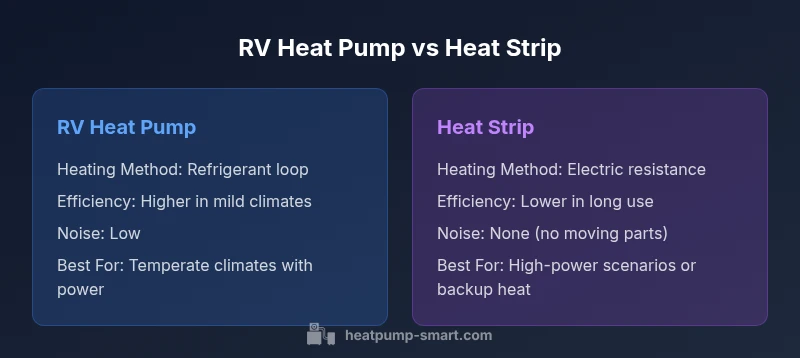
| Feature | RV Heat Pump | Heat Strip |
|---|---|---|
| Heating Method | Ducted/mini-split heat pump using refrigerant loop | Electric resistance element (heat strip) |
| Efficiency/Running Cost | Higher efficiency in mild/moderate climates; lower running costs | Lower efficiency; higher ongoing electricity use |
| Temperature Performance | Strong in temperate weather; efficiency drops in extreme cold | Immediate warmth but performance unaffected by weather |
| Noise Level | Lower noise; quieter operation overall | No moving parts, but may require noise-attenuating installation |
| Installation Complexity | More complex; needs outdoor unit and refrigerant lines | Simpler; typically easier to install with existing wiring |
| Space Requirements | Larger footprint due to two units and lines | Smaller footprint; simpler mounting |
| Electrical Demands | Requires dedicated circuit and adequate AC power | Dependent on available electrical capacity for heating elements |
| Maintenance | Coil cleaning, refrigerant checks; periodic service | Electrical wiring checks; fewer moving parts |
| Best For | Temperate climates with reliable power; energy savings | Limited power scenarios or extreme cold as supplement |
Advantages
- Higher long-term energy efficiency in milder climates
- Quieter operation and improved dehumidification
- Potential for integrated climate control (cooling in summer)
Disadvantages
- Higher upfront cost and more complex installation
- Requires adequate electrical capacity and professional service
Heat pumps win for most RV users in temperate climates; heat strips excel as a backup or in high-power setups.
In typical RV use, a heat pump provides better efficiency and comfort, reducing running costs. A heat strip is a reliable, straightforward option when electrical capacity is limited or cold weather demands a supplemental heat source.
Your Questions Answered
What is the main difference between an RV heat pump and a heat strip?
A heat pump moves heat using a refrigeration cycle for efficient heating and cooling, while a heat strip generates heat via electric resistance. The choice depends on climate, power availability, and desired comfort level.
Heat pumps move heat for efficiency and can cool too; heat strips simply convert electricity to heat. Climate and power availability decide which works best.
Can an RV heat pump operate effectively in cold weather?
Heat pumps lose efficiency as temperatures drop, and extreme cold may require supplemental heat. In very cold environments, a heat strip or backup heater ensures reliable warmth.
Heat pumps work best in milder conditions; in very cold weather, you may need extra heat.
What installation considerations should I plan for?
Heat pumps require outdoor unit mounting and refrigerant lines, plus proper sealing of the RV envelope. Heat strips need wiring and circuit protection but are generally simpler to install.
Outdoor unit placement and proper seals are critical for heat pumps; heat strips rely more on electrical setup.
How do operating costs compare between the two options?
Heat pumps typically offer lower running costs in moderate climates due to higher efficiency. Heat strips cost more to run over time, particularly during longer cold spells.
Heat pumps save energy most of the time; heat strips consume more electricity for the same warmth.
When is a heat strip preferable?
Heat strips are preferable when electrical capacity is limited, or when you need fast, straightforward heat in cold climates as a backup to a heating system.
If power is tight or you need quick heat, a heat strip can be a good backup.
What maintenance do these systems require?
Heat pumps require periodic coil cleaning and refrigerant checks; heat strips require wiring inspections and ensuring breakers are sized correctly.
Heat pumps need some upkeep; heat strips mostly require electrical checkups.
Do warranties differ between these options?
Warranty terms vary by manufacturer and installation type. Check coverage for refrigerant systems versus electric heating elements to avoid gaps in protection.
Warranty depends on the maker; refrigerant systems and heating elements may have different terms.
Top Takeaways
- Assess climate and insulation before choosing
- Heat pumps offer efficiency; heat strips prioritize simplicity
- Plan electrical capacity and backup heat for extreme cold
- Consider total cost of ownership, not just price
- Factor maintenance and warranty into your decision