3 Ton Heat Pump Square Footage: A Sizing Guide
Learn how to size a 3 ton heat pump by square footage, climate, and insulation. This guide covers sizing ranges, load calculations, and practical steps for reliable year‑round comfort.


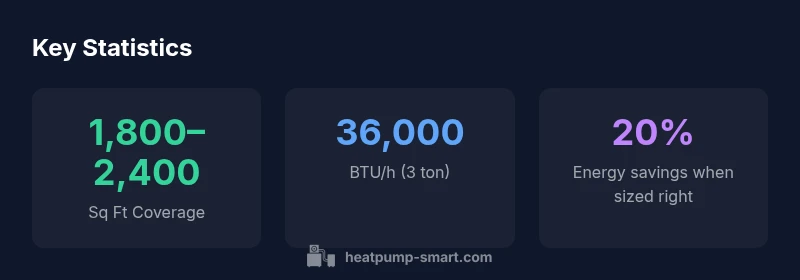
For a 3 ton heat pump, typical coverage is 1,800–2,400 square feet in moderate climates with standard insulation. This 3 ton heat pump square footage guideline starts from about 36,000 BTU/h and varies with climate and construction. According to Heatpump Smart, a professional load calculation is essential for precise sizing.
Why accurate sizing matters for a 3 ton heat pump square footage
Sizing a 3 ton heat pump is more than a quick glance at room area. It centers on delivering consistent comfort without wasting energy. A unit sized too small will struggle to maintain temperature on hot summer days or cold winter nights, leading to prolonged runtimes and higher energy bills. Conversely, an oversized system will heat and cool too quickly, causing short cycling, poor humidity control, and uneven temperatures. The Heatpump Smart team emphasizes that precise sizing hinges on a formal load calculation, not guesswork. When done correctly, a 3 ton system aligns with your home's square footage, insulation, windows, and occupancy patterns to deliver reliable comfort year round.
Practical sizing also reduces wear and tear on components, lowers maintenance costs, and supports longer system life. Homeowners who pair square footage estimates with climate data and a professional assessment often see steadier indoor temperatures and fewer hot/cold spots. A data-driven approach helps you balance comfort, efficiency, and upfront costs over the system’s lifetime.
How climate and insulation alter the square footage needs
Climate plays a decisive role in determining how much cooling or heating a home needs. Regions with extreme summer heat or long, harsh winters demand larger or more efficient systems, while temperate climates can achieve comfort with modest capacity. Insulation quality and air sealing dramatically affect your load. A tightly sealed home with good insulation reduces heat transfer, lowering the required square footage for a given comfort level. Windows, orientation, and shading also influence heat gain and loss. Heatpump Smart analysis shows that even small improvements in insulation or window efficiency can shift a home’s heating or cooling load by a meaningful amount, sometimes enough to move a home from a borderline 3-ton sizing to a leaner option or to justify a slightly larger unit if climate is demanding.
Sizing methods: from rules of thumb to Manual J
Historically, many contractors used simple rules of thumb to estimate size based on square footage. While these provide rough starting points, they lack precision for modern homes with varied insulation, air leakage, and thermal mass. A professional load calculation – typically a Manual J – accounts for climate, building materials, insulation levels, window areas, air leakage, occupancy, and equipment efficiency. The outcome is a recommended system size that aligns with actual heat gain and loss, not just surface area. For a 3 ton system, this process helps translate your home’s square footage into a precise BTU/h target and, if needed, a zoning strategy to manage different areas independently.
Real-world scenarios: homeowner examples
Consider an older 1,900 sq ft home with moderate insulation and several single-pane windows. Even with reasonable ceiling heights, its heat load may fall near the lower end of a 3-ton range, perhaps requiring a denser duct design or improved sealing to achieve optimal comfort. In contrast, a newer 2,400–2,600 sq ft home with high‑performance insulation, double or triple-pane windows, and airtight construction might size near the middle of the 3-ton band or even justify a compact, efficient 3-ton unit with a precise duct layout. These examples illustrate that square footage alone is not the sole determinant; climate, building envelope, and airflow must be considered. Heatpump Smart’s analyses emphasize verifying results with a professional load calculation to ensure the chosen system size delivers the expected comfort and efficiency.
Installation impact: duct design, zoning, and airflow
A well-sized heat pump relies on both the outdoor unit’s capacity and the indoor air distribution system. Duct sizing, run lengths, and junctions influence effective airflow, which affects perceived comfort and performance. Zoning can help a 3-ton system maintain even temperatures in larger homes or multi-story layouts by separating living spaces with independent controls. If ducts are too leaky or poorly insulated, or if the return air paths are restricted, you may not realize the full benefits of correct sizing. A professional will inspect duct leakage, insulation, and airflow balance to confirm that the square footage guidance translates into actual comfort.
Alternatives to consider if square footage doesn’t align
If your home’s footprint doesn’t neatly align with a 3-ton sizing guideline, alternatives include a two-zone or multi‑split setup, or adding supplemental heating elements for areas that experience extreme cold. In some cases, a slightly larger unit with advanced controls and zoning can be more economical than running multiple smaller devices. Always weigh the upfront cost against long-term energy savings and comfort, and discuss potential efficiency upgrades (air sealing, insulation, high-performance windows) with your installer to optimize any chosen solution.
Verification and ongoing optimization after installation
After installation, monitor indoor temperatures and energy usage to confirm the system meets expectations. If there are persistent hot spots or drafts, recheck the ductwork and seals, and consider adjusting thermostat setpoints to balance efficiency with comfort. A load that initially suggests a 3-ton system may shift over time as the home’s envelope improves or occupant behavior changes. Regular maintenance and periodic re-evaluation of insulation, sealing, and window performance help sustain the original sizing decisions and can guide future upgrades.
Sizing insights by scenario
| Scenario | Estimated Sq Ft Range | Notes |
|---|---|---|
| Typical retrofit home | 1,800-2,400 | Standard insulation, climate zone 3 |
| Energy-efficient build | 2,100-2,800 | Enhanced insulation and airtightness |
| Older poorly insulated home | 1,400-2,000 | Less favorable results |
Your Questions Answered
What does a 3 ton heat pump cover in square footage?
A 3-ton unit typically covers about 1,800–2,400 square feet in moderate climates with standard insulation. Actual coverage depends on climate, insulation quality, window area, and air leakage. Always pair square footage estimates with a professional load calculation for precision.
A 3-ton heat pump usually covers around 1,800 to 2,400 square feet in moderate climates, but you should get a professional load calculation for accuracy.
How do climate and insulation affect the needed square footage?
Climate and insulation are dominant factors. Poor insulation or many large windows raise the heat load, pushing you toward a larger or more efficient unit. Tight, well-insulated homes reduce load and may allow a smaller size or improved efficiency.
Climate and insulation have a big impact on sizing—poor insulation means you might need more capacity, while tight homes can use less.
Is Manual J necessary for sizing a 3-ton heat pump?
Manual J is the standard method used by professionals to determine exact heating and cooling loads. It accounts for climate, construction, and occupancy. While rough estimates are helpful, Manual J ensures the 3-ton system truly matches the home.
Yes—Manual J is the industry standard for precise sizing.
Can a 3-ton unit work for a 4,000 sq ft home?
A 3-ton unit for a 4,000 sq ft home is unlikely unless the home is exceptionally well insulated and climate-controlled. In many cases, multiple zones or a larger capacity system are recommended. A load calculation will clarify the best option.
Usually not; you’d likely need more capacity or zoning.
What factors besides square footage influence sizing?
Key factors include climate zone, building envelope (insulation, air sealing), window performance, air leakage, ceiling height, and occupancy patterns. All of these alter the actual load and should be considered in the final system size.
Climate, insulation, windows, and how you use the space all matter for sizing.
What should I ask a contractor during sizing?
Ask for a formal load calculation (Manual J), explanations of the proposed unit size, duct design adequacy, potential zoning options, and how insulation improvements could affect sizing. Also request post-install performance checks and a maintenance plan.
Ask for a Manual J, duct design details, and any insulation upgrades that could affect size.
“Sizing a heat pump by square footage alone is insufficient; you must confirm with a Manual J load calculation and climate considerations.”
Top Takeaways
- Use a professional load calculation for accurate 3-ton sizing.
- Square footage provides a starting point, not a guarantee.
- Climate, insulation, and windows dramatically affect required size.
- Duct design and zoning are as important as the unit itself.
- Verify sizing with post-install performance checks.