How Big of a Heat Pump for 1000 Square Feet
Learn how to size a heat pump for 1,000 square feet with practical rules of thumb, climate adjustments, and installation considerations for comfort and energy savings.


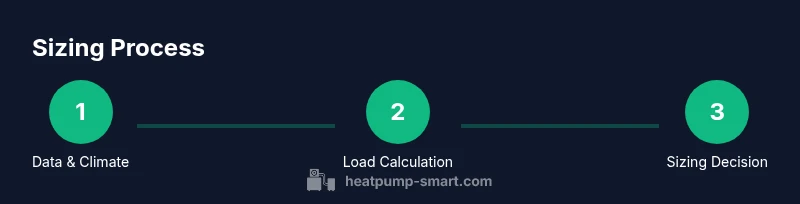
Sizing a heat pump for 1000 square feet starts with climate data and house quality, then refines the estimate with a formal load check. In temperate climates, many homes fall into roughly 1.5–2.0 tons (about 18,000–24,000 BTU/h), while cold zones may require larger units. You’ll avoid comfort issues and wasted energy by confirming with a load calculation and a pro review.
Why correct sizing matters
Sizing a heat pump correctly matters for consistent comfort, energy efficiency, and equipment longevity. If you’re asking how big of a heat pump for 1000 square feet, you’re aiming to balance heating and cooling capacity with runtime, avoiding short cycling or oversized behavior. A properly sized system runs more hours near its design point, reduces temperature swings, and lowers utility bills over the life of the equipment. According to Heatpump Smart, accurate sizing begins with climate data, envelope quality, and duct efficiency, not a casual rule of thumb. This foundation supports reliable performance in both mild and extreme weather, and sets the stage for future efficiency improvements.
Key sizing principles: BTU, tonnage, and load
To translate space into a practical unit size, you’ll need to understand BTU, tonnage, and the concept of load. BTU per hour measures how much heat a system can move, while a “ton” equals 12,000 BTU/h. For a 1000 square foot home, the goal is to match peak loads with a unit that operates efficiently in your climate. House factors such as insulation, window quality, air leakage, and duct performance influence the total load far more than simple square footage. A well-sized system achieves comfortable setpoints with minimal cycling, maximizing comfort and minimizing energy waste. Heatpump Smart emphasizes that a precise load estimate is more valuable than a neat number on a brochure.
Climate considerations: heating vs cooling loads
Climate dictates whether heating or cooling drives the sizing decision. Colder regions tend to require more heating capacity, while hot and humid areas demand robust cooling capability. The same 1000 square foot layout can lead to different equipment choices depending on window orientation, shading, and thermal mass. A correctly sized heat pump maintains steady indoor temperatures and humidity levels, reducing the stress on the compressor and improving long-term efficiency. Heatpump Smart analysis highlights that climate-aware sizing yields tangible energy savings and better comfort in all seasons.
Insulation and ductwork impact
Envelope quality and duct integrity can dramatically shift sizing needs. If insulation is weak or duct leaks are present, the system must work harder to maintain comfort, which often means choosing a larger unit than the home’s true load would indicate. Conversely, well-sealed ducts and higher insulation reduce the load, allowing a smaller, more efficient system. In practice, this means measuring attic insulation, wall performance, window efficiency, and duct leakage. Addressing these factors before final sizing can change the recommended tonnage by a full step or more and dramatically improve comfort and energy use clarity.
Quick sizing rules of thumb
A simple starting point is a per-square-foot estimate adjusted for climate and envelope quality. For a 1000 square foot house in a temperate climate with standard insulation, many homes fall in a 1.5–2.0 ton range, but this is highly site-specific. If you have large glass areas, radiant heat, or poor insulation, you may push toward the upper end or beyond. Use these baselines as a starting point, then confirm with a formal load calculation and professional guidance. This approach helps prevent oversizing or undersizing that hurts efficiency.
How to perform a professional load calculation
A proper load calculation accounts for wall orientation, window types, shading, attic and floor insulation, occupancy patterns, and appliance heat gains. The most widely used method is a Manual J calculation conducted by a licensed HVAC professional. Gather room-by-room measurements, thermostat setpoints, current energy use, and any planned renovations. The result is a precise BTU/h target and a recommended tonnage, ensuring the selected heat pump size aligns with real-world conditions.
Adjusting for 1000 sq ft with variable rooms
No two floor plans are identical. An open-plan space behaves differently from a layout with many small rooms. In such cases, zoning or multi-stage systems can improve comfort and energy use by avoiding over cooling or under heating in specific zones. Consider whether a single-zone system suffices or if multiple zones with dampers and smart thermostats would better serve the layout. Heatpump Smart notes that modular or zone-controlled setups can offer superior comfort for irregular plans.
Common pitfalls and how to avoid them
Avoid common mistakes like sizing by square footage alone, ignoring duct leakage, or assuming the brochure’s numbers reflect your home. Oversized units cause short cycling and humidity swings; undersized units struggle during extremes. Always verify with a professional load calculation, conduct a duct leakage test, and assess the insulation envelope before selecting a final size. A careful approach reduces callback visits and ensures stable comfort year-round.
Practical steps to commissioning
Sizing is only the start; commissioning ensures the system performs as designed. Steps include confirming refrigerant charge, calibrating the thermostat, verifying airflow balance, and testing defrost cycles. Outdoor unit placement, electrical connections, and wiring should meet local codes and manufacturer guidelines. Schedule a post-install performance check to confirm airflow, temperature balance, and energy use—then fine-tune controls for peak efficiency. A well-executed commissioning process maximizes long-term savings and comfort.
Real-world examples and scenarios
In practical scenarios, different factors shift the optimal size for a 1000 square foot home: insulation level, window quality, shading, and climate zone. Heatpump Smart Analysis, 2026, illustrates how these variables alter the recommended size and impact annual energy costs. By presenting multiple scenarios, homeowners can see why a formal load calculation remains essential and how envelope improvements can reduce required capacity over time. Real-world examples reinforce that sizing is dynamic, not a one-time number.
Tools & Materials
- Tape measure(to measure room dimensions and wall lengths)
- House data sheet(collect insulation levels, window types, shading, orientation)
- Manual J or load calculation software(used for precise sizing)
- Thermal imaging camera or infrared thermometer(optional to identify hotspots and insulation gaps)
- Thermostat and power data (if available)(to gauge existing heat gains)
- Notepad or spreadsheet(document results and final sizing)
Steps
Estimated time: 2-4 hours
- 1
Gather home data and climate context
Collect room dimensions, insulation levels, window types, shading, and typical occupancy. Note climate zone and historical temperature extremes for your area. This data becomes the baseline for the load calculation.
Tip: Organize measurements room-by-room so you don’t miss spaces with high heat gains or losses. - 2
Estimate area and heat gains
Calculate total conditioned floor area and approximate heat gains from occupants appliances and sun exposure. Use a simple method as a starter, then refine with a formal calculation for accuracy.
Tip: Include kitchen appliances and any continuous heat sources that raise interior temperature. - 3
Run a formal load estimate
Use Manual J or equivalent software to compute BTU/h targets. This step translates your area and envelope data into a precise heating and cooling load.
Tip: If you’re unsure, consult a licensed HVAC contractor to run the calculation. - 4
Verify envelope and duct efficiency
Assess insulation and seal leaks; test duct leakage and airflow. A leaky duct system can drastically inflate the required size.
Tip: Seal ducts first if leaks exceed recommended thresholds before final sizing. - 5
Choose size range and confirm with pro
Use the load result to select a size range (in BTU/h or tons) and verify with a professional. Consider a unit with some buffer for extreme conditions only if needed.
Tip: Ask about variable-speed or multi-stage options that improve efficiency and comfort. - 6
Plan for future efficiency
Include space for insulation upgrades, smart thermostats, and zoning if you anticipate renovations. A future-proofed design reduces the need for re-sizing.
Tip: Document potential improvements and how they would influence final sizing.
Your Questions Answered
What size heat pump do I need for a 1000 sq ft house?
The right size depends on climate and insulation. A professional load calculation will typically place many temperate-zone homes around 1.5–2.0 tons, but exact sizing varies with envelope quality and shading.
For 1000 square feet, sizing depends on climate and insulation; a professional load calculation gives the exact tonnage.
Why not rely on square footage alone?
Square footage is a starting point, but loads depend on insulation, windows, air leakage, and occupant heat gains. Without accounting for these, you risk short cycling or insufficient cooling.
Square footage isn’t enough; insulation and windows matter for accurate sizing.
Can I install a heat pump myself?
Heat pump installation requires licensed technicians, permits, and proper refrigerant handling. Prepare the site and have a pro verify electrical and refrigerant requirements.
Installing a heat pump isn’t a DIY job; hire a licensed pro for safety and code compliance.
What’s the difference between 1.5 ton and 2 ton units?
1.5 ton equals about 18,000 BTU/h and 2 ton equals about 24,000 BTU/h. The larger unit moves more heat but may require careful sizing to avoid oversizing.
A 1.5 ton unit is around 18,000 BTU/h, while a 2 ton unit is around 24,000 BTU/h.
How often should sizing be re-evaluated?
Re-evaluate sizing after major renovations, insulation upgrades, or changes in occupancy, shading, or window performance. Re-calculation helps ensure ongoing efficiency and comfort.
Reevaluate sizing after major renovations or insulation upgrades.
Watch Video
Top Takeaways
- Take control with a load calculation.
- Climate and envelope drive size, not just space.
- Avoid oversizing or undersizing to prevent comfort issues.
- Professional verification improves accuracy and results.