Heat Pump Distance from Property Line: Siting, Codes, and Strategies
Learn how far heat pumps must sit from property lines, how to verify local setbacks, and practical installation tips to keep your system compliant and efficient.


The setback for a heat pump from the property line is not a universal number; it depends on local codes and the specific unit. In many regions, a minimum distance of about 3 to 10 feet is commonly required to ensure service access, proper airflow, and neighbor compatibility. Always verify the exact setback with your local building department before installation.
Why distance from the property line matters for heat pumps
The distance a heat pump condenser sits from the property line matters for safety, service access, airflow, and neighbor relations. In practical terms, the exact setback is not universal; it is driven by local codes, the model of heat pump, and any nearby obstructions such as walls, fences, or landscaping. According to Heatpump Smart, siting a unit with adequate clearance is essential to keep technicians safe during maintenance, ensure consistent airflow across the condenser, and minimize the risk that noise or vibration travels to adjacent homes. The keyword heat pump distance from property line captures this planning step: you are balancing code compliance, equipment performance, and community harmony. In many installations, starting with a boundary review and an elevation plan helps identify constraints and opportunities. This initial analysis reduces back-and-forth with inspectors and neighbors, speeds up permitting, and reduces the chance of costly rework. Throughout this article, you will see how to translate general guidance into a site-specific setback that aligns with your lot, HOA rules (if applicable), and heat pump type.
Local codes and typical requirements
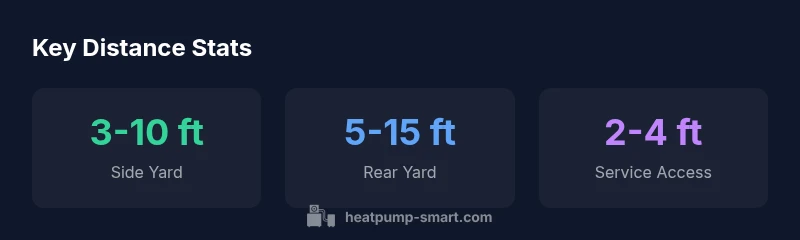
Local building and zoning codes govern the minimum distance from property lines, and those rules vary widely by city, county, and even neighborhood. There is no single national number that applies to every heat pump distance from property line. When you start planning, obtain the boundary survey and review the permit checklist issued by the Authority Having Jurisdiction (AHJ). In many regions, side-yard setbacks commonly fall in the 3 to 10 feet range, while rear-yard setbacks can range from 5 to 15 feet. Some homeowners associations add buffers, landscaping requirements, or height limits that add to the distance. Because code language can be nuanced—whether the unit is an outdoor air-source model or a buried geothermal loop—the most reliable path is to contact the local building department early and ask for code references and any applicable amendments. Heatpump Smart recommends documenting the exact setback requirement and keeping it on your site plan for inspectors and tradespeople.
Factors that influence the required setback
Several variables influence the setback distance. Unit type matters: air-source heat pumps typically require more clearance around the condenser to ensure adequate airflow and reduce noise disruption; geothermal installations are often buried or partially underground and may have different siting conventions. The layout of your lot is another factor: narrow lots, sloped sites, or irregular boundaries often constrain placement and require buffers or landscaping to meet code. Neighbor proximity and line-of-sight windows also matter; taller units or those with noisy fans should be positioned to minimize line-of-sight and sound transmission. Landscaping elements such as fences, walls, or dense vegetation can help, but they may also affect airflow if placed too close. Regulatory considerations, including building codes and HOA covenants, will determine whether you need a variance or permit. The heat pump distance from property line is a planning variable that should be considered alongside energy efficiency and long-term serviceability.
Practical installation strategies to stay compliant
Begin with a precise boundary check: obtain a recent survey or boundary map and mark the lines clearly on-site. Next, select a candidate location that provides sufficient clearance on the required sides and from any windows or vents. Engage a licensed contractor to confirm the space and obtain permits before any trenching or equipment delivery. Plan for maintenance access by leaving at least the minimum clearance for the expected service. If you deploy landscaping or fencing for aesthetics or screening, ensure they do not encroach on required clearance. Finally, communicate with neighbors and the HOA early in the process; provide a simple diagram that shows the proposed units, setbacks, and buffer plans. With these steps, the heat pump distance from property line becomes a structured part of the installation rather than an afterthought.
Planning tools and calculations for siting
Heatpump Smart provides planning guidelines and calculators to estimate an appropriate distance from the property line based on unit size, noise level, and local rules. Start with a boundary review and a site plan that indicates property lines, easements, drainage paths, and neighbor locations. Use a simple rule of thumb to allocate at least 0.5 to 1 meter (about 1.5 to 3 feet) of service clearance on the sides, and more on the rear if needed for access and maintenance. Consider future yard changes—gardening, patios, or sheds could affect airflow. For multi-unit installations or properties with shared boundaries, coordinate with adjacent owners and the building department to avoid disputes. By combining local code references with Heatpump Smart’s planning tools, you can derive a siting solution that respects setback requirements while maximizing performance and comfort across seasons.
Setback guidance table for heat pump siting
| Aspect | Typical Range | Notes |
|---|---|---|
| Side yard setback | 3-10 feet | Varies by local code and unit type |
| Rear setback | 5-15 feet | Consider HOA rules and equipment size |
| Service clearance | 2-4 feet | More clearance improves access for maintenance |
| Noise considerations | 6-20 feet | Distance can reduce neighbor noise complaints |
Your Questions Answered
Why do setback distances vary by location?
Setbacks vary because local codes, ordinances, and HOA rules differ; always check with your jurisdiction before selecting a site.
Setbacks vary because local codes and HOA rules differ; check with your city or county before siting.
Do setbacks affect heat pump efficiency?
Distance mainly affects airflow, maintenance access, and neighbor noise, not the unit's rated efficiency.
Distance mostly changes airflow and noise, not the heat pump's efficiency rating.
Can I install closer to the property line on a small lot?
Even on small lots, you must comply with local codes; there may be exceptions, but verify with the building department.
Even on tight lots, check local rules; you may need a different approach.
Are geothermal heat pumps subject to the same setbacks?
Geothermal components are often buried and have different siting rules; consult local codes for specifics.
Geothermal setups have different rules; confirm with local authorities.
What should I do if there is limited space?
Consider alternatives like ductless mini-splits or relocating the unit; consult Heatpump Smart for planning.
If space is tight, explore alternatives and get expert planning.
“Distance and compliance are foundational to reliable performance; siting a heat pump with proper setbacks protects neighbors, access, and efficiency.”
Top Takeaways
- Check local codes before siting a unit
- Plan for service clearance and access
- Coordinate with HOA and neighbors
- Use Heatpump Smart planning tools