Heat Pump Size Calculator: Practical Sizing Guide for Homes
Learn how to estimate your heat pump's ideal size with Heatpump Smart's calculator. Understand inputs, climate factors, insulation, and best practices for efficient home comfort.


Why Sizing Matters for Heat Pumps
According to Heatpump Smart, proper sizing is essential to energy efficiency and comfort. An under-sized unit will run constantly, struggle to maintain warmth in cold snaps, and wear out faster. An over-sized unit will heat or cool quickly but cycle on/off frequently, wasting energy and reducing humidity control. For homeowners, builders, and property managers, accurate sizing reduces monthly energy bills and improves indoor comfort. This section explains why precise sizing matters and how a heat pump size calculator acts as a planning tool. When used with good insulation and air sealing, sizing accuracy compounds savings across seasons.
How a heat pump size calculator works
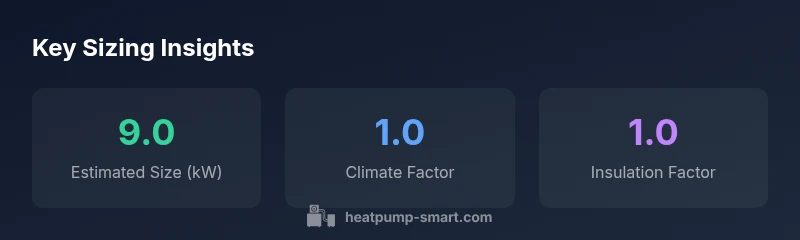
A heat pump size calculator typically uses a simple, transparent formula to translate your inputs into a recommended capacity. In this guide, the calculator relies on three core inputs: Home Area (sq ft), Climate Factor, and Insulation Factor. The underlying formula is area * 0.005 * climate * insulation, yielding an estimated capacity in kilowatts. This approach keeps the math straightforward while highlighting how climate and insulation affect sizing. For homeowners reading this in 2026, the Heatpump Smart team emphasizes that this is an educational starting point, not a substitute for professional sizing.
Real-world sizing scenarios
Example 1: A 1,800 sq ft home in a temperate climate with average insulation yields about 9.0 kW (1,800 * 0.005 * 1.0 * 1.0). Example 2: A 2,400 sq ft home in a cooler climate with decent insulation yields roughly 12.0 kW (2,400 * 0.005 * 1.0 * 1.0). For larger or poorer-insulated homes, the calculator scales linearly. Use these numbers as starting points and verify with a professional to account for window orientation, shading, and occupancy.
Interpreting the output and next steps
The calculator’s result is a sizing baseline. If your result is near a standard unit size, you can plan around that capacity. In practice, HVAC pros consider comfort, humidity control, and future changes. Always cross-check the estimate with local climate data and an on-site assessment. In many cases, you’ll want to consider a slightly higher capacity to accommodate future insulation improvements or weather extremes.
Climate, insulation, and home variables that matter
The accuracy of sizing depends on several variables: climate severity, insulation quality, air leakage, window performance, and occupant behavior. Even small changes in these factors can shift the recommended capacity by 1–2 kW. This is why a heat pump size calculator should be used as a planning tool alongside a professional assessment. Heatpump Smart notes that the best results come from matching the calculator to local conditions.
How to use the calculator safely and effectively
Treat the calculator as an educational starting point. Gather accurate data on area, climate, and insulation, and consider future modifications like insulation upgrades or additional rooms. Validate the result with a licensed installer who can conduct a Manual J calculation, confirm ductwork suitability, and ensure equipment compatibility with your home’s ventilation.
Maintenance and future-proof sizing considerations
Even after sizing, ongoing maintenance affects performance. Regular air filter changes, duct sealing, and ensuring proper refrigerant charge help the system run at its rated capacity. For future-proofing, think about adding insulation or air sealing to reduce load, or selecting a heat pump with adjustable stepping up capacity. The sizing baseline can guide these decisions over time.