How Big Is an Air Source Heat Pump? Sizing Guide for Home Comfort
Learn how to size an air source heat pump for your home. Explore typical size ranges, load calculations, climate considerations, and practical tips from Heatpump Smart.


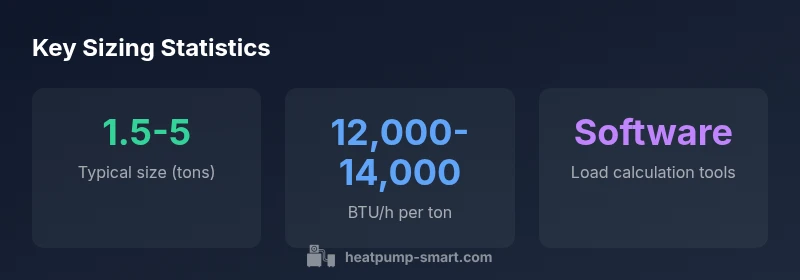
How big is an air source heat pump? In residential setups, size is typically measured in tons or BTU per hour and depends on climate, insulation, and heating load. Common ranges run from about 1.5 to 5 tons (18,000–60,000 BTU/h). Precise sizing requires a professional load calculation. According to Heatpump Smart, the right size improves comfort and efficiency over the system’s life.
What sizing means for air source heat pumps
Size refers to capacity, not the physical footprint. Capacity determines heating and cooling coverage and is measured in tons or BTU per hour. For air source heat pumps, capacity is selected to meet the design heating load of the building. Undersizing leads to longer runtimes and inadequate dehumidification; oversizing causes short cycling, reduced efficiency, and higher upfront cost. In practice, a properly sized unit balances comfort with efficiency, minimizes wear, and delivers consistent comfort. When you hear how big is an air source heat pump, think primarily about the load and climate, not merely the square footage. As Heatpump Smart notes, the most reliable sizing starts with a formal load calculation based on climate data, insulation levels, window performance, and occupancy patterns. A correctly sized system will run through the heating season in its efficient zone and avoid unnecessary cycling.
Typical size ranges by home size and climate
Residential air source heat pumps commonly come in 1.5–5 ton ranges. The exact size depends on heat loss or gain, insulation quality, window performance, and the number of occupants. In practice, 1,000–1,500 square feet often uses about 1.5–2.5 tons; 1,500–2,100 square feet typically 2.5–3.5 tons; 2,100–3,000+ square feet 3.5–5 tons. These are general guidelines rather than fixed rules; a professional load calculation remains essential. Heatpump Smart analysis shows these ranges reflect typical practice across climates, with insulation level and local weather being primary drivers.
Climate, insulation, and ductwork: sizing realities
Climate is the single biggest driver of heat pump size. Colder winters demand larger capacity, while mild climates may get away with smaller units. Insulation quality, air leakage, and window efficiency determine how much heat you lose, which directly shapes required capacity. Two homes of the same square footage can require different sizes depending on a variety of factors. Heatpump Smart analysis emphasizes pairing sizing with climate data, orientation, and future renovation plans to prevent undersizing or oversizing.
Load calculations: the backbone of accurate sizing
The most reliable method is a professional load calculation, often a Manual J, which accounts for the home’s construction details, insulation, air leakage, and local climate. Installers may supplement Manual J with software-based simulations to model peak loads and seasonal performance. Once the heating and cooling loads are established, product selection follows the matching efficiency rating and compressor type. The process also considers ventilation requirements, ductwork, and potential future changes in occupancy or insulation upgrades.
Replacements vs new construction: sizing implications
When upgrading an old system, distribution and ductwork may constrain selection; oversizing beyond the load can cause short cycling and comfort issues. In new homes, tighter envelopes and better insulation can reduce required capacity, enabling smaller equipment and improved efficiency. In both cases, accurate load calculations and proper duct design are essential for achieving energy savings and reliable comfort. An experienced installer can help map out future expansion or modifications to avoid a mismatch later.
Practical steps to confirm sizing during installation
- Request a formal load calculation and verify the recommended system size before purchasing.
- Have the installer perform a post-install check to confirm proper refrigerant charge, airflow, and duct sealing.
- Consider zoning or multi-stage systems to adapt to changing loads across seasons.
- Ensure the thermostat and controls are calibrated to operate within the designed efficiency range.
Close collaboration with the installer helps avoid common mistakes and ensures the system maintains optimal efficiency throughout its life.
Common pitfalls and how to avoid them
- Ignoring climate and insulation in sizing leads to over- or under-sizing.
- Relying on square footage alone instead of a full load calculation.
- Skipping post-install testing and commissioning, which can mask sizing errors.
- Failing to account for future renovations, occupant changes, or ductwork upgrades.
By avoiding these mistakes and prioritizing a formal load calculation, homeowners can secure a system that delivers steady comfort and meaningful energy savings.
Common sizing guidelines based on living area
| Room size (sq ft) | Suggested unit size (tons) | Approx. BTU/h |
|---|---|---|
| 1000–1500 | 1.5–2.5 | 18,000–30,000 |
| 1500–2100 | 2.5–3.5 | 30,000–42,000 |
| 2100–3000 | 3.5–5 | 42,000–60,000 |
Your Questions Answered
What determines the right size for an air source heat pump?
The right size depends on the home’s heating load, climate, insulation, air leakage, window efficiency, and occupancy patterns. A formal load calculation is essential to capture these variables and select a unit within the optimal efficiency range.
The right size comes from a detailed load calculation that considers climate, insulation, and occupancy.
Can an oversized unit be better than an undersized one?
Oversized units can short-cycle, waste energy, and create comfort swings; undersized units may run continuously without meeting heating demands. The goal is a unit that runs efficiently most of the season.
Oversized units waste energy and may feel uncomfortable; undersized ones struggle to keep up.
Do I need a professional to size the heat pump?
Yes. A professional load calculation using Manual J and climate data ensures accuracy. They also assess ductwork and ventilation to prevent future sizing issues.
Yes—get a professional load calculation for accurate sizing.
How does climate affect heat pump sizing?
Colder climates require larger capacity to meet peak heating loads; milder climates can use smaller units. Local weather patterns and humidity also influence sizing decisions.
Climate matters a lot—colder areas usually need bigger units.
What about retrofits and new homes?
New homes with tight envelopes may require smaller systems due to better insulation, while retrofits can require upgrades to achieve accurate sizing. Always re-run load calculations after major renovations.
New homes may need less, retrofits may need upgrades.
“Sizing a heat pump correctly is the most important step in achieving consistent comfort and energy savings. A precise load calculation lays the groundwork for reliable performance.”
Top Takeaways
- Start with a professional load calculation.
- Typical residential size ranges from 1.5–5 tons.
- Climate and insulation drive sizing more than square footage.
- Verify sizing with post-install commissioning.