What Size Heat Pump for 800 Sq Ft: A Sizing Guide
Learn how to size a heat pump for an 800 sq ft home. Start with a 12,000–18,000 BTU range, then refine via Manual J, climate, insulation, and ductwork for efficient comfort and energy savings.


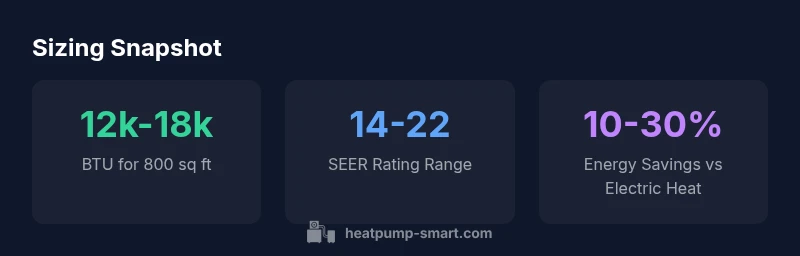
For an 800 sq ft home, a typical cooling/heating size falls in the 12,000-18,000 BTU range (about 1 to 1.5 tons), depending on climate, insulation, and airtightness. This range provides a starting point, but a Manual J calculation is essential for accuracy. A properly sized heat pump improves comfort, reduces cycling, and lowers energy use. Heatpump Smart analysis shows climate and insulation as key factors.
Why Sizing for 800 Sq Ft Matters
Sizing a heat pump for an 800 sq ft home is not just about slapping a number onto a spec sheet. The right size directly affects comfort, humidity control, and energy use. When a system is too small, it struggles to maintain comfortable temperatures during peak demand, leading to longer runtimes and higher energy costs. Conversely, an oversized unit will short-cycle, wear out components faster, and waste energy through frequent on/off cycling. According to Heatpump Smart, the optimal approach starts by understanding loads, then validating with professional calculations. This ensures your 800 sq ft space receives consistent cooling in summer and reliable heating in winter without a costly overhang of capacity.
BTU basics and 800 Sq Ft Loads
BTU, or British Thermal Unit, is a measure of heat transfer. A common rule of thumb for cooling capacity translates 12,000 BTU to roughly 1 ton of cooling. For an 800 sq ft home, the naive expectation is 12,000–18,000 BTU, but actual need depends on climate, ceiling height, insulation, windows, and airtightness. The goal is to balance the latent (humidity) and sensible (temperature) loads. Heatpump sizing should reflect both cooling and heating requirements, since most homes require a combined load calculation rather than separate numbers for summer and winter. A starting point of 1–1.5 tons (12,000–18,000 BTU) often works in moderate climates, but climate extremes push these numbers higher or lower.
Climate and insulation as sizing drivers
Climate and insulation are the dominant factors driving final size. In hot climates with high humidity, cooling loads rise, nudging BTU needs upward. In colder climates, heating loads dominate, so the system must provide sufficient heating without excessive oversizing. Air leaks, drafty windows, and poor insulation can dramatically alter loads in both heating and cooling seasons. The better the insulation (attic, walls, and ductwork), the closer your measured load will be to the calculated baseline, often allowing a smaller unit to perform well. Heatpump Smart emphasizes aligning equipment size to actual loads rather than relying on rough area-based estimates alone.
Manual J and sizing methods
Manual J is a detailed, professional load calculation used to determine true heating and cooling requirements for a property. It accounts for building envelope characteristics, occupancy, internal gains, and HVAC system layout. If you don’t have access to a certified HVAC professional, reputable online calculators can provide a reasonable estimate, though they cannot replicate the nuance of a full Manual J. Always validate any online result with a licensed technician, especially for retrofit projects where ductwork and air sealing impact outcomes. Heatpump Smart recommends starting with a load estimate and then performing a formal Manual J where feasible.
Ducted vs. ductless options for 800 sq ft homes
800 sq ft spaces can be served by a compact central system, a ductless mini-split, or a small heat pump with zone controls. Ducted systems simplify integration with existing ductwork but may require sealing and balancing to avoid pressure losses. Ductless mini-splits offer precise zoning and can be more efficient for irregular layouts or individual rooms. The choice depends on layout, existing duct integrity, and desired comfort uniformity. For many 800 sq ft homes, one to two indoor units with a single outdoor unit can deliver effective, flexible cooling and heating with fewer energy penalties when properly sized.
Efficiency metrics and operating costs
Efficiency matters as much as capacity. SEER (cooling efficiency) and HSPF (heating efficiency) influence long-term operating costs. A higher SEER/HSPF rating generally reduces energy consumption, especially in climates with frequent cycling. However, the upfront cost grows with efficiency. For 800 sq ft homes, prioritizing a balance of size and efficiency yields the best annual energy savings. Heatpump Smart notes that efficiency gains compound over time, particularly in well-insulated homes where heat loss and gain are minimized.
Oversizing vs undersizing: risks and trade-offs
Oversizing can lead to short cycling, humidity problems, and wasted energy due to frequent on/off cycles. Undersizing, while less common in market offerings, results in inadequate temperatures and persistent run times. The ideal strategy combines accurate load calculation, proper duct design, and an appropriately sized unit with good part-load performance. If you must choose between two sizes, lean toward the smaller size that meets the calculated load rather than the larger option. This approach improves comfort and efficiency.
Real-world sizing scenarios and checklists
Scenario A: An 800 sq ft, well-insulated bungalow in a temperate climate with modern windows. A 12,000 BTU unit aligns with the calculated load, offering efficient performance with good part-load operation. Scenario B: An older 800 sq ft apartment with drafty walls and single-pane windows in a hot climate. A 18,000 BTU system may be warranted to maintain comfort at peak load, but this should be validated with a Manual J and, if possible, a duct sealing and insulation upgrade plan. A practical checklist includes: 1) verify envelope tightness, 2) perform load calc, 3) assess existing ducts, 4) choose an efficiency tier, 5) confirm zoning strategy if needed.
Practical steps to finalize your choice
- Gather building data: insulation levels, window types, occupancy, and typical internal heat gains. 2) Run initial load estimates using reputable tools or a Professional Manual J. 3) Compare 1–2 suitable unit sizes in the 12k–18k BTU range (adjusted for climate). 4) Have a licensed installer assess ductwork and air balancing. 5) Review efficiency options (SEER/HSPF) and warranty terms. 6) Plan for future changes such as weatherization improvements; a well-sealed home will sustain comfortable loads for years.
Sizing fundamentals for 800 sq ft heat pumps
| Metric | Low estimate | High estimate | Notes |
|---|---|---|---|
| BTU for 800 sq ft | 12000 | 18000 | Range depends on climate/insulation |
| System size (tons) | 1 | 1.5 | Typical size for 800 sq ft |
| SEER rating | 14 | 22 | Higher rating improves efficiency |
| Annual energy savings vs electric resistance | 10% | 30% | Depends on usage and climate |
Your Questions Answered
What size BTU is typically needed for 800 sq ft?
Most homes around 800 sq ft require about 12,000–18,000 BTU (1–1.5 tons). Actual size depends on climate, insulation, windows, and airtightness. A Manual J calculation confirms exact needs.
Most 800 square foot homes need about 12,000 to 18,000 BTU; use a Manual J to confirm.
How do I calculate the right size heat pump?
Use a Manual J calculation performed by a qualified HVAC professional or a reputable online calculator, then validate with load calculations and possible zoning.
Use a professional Manual J or a reputable online calculator to calculate the load.
Can I oversize a heat pump for 800 sq ft?
Oversizing can cause short cycling, humidity problems, and higher upfront costs; aim for a precise size rather than the largest unit.
Over-sizing causes short cycling and wasted energy; size it accurately.
What climate factors affect sizing the heat pump?
Hot/humid climates increase cooling loads; cold climates influence heating loads; both affect BTU needs and equipment choice.
Climate and insulation change the needed size.
Do ductless mini-splits need different sizing guidance?
Yes, each indoor zone must be sized relative to its space and airflow; a single indoor unit may not cover all spaces.
Yes—each zone needs its own load calculation.
How does insulation impact heat pump sizing?
Better insulation reduces loads, potentially lowering BTU needs; draft sealing and window performance also matter.
Insulation and sealing can dramatically change the needed size.
“Sizing a heat pump correctly isn't guesswork—it's a calculation. Oversizing leads to short cycling and wasted energy, while undersizing reduces comfort.”
Top Takeaways
- Start with a 12k–18k BTU range for an 800 sq ft home
- Climate and insulation are the key modifiers
- Use Manual J or a reputable calculator to size accurately
- Ductwork quality and air sealing influence results
- Aim for a higher SEER when it fits budget and climate