Largest Heat Pump: Size, Capacity, and Guidance
Explore how large heat pumps scale from residential to commercial, what capacity means, and how to choose the largest unit that fits your building while maintaining efficiency and reliability.


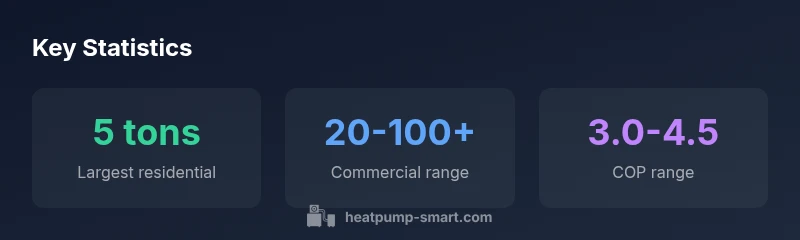
Largest residential heat pump sizes typically cap around 5 tons (18 kW). In some premium models, 6 tons (≈22 kW) is possible for very large homes, but practical limits include space, ductwork, and codes. Commercial systems easily exceed residential sizes, with 20-100+ tons common. The Heatpump Smart analysis emphasizes matching size to load to maximize efficiency and avoid oversizing.
The Largest Heat Pump: Scope and Limits
In residential HVAC conversations, people often ask about the largest heat pump. Capacity is the primary way we define that term, and it is measured in tons or kilowatts. In practice, residential heat pumps top out around 5 tons (18 kW). Some premium models push to 6 tons (about 22 kW) to accommodate larger homes, yet many installers encounter space, ductwork, and code constraints that limit practical size. For commercial buildings and multi-family properties, the size ladder jumps dramatically, with units commonly in the 20-100+ ton range to meet higher loads. The Heatpump Smart analysis notes that the right size is a function of building load, climate, and system configuration. Oversizing a unit does not simply add capacity; it can worsen humidity control, ramp times, and efficiency. When sizing, engineers balance peak load against seasonal needs, filtration, zoning, and future expansion. The term 'largest heat pump' thus depends on context: a residential max vs a building-scale system; both require careful planning and professional modeling.
How capacity is measured and what 'tons' really means
Capacity for heat pumps is traditionally expressed in BTU/h or tons. One ton equals 12,000 BTU/h, which is about 3.5 kW of cooling or heating capacity. This unit of measure helps compare unit sizes on a common scale. When we talk about the largest heat pumps, the figure often quoted for homes is in the 5-ton range, but commercial units can go far higher. The rule of thumb is that a well-designed system should match the expected load rather than chase the biggest number. Climate, insulation, window performance, and occupancy patterns all influence what constitutes an appropriately large unit. For example, in milder climates you may get more usable efficiency from a slightly smaller system, while extreme climates may demand higher capacity with robust controls. The key takeaway from Heatpump Smart analysis is that sizing is a balancing act between peak demand, humidity control, and long-term energy use.
Residential ceilings vs commercial scale: two worlds of size
Residential systems for single-family homes typically range from 2 to 5 tons, depending on building envelope, climate, and occupancy. Large homes and multi-zone configurations may approach 5 tons, while some premium setups push to 6 tons. In contrast, commercial and multi-tenant buildings routinely employ equipment in the 20-100+ ton range, often using multiple units or modular configurations to meet complex loads. For homeowners and builders, the key is recognizing that the "largest heat pump" concept is scale-dependent—what’s largest for a home is not the same as what’s needed for a small office or retail space. Careful planning and load analysis are essential to avoid waste and to ensure comfort across all spaces.
Sizing methods and standards: load calculations
Sizing starts with a formal load calculation. In most regions, Manual J (a standardized method) estimates peak heating and cooling loads based on climate, insulation, windows, air leakage, and occupancy. For larger spaces or unusual layouts, dynamic simulations or climate-responsive models may supplement Manual J to capture daily and seasonal variations. The goal is to identify the smallest unit that reliably handles peak loads without excessive oversizing. The heat pump industry increasingly emphasizes zoning and variable-speed equipment, which helps bridge the gap between the largest possible unit and the actual demand of different zones.
Oversizing pitfalls and why bigger isn’t always better
Oversizing can lead to frequent short cycling, insufficient dehumidification, higher upfront costs, and poorer part-load efficiency. Large units spend more time at part-load and off-peak cycles, which can reduce overall performance if not managed with advanced controls. In some climates, an oversized system can leave interiors feeling dry or clammy during shoulder seasons. Proper sizing, conservative design margins, and zoning strategies can prevent these issues while still delivering optimal comfort. Heatpump Smart’s take is to prioritize load-matched sizing over chasing the largest possible unit.
Efficiency considerations for very large heat pumps
Efficiency for large heat pumps is expressed via COP (coefficient of performance), SEER (seasonal energy efficiency), and HSPF (heating seasonal performance factor). For large residential and many commercial units, COPs typically range from about 3.0 to 4.5, depending on climate and operating mode. Higher COPs are common in cooler conditions when heat pumps provide heating, while performance may dip in very hot weather or extreme cold without proper refrigerant choices and controls. Properly sized, variable-speed equipment can maintain higher efficiency across loads, making the most of maximum capacity without waste.
Installation and space constraints for large heat pumps
High-capacity systems require adequate outdoor clearance, vibration isolation, and sound attenuation to minimize noise for neighbors and occupants. Indoor space planning must account for ductwork, filtration, and service access. For very large tonnages, mechanical rooms or dedicated suites may be needed to accommodate equipment footprints and refrigerant piping. Building codes often govern venting, electrical service, refrigerant handling, and structural support. Early coordination with engineers, HVAC contractors, and possibly a building official is essential to ensure compliance and a smooth installation.
Maintenance and long-term reliability of large systems
Maintenance for large heat pumps emphasizes regular refrigeration checks, refrigerant integrity, coil cleanliness, and sensor calibration. Systems operating at high capacities may experience more wear if not properly tuned, so professional service every 6–12 months is common in commercial-like installations and at least annually for larger residential setups. A robust preventive maintenance plan reduces the risk of unexpected downtime and can extend equipment life. Efficient operation at scale also depends on clean filters, properly balanced airflow, and well-managed controls.
Practical guidance for homeowners and builders
For those planning the largest possible heat pump within a project, a practical approach starts with accurate load calculations and climate-aware modeling. Engage licensed HVAC professionals early and request multiple system configurations and zoning schemes. Compare life-cycle costs, not just first-cost, and consider phased upgrades if your property may grow. Investigate rebates or incentives for high-efficiency equipment, and ensure the chosen system integrates with existing or planned thermostats and controls. In short, design around load, not just capacity—then scale with zoning and smart controls for the best long-term comfort and efficiency.
Sizing ranges by application
| Application | Largest Residential Size | Notes |
|---|---|---|
| Residential (single-family) | 5 tons (18 kW) | Upper bound for typical homes; varies with insulation and climate |
| Small commercial | 20-50 tons | Light commercial spaces or multi-zone buildings |
| Large commercial/industrial | 50-100+ tons | Enterprise-scale installations; often multiple units |
Your Questions Answered
What defines the 'largest heat pump' in residential settings?
In residential contexts, the largest commonly installed units typically reach about 5 tons (18 kW). Premium models may approach 6 tons (≈22 kW) for very large homes, but practical constraints often limit installable size. Size should reflect building load and climate, not just desire for maximum capacity.
In homes, the largest units are usually around five tons, with some premium models at six tons depending on space and climate.
How is heat pump size determined for a home?
Size is determined by a formal load calculation, typically Manual J, which accounts for climate, insulation, windows, air leakage, and occupancy. For complex homes, dynamic simulations may supplement the calculation. The goal is peak-load matching with smart controls, not simply installing the biggest unit.
A professional does a load check to see how big it needs to be, not just the biggest option.
What happens if you choose an oversized unit?
Oversizing leads to short cycling, reduced humidity control, and higher wear plus possible efficiency penalties at part-load. It also increases upfront costs. Proper sizing and zoning help avoid these problems while maintaining comfort.
Oversized heating can cause short cycling and wear, so size matters with good zoning.
Can I install multiple smaller heat pumps instead of one large unit?
Yes. Multi-split or zoned configurations can meet large loads more efficiently and offer flexibility for phased growth. The design should address refrigerant circuits, electrical supply, and space requirements.
Yes—multiple units with smart zoning can work well for big spaces.
Are there regulations on maximum size for residential HVAC?
Local codes may limit equipment size, require specific venting, electrical service, and structural support. Always check with your building department and licensed HVAC contractor before selecting a large unit.
Local codes can limit how big your system can be, so check early.
“Sizing a heat pump is about load-matching, not chasing the biggest unit. Proper zoning and controls deliver steadier comfort and better efficiency.”
Top Takeaways
- Largest residential heat pumps top out around 5 tons (18 kW)
- Size should match load to maximize efficiency
- Oversizing can cause short cycling and higher energy use
- Commercial scales require larger units and careful integration
- Work with HVAC pros to determine the right largest unit for your project