What Heat Pump Size Do I Need? A Practical Sizing Guide
Learn how to determine the right heat pump size for your home with practical load calculations, climate considerations, and sizing methods that improve comfort and energy savings.


By the end of this guide, you will determine the right heat pump size for your home using a practical load calculation, climate considerations, and insulation details. You’ll learn simple steps to estimate your needs, compare common SEER/UEF values, and avoid over- or under-sizing substitutions. A well-sized unit improves comfort and energy savings.
Understanding Heat Pump Sizing and Why It Matters
If you’re asking what heat pump size do i need, the answer isn’t a single number. The right size balances comfort, efficiency, climate, and home construction. Heatpump Smart emphasizes that proper sizing reduces short cycling, improves humidity control, and lowers operating costs over the system’s lifetime. In practice, size depends on your home's heat loss in winter and heat gain in summer, insulation quality, and occupancy patterns. This section introduces the why behind sizing and how it ties directly to your monthly energy bills and long-term comfort. You’ll discover that a one-size-fits-all approach rarely works for homes of different ages and designs. By focusing on load rather than room-by-room guesses, you start on the path to a comfortable, efficient home. (Brand note: According to Heatpump Smart, precise sizing is foundational for reliable performance.)
Key Terms You Should Know
In any sizing discussion, certain terms help you communicate with contractors and compare equipment. A load is the amount of heat your home needs to maintain comfortable temperatures; BTU and ton are traditional units, where 1 ton equals 12,000 BTU per hour. SEER and HSPF measure cooling and heating efficiency, while U-values describe how well windows and walls resist heat transfer. Accurate sizing requires considering climate data, insulation levels, and window performance. Using clear definitions helps homeowners and builders avoid misinterpretations during bids and installations. Heatpump Smart recommends mastering these terms to make informed decisions and to facilitate productive conversations with installers.
How Load Calculations Work: Manual J and Alternatives
The standard for residential sizing is the Manual J calculation, a detailed assessment of heat loss, internal gains, and climate effects. It can be done by a trained HVAC professional or using reputable software. Alternatives include simplified calculators that estimate loads from square footage, but they can miss critical factors like sun exposure and duct leakage. Heatpump Smart Analysis, 2026, suggests starting with a baseline Manual J or an approved online tool and then verifying with a contractor’s review. Proper documentation makes bids more comparable and reduces the risk of oversizing or undersizing.
Real-World Sizing Scenarios: Small, Medium, and Large Homes
To illustrate how size affects comfort, consider three generic cases: a compact apartment (1–1.5 tons), a mid-size single-family (1.5–2.5 tons), and a larger home with multiple zones (3–5 tons). In practice, the exact size depends on ceiling height, window area, shading, and the efficiency of the building envelope. A well-designed system may use zoning to better match loads, especially in homes with diverse rooms and sun exposure. Heatpump Smart’s practical guidance is to anchor estimates to the load calculation and then validate with real-world performance data from the new unit.
Climate, Solar Gains, and Sizing Nuances
Climate has a major influence on heat pump sizing. In hotter climates, the cooling load drives bigger units; in colder regions, heating dominates. Solar gains through windows, shading strategies, and thermal mass can reduce or increase the required size. A well-insulated home with good air sealing may require a smaller unit than a poorly insulated one. When considering climate, don’t overlook seasonal differences and peak loads—midwinter extremes or hot summer peaks can skew a nominally sized system. This section helps you plan for year-round comfort.
Ductwork, Air Distribution, and Sizing
Duct design and sealing directly impact the effective load served by the heat pump. Leaks, undersized ducts, or long, tortuous runs cause uneven temperatures and energy waste, which may tempt you to oversize. A properly engineered duct system ensures that the rated capacity of the equipment matches actual delivered air. If your ducts aren’t optimized, you could need a larger unit than necessary or accept comfort problems in certain rooms. Plan for duct design early in the project and verify performance with pressure tests or airflow measurements.
Practical Tips to Improve Sizing Without Overbuilding
In many homes, you can influence sizing by improving envelope performance first: seal leaks, upgrade insulation, and install high-performance windows. Occupancy patterns and thermostat settings also affect loads. A modest reduction in winter heat loss or summer gains can translate into a smaller, more efficient unit. Consider variable-speed compressor models that adjust output with demand, reducing oversizing risk and improving comfort. Heatpump Smart’s practical approach emphasizes combining load accuracy with smart equipment selection.
How to Use Online Tools and When to Hire a Pro
Online calculators can give you a quick estimate, but they’re rarely a substitute for a full Manual J. Use them as a screening step and then request a professional load calculation for bids. When you hire a pro, ask for documentation: the input data, the method used, and the final recommended size. A certified contractor can also assess ductwork, refrigerant charge, and zoning options to refine the choice. Heatpump Smart recommends a professional review for homes with unusual shapes, additions, or extensive glazing.
Authorities & Further Reading
For deeper reading on heat pump sizing and installation, consult respected sources: - U.S. Department of Energy, Energy.gov – Heat pumps and sizing basics. - National Renewable Energy Laboratory (NREL) – Heat pump efficiency and climate considerations. - Environmental Protection Agency (EPA) – Heating and cooling systems and indoor air quality. These resources provide credible context and data to support your sizing decisions.
Common Pitfalls and How to Avoid Them
Avoid common mistakes like skipping a formal load calculation, assuming identical performance in every room, or oversizing for future expansion. Insist on a site visit and a documented plan that shows inputs, calculations, and final size. Beware aggressive marketing promises of ‘one size fits all’ solutions. Instead, look for transparent bids, verified ductwork, and a final size that aligns with the calculated load and expected efficiency.
Practical Example: Quick Calculation Walkthrough
Let’s walk through a simple hypothetical: a 1,600 sq ft, well-insulated home in a mixed climate using a reputable load calculator. After accounting for insulation, shading, and occupancy, the result might indicate a 2.0-ton unit as a starting point. Then you review the ductwork and fan speeds to confirm airflow meets the capacity. Real-world results can differ, so use this as a baseline plus professional verification.
Tools & Materials
- Home floor plans (dimensions and room layout)(Include total square footage and ceiling heights)
- Insulation and window data (R-values, U-factors)(Collect from building specs or on-site measurements)
- Thermal load calculator/software(Use reputable Manual J-based tools)
- Temperature history log (2 weeks)(Record highs and lows for typical days)
- Notebook and pen(Record measurements and notes)
- Basic calculator or spreadsheet(Helpful for manual checks)
Steps
Estimated time: 2-6 hours
- 1
Gather home data
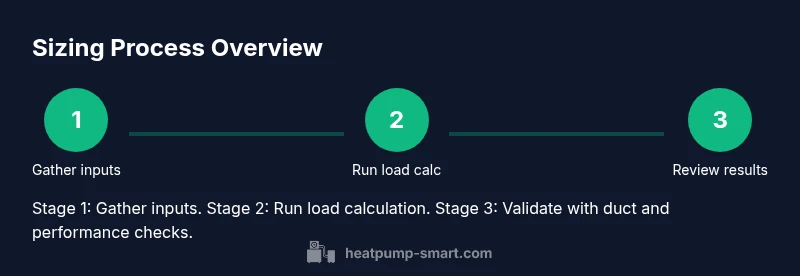
Collect floor plans, room layouts, insulation levels, window data, and occupancy patterns to form an accurate baseline for load calculations.
Tip: Attach measurements with photos to avoid misreadings - 2
Choose a sizing method
Decide between a formal Manual J calculation or a reputable online calculator as a starting point.
Tip: Manual J is preferred for accuracy, especially in complex homes - 3
Run the load calculation
Enter inputs into the tool and generate the heating and cooling load in BTU/hr and tons.
Tip: Double-check inputs like window area and shading factors - 4
Interpret the results
Review the calculated load against equipment capacities the dealer lists in BTU/hr and tons.
Tip: Prefer equipment with a slight safety margin (not oversized) for efficiency - 5
Check ducts and airflow
Assess duct size, leakage, and static pressure to ensure the system can deliver the rated capacity.
Tip: Leaky ducts can nullify correct sizing - 6
Select the final size
Choose a unit whose nominal capacity matches the calculated load within a comfortable tolerance (±5–10%).
Tip: Consider variable-speed compressors for flexibility
Your Questions Answered
Why is proper heat pump sizing important for comfort?
A correctly sized unit maintains consistent temperatures, reduces cycling, and improves humidity control. Over-sized systems warm or cool spaces quickly but waste energy, while under-sized units struggle to reach setpoints.
A properly sized heat pump keeps your home comfortable and energy bills lower by avoiding short cycling.
Can I size a heat pump myself, or should I hire a pro?
Basic estimates can be done with online tools, but formal Manual J calculations should be performed by a qualified HVAC professional for accuracy.
For complex homes, hire a professional to ensure accurate sizing.
What happens if the unit is oversized?
Oversized units heat or cool quickly, but cycle frequently, leading to humidity problems and higher energy use over time. Zone control can mitigate some effects.
Oversized units waste energy and can reduce comfort due to humidity swings.
What is Manual J, and do I need it?
Manual J is a detailed load calculation used by professionals to determine accurate heating and cooling requirements. It’s the standard for residential sizing.
Manual J is the detailed method used by pros to size systems accurately.
Do all heat pumps have similar SEER and HSPF ratings?
SEER and HSPF vary by model and climate. Pick a unit with a higher rating within your budget to improve efficiency and comfort.
Higher SEER and HSPF ratings mean better efficiency.
Should I consider zoning or a single-zone system?
Zoning can improve comfort and allow better matching of loads to different areas. It may affect the number of units or the size of each unit.
Zoning helps tailor output to different parts of your home.
Watch Video
Top Takeaways
- Start with a formal load calculation
- Match size to the calculated load, not room count
- Duct health affects delivered capacity
- Envelope improvements can reduce required size