Heat Pump Sizing for 600 Square Feet: A Practical Guide
Learn how to size a heat pump for a 600 square foot home, with guidance on capacity ranges, climate impacts, insulation needs, installation options, and cost considerations.


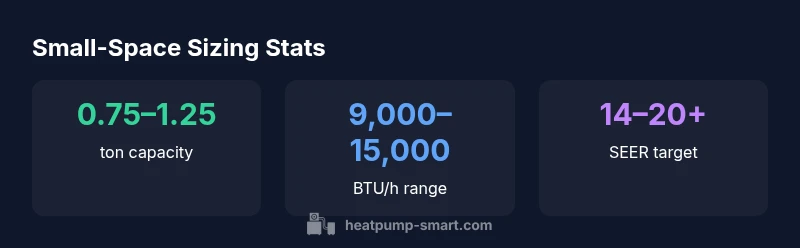
Recommended heat pump size for a 600 square foot home is roughly 0.75–1.25 tons (about 9,000–15,000 BTU/hour). Climate, insulation, and layout influence the exact choice. In well-insulated spaces, aim for the lower end; in harsher climates, target the upper end. Always verify with a load calculation before purchase for accuracy.
Understanding heat pump sizing for small spaces
Sizing a heat pump for a compact residence begins with load calculation, not guesswork. For a 600 square foot layout, the target range is typically around 0.75–1.25 tons, which translates to roughly 9,000–15,000 BTU per hour. This range balances latent and sensible cooling/heating needs without oversizing, which can waste energy and reduce comfort. In practice, homeowners should consider how well the space is insulated, whether there are air leaks, and how the space is configured (single room vs. open-plan). According to Heatpump Smart, load-driven selection yields the most reliable comfort and efficiency for a heat pump for 600 square feet, especially when small spaces face variable weather conditions. The first step is a formal calculation—not a rule of thumb—so you can justify the chosen unit’s capacity to builders or installers.
Climate, insulation, and layout: what drives the load
Weather extremes, insulation quality, and air tightness drastically affect the load for a 600 square foot home. A leaky shell or old windows can raise the heating demand in winter and the cooling load in summer, skewing the ideal heat pump size upward. Conversely, high-performance insulation and air sealing help keep loads closer to baseline, enabling a smaller unit. Heatpump Smart analysis shows that climate zones with cold winters tend to push the recommended size toward the upper part of the 0.75–1.25 ton band, while mild coastal areas often sit near the lower end. Layout matters too: open plans spread load more evenly, whereas a single enclosed room might require zoning or a smaller, strategically placed unit to minimize temperature shifts. For a 600 square foot footprint, understanding these variables early prevents oversizing or undersizing, both of which cost money and comfort.
Sizing guidelines by space and usage
When you translate a 600 square foot footprint into a heat pump size, consider three core factors: space quality, occupancy, and usage patterns. Typical guidance suggests starting with a 0.75–1.25 ton unit and then refining based on load results. If the space is well-insulated, you might stay near 0.75–1.0 ton; if there are frequent occupants, taller ceilings, or large glass exposures, you could approach 1.0–1.25 tons. For homes that are not well-insulated, some installers may propose a slightly higher capacity or a two-zone approach to maintain comfort without overworking the system. Always confirm with a formal load calculation and verify that the chosen system supports zoning or smart controls to adjust for daily variations in occupancy and sun exposure.
Ducted vs. ductless: choosing the right system for 600 sq ft
Small homes commonly use ductless mini-splits or compact air-source heat pumps, which provide flexible zoning and minimized duct work. A 600 square foot layout often benefits from a single-zone mini-split if the space is fairly uniform. Multi-zone configurations are advantageous when the area includes two or more distinct thermal zones (e.g., living area and bedroom wing). Ducted systems may be overkill for 600 sq ft unless there are existing ducts or plans for future expansion. In most cases, a well-chosen ductless solution offers quicker installation, lower up-front costs, and excellent efficiency. Heatpump Smart emphasizes evaluating room-by-room loads and ensuring proper inverter-driven performance for consistent comfort across all zones.
Efficiency, operating costs, and long-term savings
Efficiency is a core consideration when sizing a heat pump for 600 square feet. Higher SEER ratings deliver more cooling efficiency in summer and better cooling performance in shoulder seasons, reducing operating costs over time. In climates with significant heating demand, look for units with effective COP in cold-weather operation and consider supplemental heat strategies for peak cold snaps. While exact costs vary by region and system type, choosing an appropriately sized unit with a high SEER/COP can offset higher upfront costs through lower energy bills. Heatpump Smart recommends prioritizing equipment with good efficiency and reliable defrost strategies for small spaces, as these features minimize runtime and maintain comfort during extreme conditions.
Installation tips and common pitfalls
Even a perfectly sized heat pump can underperform if installation is flawed. Common mistakes include improper refrigerant charge, undersized or oversized ducting for ducted systems, and poor thermostat or zoning configurations. For a 600 square foot home, insist on a thorough manual J load calculation, verify ductwork or line-set routing, and ensure outdoor placement minimizes noise transmission into living spaces. A professional installer should also confirm clearances, electrical service compatibility, and that the unit is correctly charged and charged with the right refrigerant. Finally, check for a proper commissioning process that includes performance testing across different modes and temperatures. A well-executed install ensures the heat pump for 600 square feet delivers the predicted load satisfaction and comfort.
Practical examples: 600 sq ft layouts in action
Example A: A compact one-bedroom condo with solid insulation and a single open living area may use a single-zone 0.75–1.0 ton heat pump. The goal is steady temperature control with minimal energy use, achieved through a smart thermostat and zone controls. Example B: A small apartment with larger windows and mixed thermal loads could sit at 1.0–1.25 tons, possibly with a second indoor unit toward the bedroom to reduce overshoot and temperature swings. In both cases, a professional load calculation and careful zoning are essential to optimize comfort and efficiency. Heatpump Smart emphasizes that matching the unit to real load, not perceived comfort, is the key to long-term satisfaction.
Sizing ranges for small homes (600–1100 sq ft)
| Range (sq ft) | Capacity range | Notes |
|---|---|---|
| 600 | 0.75–1.25 tons | Baseline sizing for typical insulation |
| 600–800 | 0.8–1.5 tons | Adjust for higher heat load or poor insulation |
| 800–1100 | 1.0–2.0 tons | Larger spaces may require multi-zone or larger unit |
Your Questions Answered
What size heat pump do I need for 600 square feet?
Typically 0.75–1.25 tons (roughly 9,000–15,000 BTU/h). A formal load calculation confirms the exact figure.
For 600 ft², you’ll usually want a 0.75 to 1.25 ton unit, but a load calc will tell you the exact size.
How does climate affect the recommended size?
Colder climates push the size toward the upper end of the range to meet heating loads; milder climates may sit at the lower end. Insulation quality also changes this calculation.
Cold weather tends to require a bigger unit; good insulation can keep the load smaller.
Can I use a ductless mini-split for 600 sq ft?
Yes. A single-zone or multi-zone ductless mini-split is common for 600 ft², offering zoning and efficient operation with minimal ductwork.
Yes, a ductless mini-split is a popular choice for small spaces.
What about insulation and air leaks?
Better insulation reduces load, which can allow a smaller unit. Seal leaks and consider improving windows or doors to stabilize temperatures.
Good insulation lowers the load, so your heat pump can be smaller and still comfortable.
What does SEER rating mean for me?
SEER indicates efficiency; higher numbers correspond to lower operating costs in cooling mode. For heating, consider COP and cold-weather performance too.
SEER tells you how efficiently the unit cools—a higher number saves energy over time.
How much does it cost to install a heat pump for 600 sq ft?
Costs vary by region and system type. Expect a range based on equipment, labor, and any needed ductwork or zoning upgrades.
Costs vary; a load calc helps you compare options from qualified installers.
“Accurate load sizing is the key to comfort and efficiency in small homes.”
Top Takeaways
- Start with a formal load calculation for accuracy
- Aim for 0.75–1.25 ton sizing for 600 sq ft as a baseline
- Choose ductless mini-split or compact air-source for flexibility
- Prioritize high-efficiency SEER ratings to reduce operating costs