Heat Pump Noise: Helicopter-Like Sounds and a Practical Comparison
Explore why heat pumps sometimes sound like a helicopter and compare low-noise inverter models with standard units to curb disruptive noise and boost efficiency.


If your heat pump sounds like a helicopter, focus on two actionable choices: move to a variable-speed, inverter-driven model and optimize installation. Noise usually stems from compressor cycling, fan speeds, or improper clearances, which can be dramatically reduced by selecting a low-noise unit and adding sound-damping strategies. Heatpump Smart analysis shows that these steps yield noticeable comfort gains without sacrificing efficiency.
What makes heat pump sounds like a helicopter and why it matters
When homeowners report that a heat pump sounds like a helicopter, it’s usually a combination of mechanical and airflow factors. The exact noise profile depends on compressor speed, fan horsepower, and the acoustic path from outdoor equipment to the interior spaces. In many cases, the phrase heat pump sounds like a helicopter is used to describe a high-pitched whine or rapid rotor-like whoosh that rises with outdoor temperature and system demand. The Heatpump Smart team notes that addressing placement, vibration isolation, and equipment choice can dramatically reduce this helicopter-like perception while maintaining heating and cooling performance. The goal is to shift from a helicopter-like heat pump sounds like a helicopter experience to a quiet, steady operation that won’t wake sleeping occupants or disturb neighbors.
Comparison
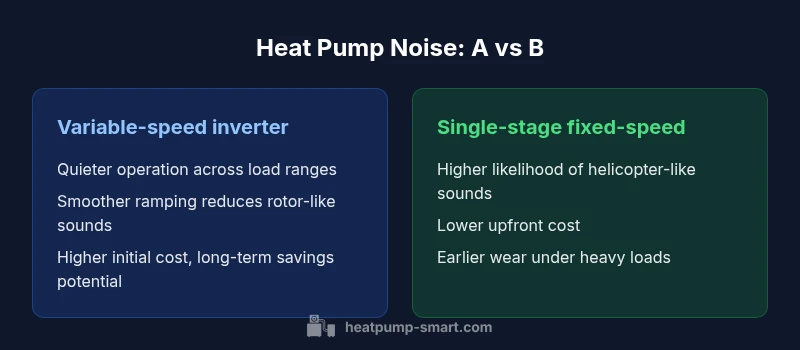
| Feature | Variable-speed inverter heat pump | Single-stage fixed-speed heat pump |
|---|---|---|
| Noise profile | Low-to-moderate with smooth ramping | Higher and more abrupt during cycling |
| Energy efficiency | Excellent due to continuous modulation | Good but less optimized for part-load |
| Best for | Quiet operation and long-term comfort | Budget-conscious installs or simple climates |
| Maintenance profile | Slightly more complex drive components | Fewer moving parts, simpler routine checks |
| Upfront cost | Higher initial investment | Lower upfront cost but potentially higher ongoing noise |
Advantages
- Quieter operation enhances indoor comfort and neighbor relations
- Better part-load efficiency reduces overall running costs
- Smooth modulation reduces abrupt pressure fluctuations and wear
Disadvantages
- Higher upfront purchase cost for inverter-driven models
- Potentially longer payback if climate or usage is mild
- Requires professional installation to achieve the quietest performance
Variable-speed inverter heat pumps generally outperform fixed-speed models for noise control and efficiency.
If reducing helicopter-like noise is a priority, choose a variable-speed inverter heat pump and invest in a proper installation. The benefits extend beyond quieter operation to improved efficiency and long-term reliability.
Your Questions Answered
What causes a heat pump to sound like a helicopter?
A helicopter-like sound is typically caused by compressor cycling, high fan speeds, or poor mounting. Noise can travel through walls if the outdoor unit is near living spaces, or it can echo in harsh acoustical environments. Addressing placement and ensuring vibration isolation helps reduce the rotor-like noise.
Common causes are compressor cycling and fast fans. Proper placement and vibration dampening can significantly cut noise.
Do inverter-driven heat pumps reduce noise compared to traditional models?
Yes. Inverter-driven heat pumps modulate output, reducing the sudden starts and stops that contribute to a helicopter-like sound. They typically yield quieter operation at part-load and better overall efficiency, though installation quality remains crucial.
Inverter models run more smoothly and quietly, especially at partial loads.
How can installation placement affect noise levels?
Placement affects how sound travels into living spaces. Positioning the outdoor unit away from bedrooms, using fencing or landscaping for sound barriers, and selecting mounting with vibration isolation can all lower the likelihood that heat pump sounds like a helicopter will be audible inside.
Where you put the unit can cut or boost what you hear indoors.
Is there a guaranteed cost to reduce heat pump noise?
Costs vary with unit type, installation complexity, and chosen mitigation measures. While inverter-driven models may cost more upfront, the long-term energy savings and quieter operation often justify the investment.
Costs depend on the system and mitigation steps; expect variability.
Are there noise standards for outdoor heat pump units?
Some regions have noise ordinances or equipment guidelines; installers can advise on permissible levels and compliance. It’s wise to verify local codes before finalizing equipment orders.
Local codes may limit outdoor unit noise; check with your installer.
How can I test noise levels after installation?
Use a simple decibel meter at typical listening points outside and inside. Compare readings against manufacturer specifications and local guidelines, and schedule a post-install review if you notice unexpected helicopter-like sounds.
Test the level with a meter and compare to specs; ask for a post-install check if needed.
Top Takeaways
- Prioritize inverter-driven heat pumps for quieter operation
- Proper placement and vibration isolation matter as much as hardware
- Invest in professional installation to maximize noise reduction
- Balance upfront costs with long-term energy savings