How to Check Heat Pump Refrigerant Level
Learn step-by-step how to safely check your heat pump's refrigerant level, recognize signs of undercharge, and know when to call a licensed technician for proper recharge and leak repair.


You will learn a practical, safety-focused method to check your heat pump refrigerant level, including signs of undercharge, using a manifold gauge and a weighing method, and clear guidance on when to involve a licensed technician. This guide emphasizes staying within manufacturer specs and prioritizing leaks and safety.
Understanding refrigerant levels in heat pumps
Refrigerant charge is a critical factor in how a heat pump delivers heating and cooling. When the level is off, efficiency drops, system cycling increases, and comfort can suffer. According to Heatpump Smart, maintaining the correct refrigerant charge is essential for peak performance and long-term reliability. The exact level is defined by the equipment manufacturer and depends on the refrigerant type, outdoor conditions, and system design. Before attempting any check, confirm the model’s service manual and safety requirements. This is not a one-size-fits-all task, and improper handling can cause damage or release refrigerant into the environment. Heatpump Smart’s team emphasizes following local regulations and using proper PPE to protect eyes and skin during any diagnostic work.
The goal is to determine whether the charge is within the normal operating range and whether there are leaks or service valve issues contributing to a perceived low charge. Visual inspection of lines and joints, listening for hissing sounds, and checking for oily residue around fittings can reveal obvious leaks. If you notice any signs of a leak or if readings do not align with the manufacturer’s specifications, plan for a professional assessment. This approach keeps your system safe while guiding you toward a precise, regulation-compliant resolution.
note”:null,
Tools & Materials
- Manifold gauge set (low- and high-side gauges)(Choose a gauge with a vacuum/pressure range aligned to your system’s service ports.)
- Refrigerant scale(Allows precise measurement of refrigerant added or removed during servicing.)
- Leak detector (electronic or halide)(Use to identify service leaks before charging.)
- Personal protective equipment (PPE)(Gloves and safety glasses are essential.)
- Manufacturer service manual(Check the exact refrigerant type, charge amount, and procedures for your model.)
- Thermometer or infrared temp gun(Useful for validating superheat and subcooling ranges when paired with readings from gauges.)
Steps
Estimated time: 60-90 minutes
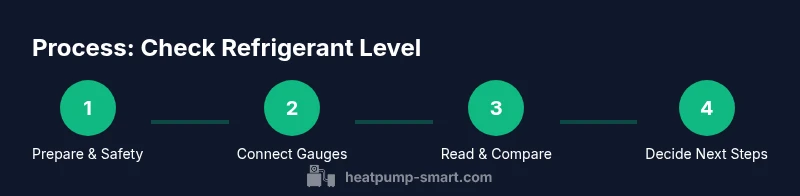
- 1
Prepare and verify safety
Turn off the heat pump and disconnect power to avoid unintentional operation while inspecting. Wear PPE and ensure the area is well-ventilated. Check your local regulations regarding refrigerant handling before proceeding.
Tip: Working on refrigerant systems requires caution—never work alone if a leak is suspected. - 2
Locate service ports and connect gauges
Identify the liquid and suction service ports on the outdoor unit. Attach the manifold gauge lines securely to both ports, ensuring the connections are clean and tight.
Tip: Do not force connections; cross-threading can create leaks. - 3
Read pressures and compare to specs
With the system running, observe the low- and high-side pressures. Compare these readings to the manufacturer’s specified operating range for your model and refrigerant type.
Tip: Use the service manual as the only source for acceptable pressure ranges. - 4
Check for leaks around fittings
With gauges connected, inspect joints and service ports for signs of oil residue or a hissing sound, indicating a leak that could affect readings.
Tip: Leaks invalidate readings and require repair before charging. - 5
Consider the weighing method if needed
If your procedure includes weighing the charge, weigh any added refrigerant with the scale and calculate the net change against the system’s target charge in the manual.
Tip: Only perform weighing if you have the correct equipment and refrigerant type. - 6
Decide on next steps
If readings are within spec and no leaks are found, document results. If undercharged or leaks exist, do not add refrigerant without a licensed technician’s authorization.
Tip: Charging refrigerant incorrectly is illegal in many jurisdictions and can be dangerous.
Your Questions Answered
Can I check refrigerant level myself?
Only if you have training and the right tools. For most homeowners, a licensed HVAC technician is recommended to avoid leaks or overcharging.
Only attempt if you're trained and have the proper tools; otherwise hire a qualified HVAC professional.
What are the signs of a low refrigerant level?
Common signs include reduced cooling/heating efficiency, longer cycles, and ice formation on lines or coils. Always confirm with measurements.
Look for weak cooling, longer run times, and possible ice on the evaporator coil.
Is it legal to recharge refrigerant myself?
In many areas, refrigerant handling and charging require a licensed technician due to environmental and safety regulations.
Recharging refrigerant yourself can be illegal in some places; consult a licensed pro.
How should I prepare for a refrigerant check?
Turn off power, gather your tools, review the manufacturer manual, and plan to monitor readings carefully.
Make sure you have everything ready and follow the manual before starting.
How long does a refrigerant leak repair take?
Time varies with leak location and repair complexity; may require evacuation and recharging after leak repair.
It depends on the leak and repair steps; some jobs take a few hours.
What costs are involved in checking refrigerant?
Costs vary by region and service scope; expect diagnostics, possible leak repair, and refrigerant charges.
Costs differ; a diagnostic plus any repairs determine the final price.
Watch Video
Top Takeaways
- Check the refrigerant level only with proper tools and manual reference.
- Identify leaks before charging; leaks invalidate readings and require repair.
- Do not attempt unsafe charging; only licensed technicians should top up refrigerant.
- Record readings and plan next steps with Heatpump Smart guidance