How to Tell If Your Heat Pump Is Overcharged: A Practical Guide
Learn how to identify an overcharged heat pump using safe checks, readings, and steps. This guide covers signs, tools, and when to call a pro to protect efficiency and equipment.


Quick answer: To tell if a heat pump is overcharged, check for high head pressure, abnormally high discharge pressure, and reduced cooling performance. Look for frost on the outdoor coil when not in a frost cycle, unusual compressor current, and gurgling sounds. Use a refrigerant gauge set and temperature checks, then consult a pro for precise charging and recovery.
Why refrigerant overcharge matters
A heat pump relies on the correct refrigerant charge to transfer heat efficiently. When the system is overcharged, it can push liquid refrigerant into the compressor, causing damage, reduced capacity, higher energy use, and premature wear. This article explains how an overcharge happens and why staying within manufacturer specifications matters for reliability and energy savings. Heatpump Smart's analysis highlights that small deviations from the recommended charge are common but costly over time, especially in climates with extreme temperature swings.
Recognizing signs of an overcharged system
Look for several indicators that the refrigerant charge is higher than specified. Common signs include unusually high head pressure on the discharge side, increased compressor current draw, and reduced cooling or heating performance. Short cycling, oil on panels, and strange noises can accompany refrigerant issues. Note that environmental conditions and equipment age can influence readings, so gather multiple data points over time for accuracy. If readings seem outside spec, proceed to safety checks and consult a professional.
Safety first: Tools and protective gear
Before checking any refrigerant-related parameters, ensure your safety. Turn off the power at the breaker, follow lockout/tagout procedures, and wear safety glasses and gloves. Use a calibrated HVAC gauge set, digital thermometer, and a notepad to record readings. Keep a clean workspace and avoid exposing refrigerant to heat sources. If you are unsure about any step, contact a licensed technician.
How to measure charge and interpret readings
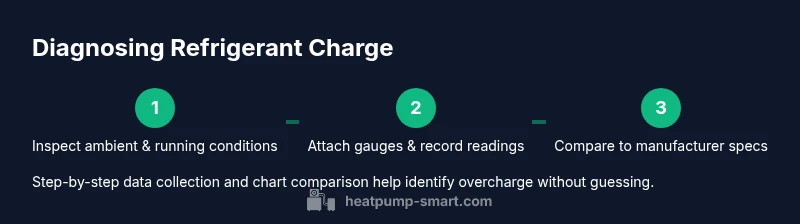
Connect the manifold gauge set to the service valves according to the manual. Record the high-side (discharge) and low-side (suction) pressures at the same ambient temperature. Compare readings to the manufacturer's specification charts for your model. Take refrigerant temperatures at the evaporator inlet and outlet to estimate superheat or subcooling. If superheat is excessively high or low while pressures are abnormal, it may indicate an overcharge or another fault requiring further diagnosis.
Common causes of overcharging and prevention tips
Overcharging often happens when technicians adjust charge without verifying the system's true condition or when a vacuum is not properly established during servicing. Other causes include incorrect refrigerant type, faulty charging procedures, or leaks that went uncorrected. Prevention relies on following manufacturer guidelines, using correct refrigerant type and charge amounts, and verifying with post-service testing. Routine maintenance helps catch issues before they escalate.
What to do if you suspect an overcharge: next steps
If readings suggest overcharge, avoid attempting a DIY fix that involves releasing refrigerant yourself. Refrigerant handling requires certification and proper recovery equipment. Arrange service with a licensed HVAC technician who can recover excess refrigerant, evacuate the system, and recharge to the correct specification. Document readings and conditions for your records and for the tech.
Troubleshooting vs diagnosis: when to call a professional
Certain signs can mimic another fault, such as airflow problems or outdoor coil fouling. A trained technician uses diagnostic tests and refrigerant recovery procedures to distinguish between an overcharge and related issues. Dry indicators or conflicting readings should trigger professional service to prevent compressor damage and warranty voiding. Proactive maintenance reduces the risk of overcharge events.
Tools & Materials
- HVAC gauge/manifold set(Calibrated and rated for your system's refrigerant type)
- Digital thermometer or infrared camera(For evaporator temperatures and surface temps)
- Safety gear (glasses, gloves)(Personal protective equipment)
- Pressure-temperature charts or software(Model-specific reference for charge interpretation)
- Notebook or digital log(Record ambient temps, pressures, and superheat/subcooling)
Steps
Estimated time: 60-90 minutes
- 1
Power down and prepare safety gear
Turn off the unit at the main breaker and lock out the panel. Put on safety glasses and gloves. Confirm power is off with a non-contact tester before touching any wiring or components.
Tip: Double-check that the outdoor unit is isolated to prevent accidental startup. - 2
Set up and calibrate your gauges
Attach the manifold gauge set to the service valves according to the manual. Ensure connections are tight and the gauges read zero when the system is off. Have your reference charts ready for comparison.
Tip: Use fresh hoses and verify calibration to avoid erroneous readings. - 3
Take a baseline reading under steady conditions
With the system off, record ambient air temperature and indoor-outdoor difference. When the system is running, note suction and discharge pressures at steady-state operation.
Tip: Record multiple data points to average out transient spikes. - 4
Compare to manufacturer specifications
Using the model-specific chart, compare the measured pressures to recommended ranges. Pull a second reading if readings seem off and verify ambient conditions.
Tip: If you don't have charts, contact the manufacturer or a licensed tech for guidance. - 5
Check evaporator inlet/outlet temperatures
Measure temperatures across the evaporator using a reliable thermometer. Calculate subcooling or superheat as appropriate for your system type to assess charge accuracy.
Tip: Incorrect subcooling or superheat often signals a charge issue or a related fault. - 6
Decide on next steps based on results
If readings point to overcharge, do not discharge refrigerant yourself. Plan professional recovery and recharge according to safety guidelines, and verify post-service performance.
Tip: Document readings and decisions for future service.
Your Questions Answered
What does it mean if a heat pump is overcharged?
An overcharged heat pump has more refrigerant than the manufacturer specifies. This can raise head pressure, reduce efficiency, and risk compressor damage. A precise diagnosis is essential, often requiring professional recovery and recharge.
An overcharged heat pump has too much refrigerant, which can harm efficiency and the compressor. A professional diagnosis is usually needed.
Can I fix an overcharge myself?
No. Handling refrigerants requires certification and proper recovery equipment. Attempting to adjust charge without training can be dangerous and illegal in many regions.
No. Refrigerant work requires certification and proper recovery equipment. Don't try this at home.
What tools do I need to assess charge?
A calibrated HVAC gauge set, thermometers, and manufacturer charge charts are essential. You should also have safety gear and a method to log readings.
You’ll need a calibrated gauge set, thermometers, and the manufacturer charts to assess charge.
How often should I check refrigerant charge?
Most systems benefit from annual professional maintenance. However, check refrigerant charge if you notice cooling drop, strange noises, or abnormal temperature differences.
Annual professional checks are typical, but check if you notice performance issues.
What are the risks of ignoring an overcharge?
Continued overcharging can stress the compressor, reduce efficiency, and shorten system life. It may also void warranty if not handled properly.
Ignoring an overcharge can damage the compressor and reduce efficiency.
How is an overcharge corrected?
A licensed technician recovers excess refrigerant, evacuates air, rechecks pressures, and recharges to the correct spec. Post-service testing ensures proper operation.
A licensed tech recovers refrigerant and recharges to spec after proper checks.
Watch Video
Top Takeaways
- Verify readings with calibrated gauges and ambient temps
- Do not attempt DIY refrigerant work; call a pro
- Compare charge to model specs and chart data
- Address issues promptly to protect the compressor