What Happens If a Heat Pump Does Not Defrost
Urgent troubleshooting guide for heat pumps that won't defrost. Learn common causes, a diagnostic flow, step-by-step fixes, safety tips, and when to call a pro.


According to Heatpump Smart, when a heat pump does not defrost, ice can accumulate on the outdoor coil, reducing efficiency and stressing the compressor. Most often the issue is a faulty defrost control or sensor, restricted airflow due to a dirty coil, or an air stream blockage. Simple checks can confirm the likely cause before contacting a professional.
what happens if heat pump does not defrost
What happens when a heat pump fails to defrost goes beyond a frosted coil. The outdoor coil thrives on a clear air path, and frost interferes with heat transfer, lowers system efficiency, and can cause the indoor temperature to swing or the unit to cycle excessively. This is exactly what happens if heat pump does not defrost. According to Heatpump Smart, the most common failures involve control or sensor components, but airflow and coil cleanliness play a critical role too. By understanding the failure modes, homeowners, builders, and property managers can prioritize actions that protect the equipment and maintain comfort without unnecessary downtime. The Heatpump Smart team found that starting with simple, safe checks often reveals the root cause before a service call is needed.
Consequences of skipped defrost cycles
Ignoring a non-defrosting heat pump can lead to persistent ice accumulation. Ice acts as insulation, forcing the system to work harder, increasing energy consumption and the risk of compressor wear. In cold weather, the lack of a proper defrost cycle can limit heating output precisely when demand is highest. Heatpump Smart emphasizes that early detection prevents frost-related damage and keeps the system running more reliably throughout the heating season.
Diagnosing the most common failure modes
Defrost faults usually fall into sensor/controls or airflow/coils categories. A faulty defrost sensor or control board prevents the cycle from starting or ending properly. A dirty outdoor coil or blocked airflow reduces heat transfer efficiency, which can mimic a defrost failure. Less common but possible are issues with the reversing valve in some heat pump configurations and refrigerant-related problems that indirectly impact defrost performance. Heatpump Smart recommends a systematic approach to isolate which family of causes is active.
Quick checks you can perform safely
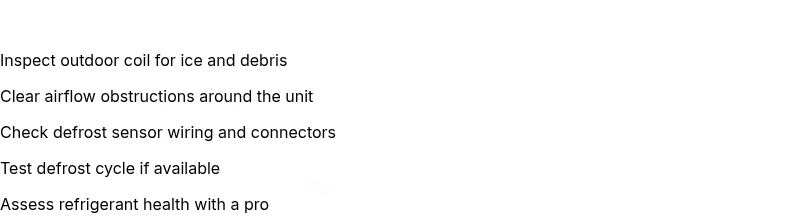
Before touching electrical components, ensure the system is powered off at the breaker. Check the outdoor coil for ice buildup and debris, then inspect the cabinet for restricting airflow (shrubs, snow, or dirt piles). Verify that the thermostat setting is appropriate and that the defrost option is enabled if your model has manual defrost or a frost sensor setting. Confirm that wiring connections to the defrost sensor and control board appear intact and free of corrosion or loose connectors. These basic checks can rapidly point to a sensor, control, or airflow issue.
Safety and professional boundaries
Some defrost components require electrical testing or refrigerant handling. If you observe live electrical wires, refrigerant lines, or a refrigerant smell, stop immediately and contact a licensed HVAC tech. Heatpump Smart strongly advises homeowners to avoid disassembly of sealed components and to schedule professional service for sensor replacement, control board work, or refrigerant charging. Regular maintenance by a qualified technician can help detect wear on defrost sensors and boards before a fault becomes a safety risk.
Steps
Estimated time: 45-90 minutes
- 1
Power down and safety check
Turn off the outdoor and indoor power at the breaker panel. Confirm there is no live voltage anywhere near the outdoor unit. This first step prevents electric shock and protects sensitive components during inspection.
Tip: Use a non-contact voltage tester to verify circuits are de-energized before touching any wiring. - 2
Inspect outdoor coil and airflow
Check the outdoor condenser for ice, debris, and obstructions. Clear snow, leaves, or vegetation that could block airflow. A clean coil plus free airflow is essential for proper defrost operation.
Tip: Keep a clear radius of at least 3 feet (1 meter) around the unit for optimal airflow. - 3
Check defrost sensor connections
Open the control access panel and inspect the defrost sensor wiring. Look for loose connectors, corrosion, or damaged insulation. Re-seat connectors and replace damaged components as needed.
Tip: Take photos of wiring before disconnecting to aid correct reassembly. - 4
Test the defrost sequence
If your system allows, manually initiate a defrost cycle or run a diagnostics test to observe whether the cycle starts and melts ice. Note any error codes displayed by the controller.
Tip: Refer to the equipment manual for the exact diagnostic codes and safety precautions. - 5
Evaluate the control board/timer
If the defrost sequence does not engage or fails to terminate, the control board or timer may be faulty. This step often requires professional replacement.
Tip: Document any abnormal codes to share with the technician. - 6
Assess refrigerant and system integrity
If all prior checks fail, a refrigerant leak or charge issue could be involved. Only a licensed technician should perform this check due to safety and environmental regulations.
Tip: Avoid attempting to charge refrigerant yourself; it’s a regulated hazardous operation.
Diagnosis: Ice buildup on the outdoor coil and no defrost cycle observed
Possible Causes
- highDefrost control board or timer failure
- highDefrost thermostat/sensor fault
- mediumRestricted airflow from a dirty/coiled obstructed outdoor unit
- mediumOutdoor temperature sensor fault
- lowReversing valve issue in defrost mode
- lowLow refrigerant charge or leak
Fixes
- easyPower cycle the system and verify defrost controls are enabled
- mediumInspect and reseat defrost sensor connections; replace faulty sensor if needed
- easyClean outdoor coil and ensure unobstructed airflow around the unit
- mediumTest and, if necessary, replace defrost control board or timer
- hardCheck refrigerant charge and repair leaks by a licensed tech
- mediumInspect reversing valve operation if your model uses electric valve control
Your Questions Answered
What is the defrost cycle on a heat pump?
The defrost cycle periodically switches the system to melt frost on the outdoor coil. It is controlled by sensors and the defrost timer and is essential for maintaining heat output in cold weather.
The defrost cycle melts frost from the outdoor coil to keep heating efficiency up. It’s controlled by sensors and a timer.
Why would ice form on the outdoor coil even when the system is running in heat mode?
Ice can form if the defrost cycle isn’t triggering, sensors are faulty, or airflow is blocked. It can also occur if the coil is dirty or the outdoor temperature is very low.
Ice on the outdoor coil usually means the defrost cycle isn’t working or airflow is blocked.
How do I test the defrost thermostat or sensor?
Testing usually involves checking continuity and resistance with the unit powered off, and ensuring sensor wiring is intact. If unsure, contact a licensed technician.
You can inspect the sensors for loose wiring, but testing with power on should be done by a pro.
Can I manually trigger a defrost cycle, and is it safe?
Some units support manual defrost via the service menu or external jumper; follow the manual closely. If unsure, don’t risk damaging the control board.
Some models let you trigger defrost manually, but it’s safest to use the built-in diagnostic options or call a pro.
When should I call a professional?
If ice persists after basic checks, if you smell refrigerant, or if you notice electrical issues, schedule professional service promptly.
Call a pro if the defrost problem continues after checks or if you suspect refrigerant or electrical faults.
Can a dirty coil cause defrost failure?
A dirty outdoor coil reduces heat transfer and can mimic a defrost failure by triggering excessive icing. Cleaning is often the first fix.
Yes—a dirty coil can make the system ice up and behave as if defrost isn’t working.
Watch Video
Top Takeaways
- Inspect sensors and controls first
- Keep outdoor coils clean and unobstructed
- Call a pro for refrigerant or control-board work
- Regular maintenance reduces defrost failures