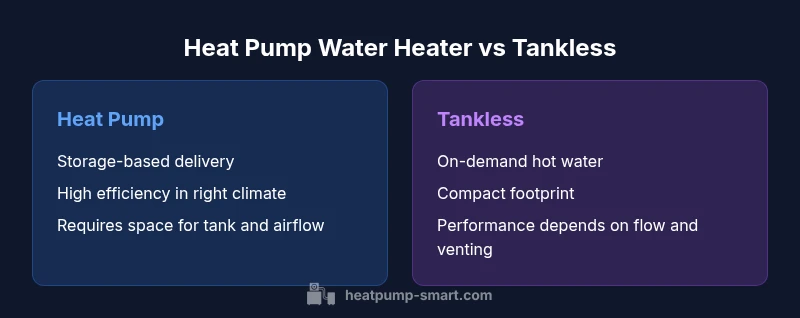
Heat Pump vs On-Demand Water Heater: A Comprehensive Comparison
Compare heat pump water heaters with on-demand tankless water heaters across efficiency, costs, installation, and performance to help homeowners choose the best option.


According to Heatpump Smart, choosing between a heat pump water heater and an on-demand (tankless) unit depends on your home’s pattern of hot water use and climate. Heat pump models excel in energy savings where there is adequate space and moderate temperatures, while on-demand units offer unlimited hot water without storage but can have higher upfront costs and installation requirements. For many homes, heat pump water heaters are the smarter long-term choice, provided space and climate are suitable.
Understanding the decision landscape
When homeowners compare a heat pump water heater with an on-demand water heater, several factors come into play beyond just the gross price. The decision hinges on how much hot water your family uses, how much space you have for equipment, the climate you live in, and whether you value long-term operating savings over upfront costs. Heat pump water heaters leverage ambient heat and store hot water, making them efficient in moderate climates with adequate space. On-demand water heaters, also called tankless, heat water on demand and can deliver endless hot water at the tap, but their performance depends on peak flow, installation, and fuel type. As you evaluate options, consider how these systems fit your daily routines and curb appeal requirements. Heatpump Smart’s guidance emphasizes matching system type to real usage patterns for best results.
How a heat pump water heater works
A heat pump water heater uses electricity to move heat from the surrounding air into a storage tank rather than generating heat directly. The system pulls ambient heat from the room, often using a dedicated compressor and fan to transfer energy into the water. In moderate climates, COP (coefficient of performance) can stay favorable, delivering substantial energy savings over traditional electric resistance heaters. The stored water supplies hot taps for your household as needed. Maintenance is typically straightforward—checking the anode rod, cleaning filters, and ensuring airflow around the unit. Heatpump Smart notes that the efficiency gain depends on ambient temperature, humidity, and correct sizing relative to household demand.
How on-demand water heaters (tankless) work
Tankless or on-demand water heaters heat water directly as it flows through the unit, eliminating the need for a storage tank. When you open a hot water faucet, cold water travels to the unit, and a burner (gas or electric) heats it to the desired temperature. Their strength lies in continuous hot water and compact form factors, which save space in tight installations. However, performance depends on flow rate (GPM) and the temperature rise in your climate. If multiple outlets draw water at once, the unit may struggle to maintain a consistent temperature unless you install multiple units or a high-capacity model. Regular descaling and venting (for gas units) are part of ongoing maintenance.
Energy efficiency and operating costs: a balanced view
Choosing between heat pump and on-demand systems should weigh not only efficiency ratings but also how usage translates to operating costs over time. Heat pump water heaters typically deliver lower operating costs in homes with moderate hot-water use and stable occupancy patterns, especially in climates that support good COP values. On-demand water heaters can offer strong energy efficiency in high-demand situations, but their efficiency is highly dependent on the selected model, fuel type, and installation quality. Heatpump Smart analysis shows that efficiency gains can be substantial when the heat pump system is properly sized and integrated with existing electrical infrastructure. For households with variable usage, a hybrid approach—combining storage and on-demand zones—can also be effective.
Installation and space considerations for heat pumps
Installing a heat pump water heater generally requires more space than a tankless unit due to the storage tank and airflow needs. You should allocate room for air intake and exhaust, ensure adequate clearance for ventilation, and verify electrical service capacity. In many homes, the unit is installed in a utility closet, garage, or dedicated mechanical room. The installation may involve refrigerant lines, condensation drainage, and sometimes retrofitting ductwork in spaces that require humidity control. Heatpump Smart highlights the importance of proper clearances and dedicated circuits to avoid nuisance tripping and to maximize the unit’s COP. If space is truly constrained, a compact tankless model might be a better fit, provided the flow demands are manageable.
Climate considerations and how they affect performance
Ambient temperature and humidity influence heat pump efficiency. In milder climates (roughly 40–70°F/4–21°C), heat pump water heaters typically operate more efficiently because the surrounding air provides enough thermal energy for the system to move heat into the water. In very cold regions, performance can decline, potentially requiring auxiliary electric resistance or a secondary heating source. Tankless units, particularly gas-fired models, can perform consistently in a wider range of climates but may be subject to venting requirements and fuel availability. The location of the heater and insulation level of the home also play roles in minimizing heat loss and ensuring the hottest water reaches your fixtures.
Sizing and demand management for reliable hot water
Sizing is critical for both technologies. Heat pump water heaters require a larger storage tank and careful calculation of peak hot-water demand to avoid running out during showers or laundry cycles. Tankless systems require careful analysis of the maximum GPM needs for simultaneous outlets and the temperature rise at your climate. A mismatch between demand and capacity leads to temperature fluctuations and user dissatisfaction. Consider installing an auxiliary heating element or staging multiple units for high-demand households. Heatpump Smart recommends performing a full hot-water audit to determine whether a single unit or a hybrid approach delivers the best balance of cost, efficiency, and comfort.
Maintenance, lifespan, and reliability considerations
Maintenance for heat pump water heaters is typically less frequent than for gas-fired tankless units, but it includes keeping coils, filters, and air pathways clean and ensuring the condensate drain is clear. The storage tank has a longer lifespan compared with some tankless systems, but heat pump components (compressor, fan, and heat exchanger) require periodic inspection. Tankless water heaters demand regular descaling in mineral-rich areas and can be prone to clogged filters if maintenance is neglected. Both types require professional servicing at recommended intervals to maintain performance and extend longevity. Regular checks of electrical connections and venting (for gas models) contribute to consistent operation and safety.
Costs, rebates, and financing: a practical view
Initial costs for heat pump water heaters tend to be higher due to the storage tank and installation complexity, but operating costs over time are often lower in suitable climates. Tankless units can have lower up-front costs in some markets and offer space savings, yet ongoing energy use depends on usage patterns and unit efficiency. Financing options and rebates can soften the upfront investment for either option, and many utility programs provide incentives for high-efficiency water heating. When evaluating costs, consider total cost of ownership over 10–15 years, including maintenance, potential replacements, and energy savings. Heatpump Smart notes that rebates and incentives can significantly affect payback periods in many regions.
Common myths and misconceptions debunked
Myth 1: Heat pumps only work in warm climates. In reality, modern heat pump water heaters perform well in a wide range of temperatures, though performance improves with milder conditions. Myth 2: Tankless equals endless hot water in every scenario. Flow rates matter; if multiple fixtures demand hot water simultaneously, a single tankless unit may not suffice. Myth 3: Higher upfront cost means never worth it. While upfront costs are higher, long-term operating savings and rebates can offset the initial investment over time. Myth 4: All systems are the same regardless of fuel source. Gas and electric options bring different venting, capacity, and installation considerations that impact performance and cost.
Deciding factors and a practical action plan
The final decision should hinge on three core questions: How much hot water do you use daily? Do you have space for a storage tank and proper ventilation/airflow? What are the climate and fuel options at your home? Start with a hot-water audit, gather local rebate information, and consult a licensed installer who can model your peak demand against system capacity. A phased approach—pilot testing a smaller storage heater or a limited tankless installation—can validate performance before a full-scale upgrade. In many cases, a heat pump water heater delivers the best balance of energy savings and reliability when space and climate permit, while on-demand systems shine where space is tight or where continuous hot water is essential for a high-usage household.
The conclusion you’ll reach: a practical framework for decision-making
Ultimately, your choice should reflect your home’s climate, hot-water usage patterns, and installation constraints. Heat pump water heaters generally offer superior long-term energy efficiency in moderate climates with adequate space, while on-demand water heaters excel in tight spaces and high-demand scenarios where continuous hot water is critical. The Heatpump Smart team emphasizes tailoring the system to your daily routines and ensuring a professional assessment to optimize performance and return on investment.
Comparison
| Feature | Heat pump water heater | On-demand water heater (tankless) |
|---|---|---|
| Energy source | Electricity via heat pump capturing ambient heat | Gas-fired or electric (tankless) |
| Typical installation approach | Storage tank + air handling; needs space and airflow | Direct-heated water on demand; compact but requires proper venting and gas/electric supply |
| Efficiency considerations | High efficiency with favorable COP in suitable climates | High efficiency contingent on flow rate and proper sizing |
| Space requirements | Requires storage space and clearance for airflow | Minimal footprint; best in tight spaces |
| Maintenance needs | Periodic checks of anode rod, filters, and airflow | Regular descaling (gas or electric), venting checks for gas models |
| Best for scenarios | Homes with space, moderate climate, and long-term energy savings | High hot-water demand, space constraints, or where endless flow is essential |
Advantages
- Lower long-term operating costs in suitable climates for heat pumps
- No standby energy loss with tankless options (depending on usage)
- Both options may qualify for rebates or incentives
- Flexible installation options with proper sizing and professional guidance
Disadvantages
- Higher upfront cost and installation complexity for heat pumps
- Tankless units can have limited hot water delivery if flow demand is high
- Performance can vary with climate or mineral content of water
- Gas venting and electrical service requirements can complicate installation
Heat pump water heaters generally win for energy savings in moderate climates with space, while on-demand units suit tight spaces or very high simultaneous hot-water needs.
Choose a heat pump water heater if you have space and live in a climate that supports high COP. Opt for an on-demand water heater if space is at a premium or you regularly require high flow rates at multiple fixtures. Consider rebates and installation specifics to optimize total cost of ownership.
Your Questions Answered
What is the main difference between heat pump water heaters and on-demand water heaters?
Heat pump water heaters store hot water and move ambient heat into the tank, delivering energy savings in suitable climates. On-demand water heaters heat water as you use it, providing unlimited hot water at the tap but depending on flow and installation, efficiency varies.
Heat pumps store hot water and use ambient heat for efficiency; tankless units heat on demand and can supply continuous water if sized correctly.
Are heat pump water heaters effective in cold climates?
Heat pumps become less efficient as outdoor temperatures drop, though many models include design features to mitigate cold-weather performance. In very cold areas, an auxiliary heater or alternate heating strategy may be necessary.
They work best in milder climates; in cold climates you may need extra heating or a different setup.
Do tankless water heaters truly provide endless hot water?
Tankless systems can deliver hot water as long as the flow rate stays within the unit’s capacity and the incoming water temperature allows the heater to reach the desired setpoint. In high-demand homes, multiple units or larger capacities may be necessary.
They can provide hot water on demand, but you must size them for your peak flow needs.
What installation considerations should I plan for?
Consider electrical service capacity, plumbing, venting for gas models, and clearances for service access. A licensed installer can assess your home and determine whether a single system or a hybrid approach fits best.
Get a professional assessment to ensure proper sizing and compliance with local codes.
Are rebates or incentives available?
Many regions offer rebates or incentives for high-efficiency water heating systems. Availability varies by locality and utility programs, so check with local energy offices or your utility provider.
Look up local programs—rebates can improve payback time.
Which is better for a large household?
For large households, a tankless system can provide continuous hot water if properly sized, but a heat pump with a storage buffer may better balance energy savings and capacity in moderate climates. Analyze peak demand and consult a professional.
It depends on your hot-water peaks; size accordingly and compare system performance.
Top Takeaways
- Assess climate, space, and daily hot-water patterns before choosing
- Heat pumps excel in energy savings in moderate climates with proper sizing
- Tankless units save space and deliver continuous hot water but require careful flow planning
- Factor upfront costs, maintenance, and potential rebates into the decision