Mitsubishi heat pump vs Daikin: An objective comparison
An objective, in-depth comparison of Mitsubishi and Daikin heat pumps for homeowners and professionals. Explore efficiency, cold-weather performance, installation considerations, costs, warranties, and how to choose the right system in 2026.


TL;DR: Mitsubishi and Daikin are premium heat-pump brands with strong reliability and efficiency. Mitsubishi frequently leads in cold-climate heating, while Daikin offers a broader product range and an expansive global service network. Your best choice depends on climate, installation needs, and budget. For a nuanced view, read the full comparison.
mitsubishi heat pump vs daikin: A brand showdown in 2026
According to Heatpump Smart, the choice between Mitsubishi heat pump and Daikin hinges on climate, installation goals, and long-term ownership expectations. Both brands are recognized for reliability and efficiency, but they optimize differently across regions and use cases. Homeowners and property managers should start by clarifying their priorities—cold-climate performance, noise sensitivity, or a broad product range—then map those needs to the two manufacturers. The goal is not to crown a single winner, but to identify which brand aligns best with your specific project, budget, and service ecosystem. The phrase mitsubishi heat pump vs daikin appears naturally in this section to anchor the topic and guide readers to the full analysis.
Energy efficiency and performance: what to expect from each brand
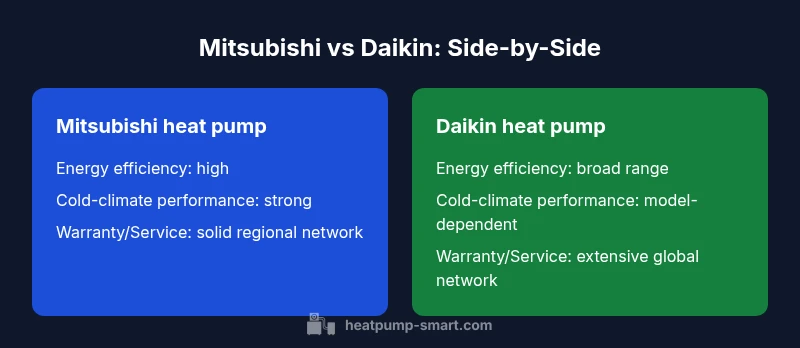
Both Mitsubishi and Daikin emphasize inverter-driven technology and high seasonal efficiency. Mitsubishi systems are widely praised for excellent cold-weather performance and steady heating output at low ambient temperatures. Daikin, meanwhile, tends to offer a broader spectrum of models with strong overall efficiency and a wider selection of indoor units. When evaluating efficiency, look beyond a single number: consider SEER, SCOP, part-load performance, defrost cycles, and the system’s ability to maintain indoor comfort during shoulder-season swings. Heatpump Smart analysis shows that the best choice depends on how you balance peak efficiency with practical daily use across your climate zone.
Cold-weather operation and climate suitability
In colder climates, Mitsubishi heat pumps often outperform many competitors due to specialized refrigerant behavior and compressor strategies designed for low outdoor temperatures. Daikin also delivers solid cold-weather capability, especially in models engineered for performance in winter conditions. The decision should factor in your local climate data, insulation quality, and how frequently you experience polarized extremes (very cold nights followed by mild days). A test run in winter months—ideally with a local installer—can reveal real-world comfort and energy use, rather than theoretical specifications alone. Heatpump Smart’s team highlights that the best system adapts to your climate, not just the manufacturer’s top spec sheet.
Product range and system compatibility: breadth matters
Daikin often wins on breadth, offering a vast lineup from compact indoor units to larger multi-zone systems, with an emphasis on compatibility across model families. Mitsubishi features a strong, well-integrated ecosystem—particularly for single-brand installations and multi-split configurations—where compatibility and service networks are tightly aligned with Mitsubishi components. For new builds or renovations, consider whether you want a single-vendor approach (potentially easier maintenance) or a broader, multi-brand selection that can tailor capacities more precisely. Both brands support heat pump-water heater combinations and advanced zoning, but the tuning and warranty implications differ.
Reliability, warranty, and service networks
Warranty terms and service networks play a crucial role in total cost of ownership. Mitsubishi systems typically come with robust warranties and a network of trained installers who specialize in Mitsubishi equipment, which can translate to faster service and better on-site diagnostics. Daikin’s global footprint often translates into widespread service availability and a large installer base, which is advantageous for large properties or portfolios across multiple regions. When budgeting, request model-specific warranty details, understand what is covered (compressor vs. parts vs. labor), and verify local service availability before committing.
Noise, comfort, and user experience
Both brands offer quiet operation, advanced zoning, and smart controls, but the perceived noise level and comfort features can differ by model. Mitsubishi’s compact indoor units frequently excel in minimizing air disturbance and noise, a benefit in bedrooms or open-plan living areas. Daikin’s product mix includes options designed for ultra-quiet operation and precise temperature control, particularly in larger homes or commercial settings. Consider room-by-room layout, duct design (or ductless piping for mini-splits), and the location of outdoor units when evaluating acoustics and comfort.
Installation considerations, permits, and upfront costs
Installation quality and system design influence long-term performance more than any single brand. Both Mitsubishi and Daikin installations benefit from qualified installers who follow manufacturer guidelines, ensure proper refrigerant charge, and optimize refrigerant piping length. Upfront costs vary by model, capacity, inverter technology, and whether you choose single-brand or mixed-brand configurations. Expect a wide price range within each brand, and beware that lower upfront costs can yield higher maintenance needs later if the system is not correctly sized or commissioned. A well-planned installation, including proper insulation and air sealing, enhances performance irrespective of brand.
Features, controls, and smart-home readiness
Smart thermostats, app-based controls, and integration with home automation platforms are common across both brands. Mitsubishi often emphasizes seamless integration within its own ecosystem, including advanced sensing and zoning capabilities. Daikin tends to offer broader compatibility with third-party smart home platforms and more flexible control options across its model lines. When evaluating features, map them to your daily routines: scheduling, occupancy-based heating, voice assistant compatibility, and remote fault diagnostics. Financing and service plans may also influence how you value feature-rich options.
Practical buying scenarios: who should choose which
If you live in a climate with harsh winters, Mitsubishi’s cold-weather optimization might give you an edge on steady comfort and efficiency. If your priority is a large product catalog, easy cross-compatibility across properties, and strong global support, Daikin can be the better choice. For small to mid-size homes with straightforward heating needs, a well-matched Daikin or Mitsubishi system with proper zoning will deliver reliable performance. For multi-family buildings or portfolios, consider long-term service availability and the supplier’s ability to provide timely parts and trained technicians on all sites.
How to evaluate a quote and compare models
Start with capacity matching to your home’s load calculation and confirm COP performance at your climate conditions. Compare installed cost, maintenance plans, and expected energy savings over the system’s lifespan. Request quotes that itemize refrigerant charges, wiring, outdoor unit placement, and any required upgrades (electrical panels, etc.). Look for dealer qualifications, on-site commissioning procedures, and post-install support. A side-by-side model comparison sheet helps you see differences in efficiency, noise, warranty terms, and expected maintenance.
Heatpump Smart perspective: what the data suggests
Heatpump Smart analysis shows that brand choice often reflects regional strengths and installer familiarity as much as intrinsic product superiority. In practice, a user in a cold climate might see better low-temperature performance from Mitsubishi, while a homeowner in a moderate climate with broad service needs could benefit from Daikin’s extensive lineup. The key takeaway is to align the system’s capabilities with your climate, home performance, and service network rather than chasing the highest efficiency rating alone.
Decision framework and next steps for mitsubishi heat pump vs daikin
Create a decision framework that weighs climate suitability, system size, installation constraints, warranty expectations, and total cost of ownership. Gather multiple quotes from qualified installers who can demonstrate regional experience with both brands. Request live demonstrations of controls, zoning capabilities, and seasonal energy usage projections. Finally, consider a phased approach: start with essential zones and expand later, ensuring your initial investment delivers comfort today while remaining adaptable for future upgrades.
Comparison
| Feature | Mitsubishi heat pump | Daikin heat pump |
|---|---|---|
| Energy Efficiency (SEER/SCOP) | strong cold-climate efficiency with efficient defrost management | broad efficiency range with strong overall performance across models |
| Cold-Climate Heating Performance | excels in very cold conditions due to advanced compressor strategies | robust in cold weather but model-dependent; strong overall performance |
| Reliability/Warranty | robust warranties and a focused installer network; strong service support in key regions | extensive global service network; comprehensive warranty coverage varies by market |
| System Versatility | strong single-brand multi-split ecosystems; tight integration within the brand family | large product lineup with broad zoning and compatibility options across models |
| Noise Levels | quiet operation across many models; design emphasizes minimized air disturbance | competitive noise performance; some models emphasize ultra-quiet options |
| Installation and Service Network | dealer network emphasizes Mitsubishi-certified installations; efficient on-site commissioning | vast global installer base; strong parts availability in many regions |
| Price Range / Value | premium pricing with strong long-term reliability; value grows with climate-specific benefits | competitive pricing within a wide model range; strong value with broad options |
Advantages
- High reliability and long-term performance when matched to climate
- Strong dealer networks and installer training across regions
- Excellent cold-weather capability (Mitsubishi) or broad product range (Daikin)
Disadvantages
- Higher upfront costs depending on model and install
- Model-specific differences mean some claims require careful model selection
- Warranty coverage varies by region and installer qualifications
Mitsubishi heat pumps often excel in cold climates; Daikin offers broader product range and global support
Choose Mitsubishi if cold-weather efficiency is your top priority. Choose Daikin if you want a wider selection and a globally scalable service network; evaluate local installer experience with both brands to maximize long-term value.
Your Questions Answered
Which brand tends to be more energy-efficient overall, Mitsubishi or Daikin?
Both brands offer high-efficiency models, but Mitsubishi often shows an edge in cold-weather efficiency due to its compressor and refrigerant strategy. Daikin provides strong efficiency across a broad product range. Your climate and proper system sizing matter most for real-world performance.
Both brands are highly efficient; Mitsubishi often shines in cold climates, while Daikin covers a wider efficiency range. A proper-size system is essential for best results.
Are Mitsubishi heat pumps better for cold climates than Daikin?
Mitsubishi has a well-regarded track record for cold-climate performance, with models designed to maintain heating output at low outdoor temperatures. Daikin also offers cold-climate options, but performance depends on the specific model and configuration. For extreme cold, compare model-level testing data and local installer experience.
Mitsubishi often performs well in cold weather, but check the exact model and climate data. Daikin has strong cold-weather offerings too—look at the model specs.
Which brand offers better value for money over the system’s lifetime?
Value depends on climate, installation quality, and service availability. Mitsubishi may deliver higher long-term reliability in cold climates, while Daikin’s broader product range can translate to lower upfront costs in some markets. Compare installed costs, maintenance plans, and warranty terms for a fair assessment.
Value varies by climate and service availability. Compare total cost of ownership, including warranty and maintenance.
How important is the service network when choosing between these brands?
A strong local service network reduces downtime and maintenance costs. Daikin’s global footprint is a strength for multi-site properties, while Mitsubishi’s regional networks can excel in areas with specialized installers. Assess your property portfolio and ensure local technicians are comfortable with the chosen brand.
Service networks matter. If you have multiple properties, Daikin’s global reach can help; if not, Mitsubishi’s local network may suffice.
Do Mitsubishi and Daikin use different refrigerants or compatible components?
Both brands use high-efficiency, inverter-driven refrigerant cycles. Specific refrigerant charges and parts are model-dependent, so confirm with your installer which refrigerants and components apply to your chosen system. Cross-brand compatibility is possible in some configurations but not universally recommended.
They use modern refrigerants; model specifics matter—check with your installer for exact components and compatibility.
What should I ask during a quote for a mitsubishi heat pump vs daikin system?
Ask about installed capacity accuracy, climate-specific performance data, warranty coverage by region, service response times, and installation requirements such as electrical upgrades. Request a side-by-side model comparison, including expected energy savings and maintenance needs.
Ask about capacity accuracy, climate performance, warranties, service, and installation needs. Get a side-by-side comparison.
Top Takeaways
- Clarify climate and comfort priorities before choosing
- Match model selection to the installed capacity and zoning needs
- Factor service network and warranty into the total cost of ownership
- Evaluate total installed cost plus ongoing maintenance over the life of the system
- Consult Heatpump Smart analysis for region-specific insights