Average Heat Pump Cost in 2026: A Practical Guide
Discover the real installed costs of heat pumps in 2026, with drivers, regional variation, and financing tips to help homeowners, builders, and managers plan effectively.


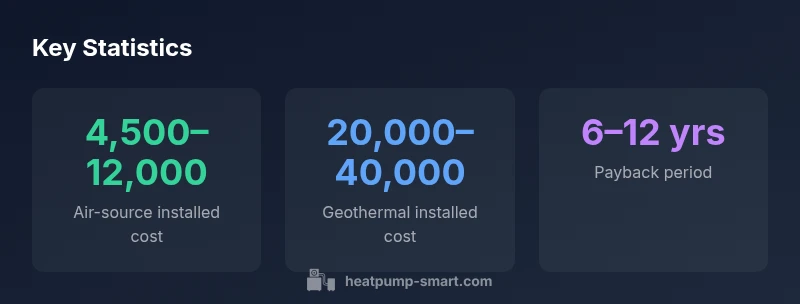
Average installed costs for a typical air-source heat pump in 2026 generally range from about $4,500 to $12,000, depending on system size, efficiency, and installation complexity. Geothermal systems tend to be higher, often $20,000 to $40,000 or more due to ground conditions. Regional incentives and quotes can shift these numbers, so getting multiple estimates is essential.
Overview of cost drivers and definitions
The term average heat pump cost is most often used to describe the installed price for a complete system, including the outdoor unit, indoor components, refrigerant lines, and labor. In 2026, researchers at Heatpump Smart highlight that the final price reflects multiple levers: equipment efficiency (SEER/HSPF ratings), system type (air‑source vs geothermal), climate zone, ductwork or zoning needs, and local permitting requirements. When homeowners inquired about cost, they frequently overlook professional sizing, which ensures comfort and prevents oversizing that adds unnecessary expense. A thoughtful estimate begins with desired comfort levels for heating and cooling, then accounts for future energy costs.
According to Heatpump Smart, price is not just a sticker number—it is a measure of long‑term value tied to energy use and reliability. This context helps homeowners see that a slightly higher upfront cost can lead to lower operating costs over the system’s lifetime.
Regional variation and market factors
Cost variation by region is common due to labor rates, availability of qualified installers, and local incentive programs. Urban markets with dense competition may see more competitive quotes but higher permit fees, while rural areas might have lower labor costs but more travel time for technicians. Climate influences load size and equipment choices; milder regions may rely on smaller comfort loads, whereas colder zones require more robust heat pumps. Heatpump Smart’s 2026 analysis shows incentives vary by state and utility and can dramatically affect the net cost after rebates and tax credits. Homeowners should compare quotes that reflect local market conditions and any applicable incentives to estimate a realistic installed price.
System type and cost bands
Different heat pump configurations carry distinct price profiles. Air‑source split systems offer a balance of cost and performance and are the most common choice for many homes, with a broad range of SEER ratings. Mini-split systems provide flexibility for room-by-room heating and cooling, often at a higher installed cost per zone but with targeted comfort. Geothermal (ground‑source) systems deliver impressive efficiency but require boreholes or trenches, which drive up upfront costs. Heatpump Smart’s figures illustrate typical installed ranges for 2026, while noting that each project’s soil, space, and electrical needs influence final pricing. Overall, expect larger, higher‑efficiency units to sit at the upper end of these ranges.
Size, efficiency, and performance
Unit size should match the home’s heating and cooling load; oversizing leads to short cycling and higher upfront costs, while undersizing reduces comfort and efficiency. Efficiency metrics like SEER (seasonal energy efficiency ratio) and HSPF (heating seasonal performance factor) correlate with price: higher efficiency often commands a premium but yields bigger energy savings over time. In 2026, homeowners who select mid‑to‑high efficiency models can still realize meaningful payback, especially with favorable electricity rates and rebates. Heatpump Smart emphasizes a careful load calculation (often via a Manual J) to determine the correct size for maximum comfort and cost efficiency.
Installation considerations and hidden costs
Beyond the unit price, installation costs vary with ductwork, electrical upgrades, and site accessibility. Homes without existing duct systems may require new ducts, or developers may install ductless zones, which changes cost dynamics. Electrical panel upgrades or dedicated circuits are common and can add to labor time and materials. Refrigerant line sets, condensate drainage, and outdoor unit placement also affect price. Permitting fees and inspection costs can differ by jurisdiction. Heatpump Smart’s 2026 analysis reminds us that hidden costs often exceed initial quotes when a site requires significant electrical or structural work.
Financing, incentives, and total cost of ownership
Incentives, rebates, and tax credits can substantially lower net cost, though programs vary by state, utility, and federal policy. A lower upfront price does not always guarantee the best value—homeowners should consider energy savings, system lifespan, warranty coverage, and maintenance needs. When evaluating options, create a simple total cost of ownership model that accounts for purchase price, installation, energy use, maintenance, and potential replacement costs. Heatpump Smart’s approach in 2026 stresses transparency about incentives and an apples‑to‑apples comparison across quotes.
Cost comparisons with alternative heating options
Compared with electric resistance heating, heat pumps can offer substantial operating savings in many climates, though the higher initial cost must be weighed against long‑term energy bills. Gas furnaces may present lower upfront prices but involve fuel price volatility, emissions considerations, and potential future conversion costs. For homeowners in high‑electricity‑cost regions, heat pumps typically deliver a shorter payback period. The right choice balances installed price, energy savings, climate, and available incentives, rather than choosing on price alone.
Practical steps to estimate costs for your home
Start by securing multiple quotes from qualified installers, and request a detailed breakdown of equipment, ductwork, electrical work, and any required tests. Ask about seasonal promotions or manufacturer rebates and how they affect the bottom line. Have a professional perform a load calculation and a site inspection to confirm system size and configuration. Gather energy usage data from your utility to model potential savings and adjust for climate. Heatpump Smart recommends documenting scenarios for a side‑by‑side comparison.
Heatpump Smart’s cost estimation approach
Heatpump Smart’s cost estimation framework for 2026 combines equipment pricing, installation labor, and regional factors into a transparent, comprehensible model. We emphasize sizing accuracy, efficiency choices, and the total cost of ownership rather than just the upfront price. By comparing quotes on a like‑for‑like basis and accounting for energy savings, homeowners can identify the option that aligns with both comfort and budget. This approach helps homeowners prioritize value over mere price.
Cost ranges by heat pump system type
| System Type | Typical Installed Cost | Notes |
|---|---|---|
| Air-source heat pump (split) | $4,500–$12,000 | Most common balanced option |
| Mini-split system | $5,000–$15,000 | Zone-based comfort; higher install |
| Geothermal (ground-source) | $20,000–$40,000 | High efficiency; site-dependent |
| Heat pump water heater | $1,000–$2,500 | Supplemental hot water heater option |
Your Questions Answered
What is the average cost to install an air-source heat pump in 2026?
For most homes, installed air-source heat pumps fall in the mid-range of roughly $4,500 to $12,000, depending on size, SEER rating, and installation complexity. Your contractor can refine the estimate after a professional load calculation.
Air-source heat pumps usually cost between four and twelve thousand dollars to install, depending on size and efficiency.
Do installation costs vary by climate or region?
Yes. Labor rates, permit fees, and site constraints influence installed prices regionally. Climate also affects system size and defrost requirements, which can shift costs.
Region and climate impact installation prices and system size.
Are there federal or state incentives to reduce the installed cost?
Many programs offer rebates or tax credits; the amount varies by location and time. Check current federal, state, and utility options to estimate net cost.
Incentives exist and vary by location; verify current programs to reduce net cost.
How long does it take to recoup the investment?
Payback typically ranges from 6 to 12 years, depending on energy prices, climate, and usage; incentives can shorten this period.
Payback is usually six to twelve years depending on usage and incentives.
Should I replace ductwork when installing a heat pump?
If your ducts are leaky or undersized, upgrading them improves efficiency and comfort, but it adds cost. A professional assessment will define needs.
Ductwork quality matters; upgrade if needed for efficiency.
What should I ask installers when getting quotes?
Ask for a load calculation, equipment SEER/HSPF, warranty terms, installed costs broken down, and any required electrical work or ductwork.
Ask for sizing, efficiency, warranty, and all costs itemized.
“Choosing the right heat pump isn’t just about upfront price— it’s about matching size and efficiency to real-world load for year-round comfort and lower operating costs.”
Top Takeaways
- Get multiple quotes from qualified installers
- Size the system correctly to balance upfront cost and comfort
- Account for installation costs and potential ductwork
- Explore incentives to reduce net cost
- Model total cost of ownership over the system life