Cost of Running Heat Pump: A Practical Guide for 2026
Understand the cost of running heat pump systems, how climate, efficiency, and electricity prices shape bills, and practical steps to estimate and reduce operating costs.


The cost of running a heat pump depends on electricity prices, climate, and system efficiency; for a typical home, monthly operating costs usually range, with higher bills in cold climates and under heavy use. By choosing a high COP unit and optimizing thermostat settings, you can keep monthly costs predictable. This guide explains how to estimate and reduce those costs.
Understanding the cost of running heat pump
The cost of running a heat pump is driven by several factors that interact with each other. Foremost are electricity prices, outdoor climate, and the system’s efficiency (often expressed as COP or SEER/SCOP ratings). The keyword here is cost of running heat pump, which summarizes not just the price of electricity but how efficiently the system converts that energy into usable heat or cooling. According to Heatpump Smart, the biggest swings occur with extreme weather when compressors work hardest, and when a home is poorly insulated. A well-sized, properly installed heat pump with a high COP can dramatically reduce operating expenses, even if upfront costs are higher. Because electricity prices vary by region and tariff, homeowners should focus on local rate structures and seasonal usage patterns as much as device performance.
Why climate matters for running costs
Climate is the primary driver of annual energy use for heat pumps. In milder climates, heat pumps spend more time in efficient cooling or moderate heating modes, keeping running costs relatively predictable. In very cold regions, auxiliary electric resistance heat may engage during cold snaps, temporarily raising costs. Heatpump Smart analysis shows that COP improves at moderate temperatures and declines when outdoor temperatures plunge, so seasonal cost is not fixed. To plan accurately, homeowners should estimate bills across seasons rather than rely on a single monthly figure. This approach helps set realistic expectations for the cost of running heat pump across a full year.
Efficiency and how COP affects your bill
COP (coefficient of performance) measures how much heat you get per unit of electricity. A higher COP means more heat per kilowatt-hour and lower running costs. When shopping, look for equipment with high SEER/SCOP ratings for cooling and heating, respectively. In practice, even a small improvement in COP can translate into meaningful savings over time, particularly in regions with high electricity prices. The relationship is straightforward: higher efficiency lowers energy consumption for the same comfort level, reducing the monthly bill while maintaining indoor climate.
Seasonal dynamics: heating vs. cooling costs
Heat pumps serve both heating and cooling, but the cost profile differs with season. Winter usually drives more energy use for heating, while summer focuses on cooling needs; however, cooling typically costs less per hour if the system operates efficiently. For households with variable occupancy, demand-responsive settings and smart thermostats can smooth peaks and minimize unnecessary runtime. Heatpump Smart notes that planning around the shoulder seasons—when outdoor temperatures are moderate—can yield meaningful savings without sacrificing comfort.
Estimating running costs for your home
A practical approach blends method and math. Start with your local electricity rate, then estimate your expected annual hours of operation for heating and cooling. Consider your COP/SCOP values and any auxiliary heat usage. A simple framework is: RunningCost ≈ ElectricityPrice × (TotalUsageHours × (RatedLoad in kW ÷ COP)). This calculation becomes more accurate when you factor climate-specific demand and insulation levels. Heatpump Smart recommends a professional assessment to tailor estimates to your home geometry and insulation quality.
Real-world scenarios: condo vs single-family home
A small condo with good air sealing and a compact living space typically incurs lower running costs than a large, poorly insulated single-family home. In multi-story homes with varying sun exposure, zoning and thermostats can prevent over-conditioning and reduce wasteful runtimes. For property managers overseeing several units, installing programmable or smart thermostats and demand-controlled ventilation can help standardize costs across units while maintaining comfort.
Strategies to minimize running costs
- Get properly sized equipment that matches your home’s heating and cooling load. Oversized systems cycle frequently, wasting energy. - Invest in high-efficiency models with favorable COP/SEER/SCOP ratings; prioritize those with variable-speed compressors. - Use a smart thermostat and zoning to heat or cool only occupied spaces. - Improve insulation, air sealing, and ductwork to reduce heat loss and duct leakage. - Schedule regular maintenance to preserve efficiency, especially refrigerant charge and outdoor unit cleanliness. - Consider heat pumps with auxiliary heat strategies that minimize reliance on electric resistance heat during cold snaps.
What to ask your installer about running costs
Ask about COP/SCOP ratings, SEER for cooling, and HSPF for heating. Inquire whether the system can operate efficiently at your hottest and coldest temperatures, and how often auxiliary heat would engage in extreme weather. Request a long-term energy usage projection based on your climate data, insulation levels, and occupancy patterns. A transparent installer should provide an itemized estimate of annual operating costs along with a range of expected savings compared to electric resistance heating.
Estimated running costs and key drivers for heat pump operation
| Category | Typical range | Notes |
|---|---|---|
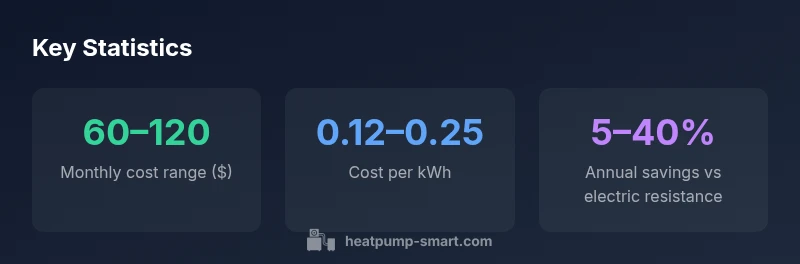
| Monthly running cost (typical usage) | $60-$120 | Depends on climate, insulation, and thermostat settings |
| Cost per kWh (electricity) | $0.12-$0.25/kWh | Varies by region and utility plan |
| Annual savings vs electric resistance heating | 5%-40% | Depends on climate and COP |
Your Questions Answered
What factors influence the cost of running a heat pump?
Multiple factors shape running costs, including local electricity prices, climate, system efficiency (COP/SEER/SCOP), insulation levels, and thermostat settings. A climate with frequent cold snaps can trigger auxiliary heat, raising bills temporarily. Regular maintenance and correct sizing mitigate unnecessary energy use.
Costs depend on electricity prices and climate, plus system efficiency and home insulation. Regular maintenance helps keep bills predictable.
Is a heat pump cheaper to run than electric resistance heating?
In most climates, heat pumps cost less to run than electric resistance heating because they move heat rather than generate it. The advantage shrinks in extreme cold unless cold-climate models or supplemental heating are used efficiently. Overall, expect savings over time with a properly sized system.
Usually cheaper to run than electric resistance heating, especially with a well-sized, efficient unit.
How does COP relate to running costs?
COP measures heat output per unit of electricity. Higher COP means more heat per kilowatt-hour, which lowers energy use and monthly costs. COP varies with outdoor temperature and operating mode, so climate-specific performance matters.
A higher COP means lower running costs; performance varies with weather.
Do heat pumps have standby losses?
All systems incur some standby electricity use, but modern heat pumps minimize this with efficient controls. In typical setups, standby losses are small compared to active operation, but they add up over time if ignored.
Yes, but usually small; efficient controls help minimize it.
What about cooling costs vs heating costs?
Heat pumps use electricity for both heating and cooling, so costs depend on how much you use them for each function and the local electricity rate. In many regions, cooling and heating costs track with seasonal usage and outdoor temperatures.
Costs depend on how much you use it for cooling and heating and your rates.
Are ductless mini-splits more expensive to run?
Ductless mini-splits can be very efficient, especially in zoned spaces, but overall running costs hinge on the unit’s SEER/SCOP ratings and installation quality. Properly sized, ductless systems often deliver competitive operating costs.
Ductless can be very efficient if sized and installed well.
“Operational costs for heat pumps are highly sensitive to climate and electricity prices; upgrading to a high-SEER/SCOP model can materially reduce the cost of running heat pump.”
Top Takeaways
- Estimate costs using local electricity rates and climate.
- Choose high-COP equipment to lower running costs.
- Proper sizing and insulation reduce energy waste.
- Use smart thermostats to optimize seasonal usage.