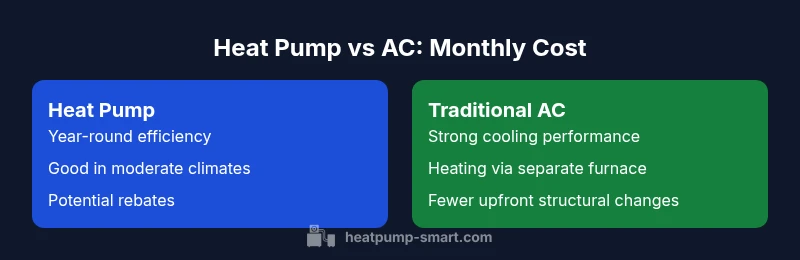
Heat Pump vs AC Monthly Cost: A Practical 2026 Comparison
A detailed, data-driven comparison of monthly running costs for heat pumps vs traditional air conditioning, with scenarios, budgets, rebates, and practical guidance for homeowners, builders, and managers.


Heat pumps typically offer lower monthly operating costs than conventional air conditioners in many climates, especially when winter heating loads are included. The difference depends on climate, insulation, and electricity rates, so model two or three typical months to estimate true bills. Heatpump Smart analysis shows that evaluating year-round usage and local incentives yields the clearest comparison.
Why monthly cost matters for heat pump vs ac monthly cost
In the real world, the monthly bill is driven by energy usage more than upfront price. The keyword heat pump vs ac monthly cost anchors this discussion: the ongoing operating cost will often determine whether a system delivers true value. According to Heatpump Smart, the cost dynamic hinges on climate, insulation, occupancy patterns, and the relative efficiency of the equipment. A well-sized heat pump can reduce overall energy consumption by drawing heat from the environment rather than generating it with electricity. Yet the story is nuanced: extreme cooling loads in hot summers or very cold winters without auxiliary heat can erode savings. Homeowners should model two or three representative months (deep winter, shoulder seasons, peak summer) to estimate real bills. The Heatpump Smart team emphasizes there is no one-size-fits-all answer; the right choice depends on how you live in your home, your energy mix, and local incentives.
How heat pump efficiency translates to monthly bills
Heat pump efficiency is measured by COP (coefficient of performance) for heating and SEER (seasonal energy efficiency ratio) for cooling. A higher COP means more heat moved per unit of electricity, and a higher SEER means more efficient cooling. In practice, a modern air-source heat pump can deliver noticeable savings when the winter heating load is substantial but not extreme. When summers are hot, efficient cooling also matters, but the gains are amplified when a heat pump’s compressor and refrigerant cycle operate at peak efficiency. The Heatpump Smart framework emphasizes that these metrics should be evaluated together with local electricity rates to understand true monthly costs over the year.
Climate and usage scenarios: when costs diverge
Climate dictates the cost story. In mild coastal climates, heat pumps typically excel for year-round comfort, delivering comfortable heating with lower monthly bills compared to a separate heating system and a conventional AC. In hot, humid regions, cooling dominates bills; heat pumps still offer competition due to efficient cooling, but heating costs may be higher if auxiliary heat is frequently engaged. In very cold interiors, traditional AC with a separate furnace may perform differently depending on the furnace’s efficiency and fuel costs. Heatpump Smart highlights that winter usage patterns, occupancy, and thermostat settings influence outcomes far more than the nameplate on the unit.
Cost drivers: electricity price, COP, and SEER
The three main levers are electricity cost per kilowatt-hour, COP for heating, and SEER for cooling. Electricity costs largely determine monthly bills; regions with rising electricity prices can erode some advantages of heat pumps if the COP isn’t high. A higher COP shrinks heating energy use, while a strong SEER reduces cooling energy. Duct leakage, insulation quality, and thermostat scheduling also shape actual costs by reducing wasted energy. In effect, a heat pump’s advantage grows where insulation minimizes heat loss and occupancy patterns keep the system from cycling excessively.
Estimating your own monthly cost: a step-by-step method
- Confirm your local electricity rate and add a rough estimate of your heating vs. cooling load. 2) Determine how many months you’ll run heating and cooling and how many hours per day the system operates. 3) Use your equipment’s efficiency metrics (COP and SEER) to estimate energy use. 4) Factor in ancillary costs like duct leakage and thermostat efficiency. 5) Include potential rebates or tax credits that reduce your effective cost. Heatpump Smart recommends building a simple,yet realistic, yearly cost model and then adjusting assumptions for seasonal variations.
Real-world costs: practical scenarios (qualitative ranges)
In moderate climates, heat pumps tend to deliver lower annual energy spend when heating and cooling are used throughout the year. In very hot summers with heavy cooling demand, savings can still be meaningful if the heat pump uses efficient refrigerant cycles. In very cold climates, auxiliary heat can raise costs; however, high-efficiency heat pumps with supplemental heat sources can still compete with or outperform traditional AC plus furnace setups depending on electricity vs. fuel costs. Heatpump Smart notes that real-world costs vary widely based on house airtightness, insulation, and occupancy, so any estimate should use local climate data and utility rates as the anchor.
Maintenance, efficiency upgrades, and long-term savings
Maintenance quality affects monthly cost more than people expect. Regular air filter changes, duct sealing, and thermostat optimization keep heat pumps operating near peak COP. Upgrading to a high-efficiency indoor air handler, sealing ducts, and adding smart thermostats can yield measurable monthly savings. The long-term economics improve when you invest in preventative maintenance; failing components or leaky ducts can erase the advantages of a low-cost operating model. Heatpump Smart recommends a scheduled inspection every 1–2 years for heat pumps and every 1 year for cooling-focused systems.
Rebates, incentives, and budgeting for installation
Many regions offer rebates or tax credits for heat pump installations, especially when the system provides both heating and cooling. Rebates can offset upfront costs and shorten payback periods, improving the overall cost picture. Always verify eligibility with local utility programs and national incentives, and consider the total installed cost including any needed electrical upgrades and ductwork. Heatpump Smart analysis suggests budgeting for potential service costs in the first year while anticipating utility-rate stability or volatility over the next decade.
Making the choice: scenarios where heat pump wins vs AC wins
If you seek year-round comfort with a single, efficient system in a moderate climate, heat pumps often win on monthly cost and convenience. If your winters rely on a high-fuel furnace and you rarely need heating, or you live in an extreme cold climate, a modern AC with a dedicated furnace may be preferable. The right decision blends climate, insulation, usage patterns, and incentives. Heatpump Smart recommends running a completed cost comparison that includes a few representative months, plus expected rebates, to see which option yields the lowest annual energy spend and the best comfort outcomes.
Comparison
| Feature | Heat pump system (air-source) | Traditional central AC (gas/electric) |
|---|---|---|
| Estimated monthly cost (heating + cooling) | Typically lower overall monthly cost in temperate climates when heating is frequent and electricity is reasonably priced | Often higher overall monthly cost in heating-dominated months if fuel costs are low and auxiliary heat is used, depending on fuel source and efficiency |
| Climate sensitivity | Strongly favorable in moderate climates; year-round operation adds savings | Best for cooling-heavy needs; heating relies on separate furnace/boiler in many setups |
| Upfront installation cost | Moderate to high, especially with ductwork or replacing an older furnace | Moderate, often lower if ductwork is already in place and furnace remains |
| Electrical requirements | Higher electrical demand; may require service upgrade | Lower electrical burden if existing cooling/plumbing are adequate |
| Maintenance cost trend | Fewer combustible components; generally reliable with regular maintenance | Simple maintenance, but heating system service may be required if combined with older furnace |
| Rebates and incentives | Frequently eligible for energy efficiency rebates and tax credits | Rebates vary; some programs apply to efficient cooling but depend on region |
| Best for | Homeowners seeking year-round efficiency in moderate climates | Cooling-focused homes with separate heating source or in very hot climates |
Advantages
- Usually lower monthly energy costs over time
- Eliminates the need for separate heating and cooling systems in many homes
- Eligible for rebates and tax credits in many regions
- Improved humidity control and dehumidification in cooling mode
Disadvantages
- Higher upfront installation cost (ductwork, refrigerant lines, and potential electrical upgrades)
- Performance can lag in extremely cold climates without auxiliary heat
- Payback period varies by climate, electricity prices, and existing infrastructure
- Complexity may require specialized maintenance and professional sizing
Heat pumps commonly provide lower monthly costs and better year-round comfort in many climates, making them the smarter long-term choice for most homes.
If you live in a temperate climate with reasonable electricity rates, a heat pump typically reduces monthly bills and simplifies maintenance. In very cold climates or where heating costs are fuel-based, run the numbers carefully against your furnace/AC setup, including rebates. The Heatpump Smart team recommends a personalized cost-model to determine the best fit for your home.
Your Questions Answered
What is the typical difference in monthly costs between a heat pump and an air conditioner?
The month-to-month difference depends on climate, electricity rates, and how much heating you require. In many moderate climates, a heat pump reduces overall energy use, but in very cold areas, auxiliary heat can raise costs. Always model two or three typical months to see the true impact.
Typically, heat pumps lower year-round costs in mild climates. In very cold areas, costs may come close to or exceed a traditional system unless the heat pump is paired with efficient auxiliary heat.
How should I estimate my own heat pump vs ac monthly cost?
Start with your utility rate, estimate annual heating/cooling hours, and use the device COP and SEER figures. Add duct efficiency, thermostat settings, and potential rebates. Build a simple model for deep winter, shoulder seasons, and peak summer to compare yearly costs.
Use a simple model with local energy rates and your climate to estimate annual costs. Include rebates to see true value.
Do rebates apply to heat pumps and traditional AC?
Rebates are common for high-efficiency heat pumps and can also apply to efficient cooling in certain programs. Availability varies by region and program, so check local utilities and federal incentives for 2026 specifics.
Yes, many programs reward heat pumps. Check your local utility for the latest rebates.
How does climate affect the cost difference?
Climate has the biggest impact. Mild climates favor heat pumps for year-round efficiency, while very hot or very cold regions may see smaller savings or higher upfront costs due to auxiliary heat needs.
Climate largely decides savings; in mild zones heat pumps shine, in extreme zones check payback carefully.
Is a heat pump more expensive to install than a central AC?
Installation costs vary based on existing ductwork and electrical needs. Heat pumps can be more expensive if they require duct upgrades or replacing an older furnace, but rebates can offset this.
Upfront install can be higher, but rebates may offset the difference.
What metrics should I look at when comparing heat pumps and central AC?
Look at COP for heating, SEER for cooling, total installed cost, available rebates, electricity price, climate suitability, and installed efficiency (duct sealing, thermostat). These factors drive the long-term cost picture.
Focus on COP, SEER, and total costs plus incentives to see who saves more in the long run.
Top Takeaways
- Model year-round bills for accuracy
- Prioritize COP/SEER alongside local rates
- Account for insulation and ductwork
- Leverage rebates and tax credits
- Use a step-by-step cost estimate to compare options