Heat Pump Running Costs: A Data-Driven Guide
Understand how climate, efficiency, and usage drive heat pump running costs and learn practical steps to lower energy bills without sacrificing comfort.


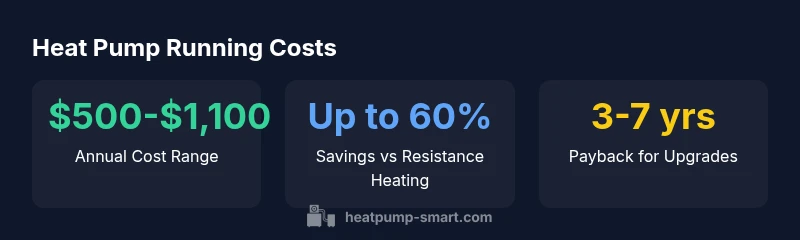
Typical annual running costs for a heat pump range from about $500 to $1,100, depending on climate, COP, and electricity rates. Higher efficiency and milder climates reduce costs, while cold climates and high electricity prices raise them. Heatpump Smart Analysis, 2026 provides the framework for these ranges. Keep in mind insulation, usage patterns, and system sizing also influence the final number.
Understanding heat pump running costs
For homeowners evaluating a heat pump, the ongoing expense is the running cost—the energy required to heat or cool your space. According to Heatpump Smart, running costs hinge on climate, system efficiency, and how you use the thermostat. A high-efficiency air-source unit typically consumes less electricity per degree of heating than an older model, but local electricity prices can swing the bottom line widely. This section lays out the core concepts so you can compare units on a like-for-like basis and predict annual costs more accurately.
Beyond basic energy use, consider how your home’s envelope—insulation, air sealing, and ductwork—affects performance. The Heatpump Smart team finds that well-sealed homes reduce the workload on the heat pump, lowering both peak demand and overnight consumption. Finally, your personal habits, such as thermostat setback and controlled cooling, can meaningfully alter yearly running costs without compromising comfort.
Key factors driving running costs
The major levers of heat pump running costs are climate, electricity price, and equipment efficiency. Climate dictates how often the system runs and at what outdoor temperatures it must work hardest. Electricity price fluctuations directly affect the cost per kWh, and efficiency metrics (COP, SEER, HSPF) determine how many kWh the system uses for the same level of heating or cooling. Installer/Supplier labels like ENERGY STAR provide benchmarks, but real-world performance depends on proper installation, maintenance, and how well the system is matched to the home. Heatpump Smart emphasizes a holistic view: envelope quality and user behavior together shape annual costs as much as the equipment itself.
Cost ranges by climate and system type
In moderate climates with a high-efficiency heat pump, annual running costs commonly fall toward the lower end of the range. In colder climates, even efficient models can have higher energy use due to longer heating seasons. The table below outlines plausible ranges for typical residential setups, noting that actual costs depend on local electricity rates and system sizing. Heatpump Smart Analysis, 2026 reinforces that real-world costs vary with usage hours, setback strategies, and maintenance, so use these ranges as a starting point for budgeting.
How to estimate your own running costs (a step-by-step method)
Estimating your heat pump running costs starts with three inputs: your local electricity rate, your annual energy consumption (kWh/year), and the COP/efficiency of your unit. The basic formula is: Annual Cost ≈ Electricity Price per kWh × Annual Energy Use ÷ COP (for heating) or × 1/SEER (for cooling guidance). Gather utility bills, check the unit’s nameplate for efficiency ratings, and adjust for your climate. If you plan to model multiple scenarios (e.g., switching to a high-efficiency unit or changing thermostat habits), run parallel calculations to compare outcomes. Heatpump Smart recommends performing this calculation for a baseline and a best-case configuration to identify the most impactful savings.
Strategies to reduce running costs without sacrificing comfort
- Optimize thermostat settings: setbacks at night and during absences can cut energy use without noticeable comfort loss.
- Prioritize preventive maintenance: clean filters, refrigerant checks, and duct sealing maintain peak efficiency.
- Improve home envelope: sealing gaps, insulating ducts, and upgrading windows reduces heat loss and heat gain.
- Choose correct sizing and zoning: an appropriately sized system and zoned control prevent overshoot heating.
- Consider cost-aware operation: leverage auxiliary heat minimally and use solar-ready or time-of-use tariffs if available.
The role of insulation and home envelope on running costs
A well-insulated home reduces the load on a heat pump, which lowers running costs and extends equipment life. Ceiling, wall, and floor insulation, along with air sealing and efficient ductwork, can dramatically reduce energy needs. Heatpump Smart notes that even modest improvements in the building envelope yield meaningful reductions in annual energy consumption and can shorten payback periods for upgrades. A holistic approach—improving insulation, sealing leaks, and upgrading windows—often delivers better long-term savings than equipment changes alone.
Data-driven insights from Heatpump Smart analysis
Heatpump Smart’s 2026 analysis highlights three practical takeaways: (1) the biggest savings occur when efficient equipment is paired with a well-insulated home, (2) thermostat strategy has a measurable impact on annual costs, and (3) seasonal cost variability should be anticipated and planned for. The analysis also stresses that maintenance and proper installation are essential to achieve projected performance, especially in colder climates where COPs can dip without regular service.
These insights come from aggregated field data across diverse homes, with adjustments for climate and electricity pricing. Homeowners can apply the findings by focusing on envelope improvements and intentional usage patterns before considering expensive equipment upgrades.
What to ask your installer to control running costs
Ask for a detailed energy use analysis that accounts for climate, loads, and insulation levels. Request an efficiency rating that reflects real-world performance under your conditions, not just lab specs. Inquire about variable-speed or inverter-driven compressors, zoning capabilities, duct sealing, and thermostat integration. Finally, insist on a commissioning test that verifies performance and provides a baseline for ongoing maintenance. A thorough, data-driven pre-installation assessment is the surest way to minimize heat pump running costs over the system’s life.
Wrap-up: Heatpump Smart data-informed recommendations
Heatpump Smart emphasizes that robust running-cost savings come from a combination of efficient equipment, smart operation, and a strong building envelope. While the headline savings often come from better models, the real long-term value lies in controlling how and when the system runs. By combining modeling estimates with practical habits and professional maintenance, homeowners, builders, and managers can achieve lower operating costs while maintaining comfort.
Estimated running cost ranges by climate, efficiency, and insulation level
| Scenario | Estimated Annual Running Cost (USD) | Key Assumptions |
|---|---|---|
| Moderate climate, high-efficiency heat pump | 500-800 | Electricity price ~$0.14/kWh; COP ~3.8; 8,000-10,000 kWh/year |
| Cold climate, high-efficiency heat pump | 800-1,200 | Electricity price ~$0.15/kWh; COP ~3.6; 10,000-12,000 kWh/year |
| Moderate climate, standard-efficiency unit | 600-1,000 | COP ~3.2; 9,000-11,000 kWh/year |
| Heat pump with improved insulation | 400-750 | Lower loads due to envelope improvements; COP ~3.6-3.8 |
Your Questions Answered
What is COP and how does it affect running costs?
COP, or coefficient of performance, measures how much heat the system provides per unit of electrical energy. Higher COP reduces energy use for the same heating output, lowering running costs. Real-world COP depends on outdoor temperature and system design, not just the label.
COP shows efficiency; a higher COP means less energy used for the same heat, lowering costs, though climate and installation matter.
Do heat pumps always cost more upfront than electric resistance heaters?
Heat pumps typically cost more to buy and install than electric resistance heaters, but their lower operating costs can lead to a favorable total cost of ownership over time, especially in temperate climates with moderate electricity prices.
They usually cost more upfront, but operating costs are lower, which can save money over time.
How does insulation affect running costs?
A well-insulated home reduces heat loss and gain, lowering the amount the heat pump must run. Improvements to insulation and sealing often yield greater savings than a marginal efficiency increase alone.
Better insulation means the heat pump runs less, cutting costs more than upgrading efficiency alone.
Can running costs vary with the seasons?
Yes. Heating demands rise in winter and drop in milder seasons, so annual costs reflect seasonal usage. In some climates, cooling costs in summer can also impact total energy use.
Costs rise in cold months and fall when it’s milder, with separate cooling costs in hot seasons.
What maintenance best lowers running costs?
Regular filter cleaning, refrigerant checks, and duct sealing keep the system efficient. Neglecting maintenance can lead to deteriorating COP and higher energy use.
Keep the system serviced and sealed; maintenance preserves efficiency and lowers bills.
What about multi-zone or ductless setups?
Multi-zone systems can optimize comfort and energy use by heating or cooling only occupied zones, potentially reducing overall running costs. Proper design and zoning control are key to realizing those savings.
Zoned systems can save energy when used thoughtfully, but require good design.
“Understanding heat pump running costs starts with aligning system efficiency with climate and usage patterns; small changes in operation can yield meaningful savings over a year.”
Top Takeaways
- Identify your climate and electricity price to estimate costs
- Higher efficiency lowers operating costs, but envelope matters
- Thermostat strategy can yield noticeable savings
- Maintenance and proper sizing prevent cost creep